
‘The Republic of Alberta’: A Brief History of Longstanding Grievance
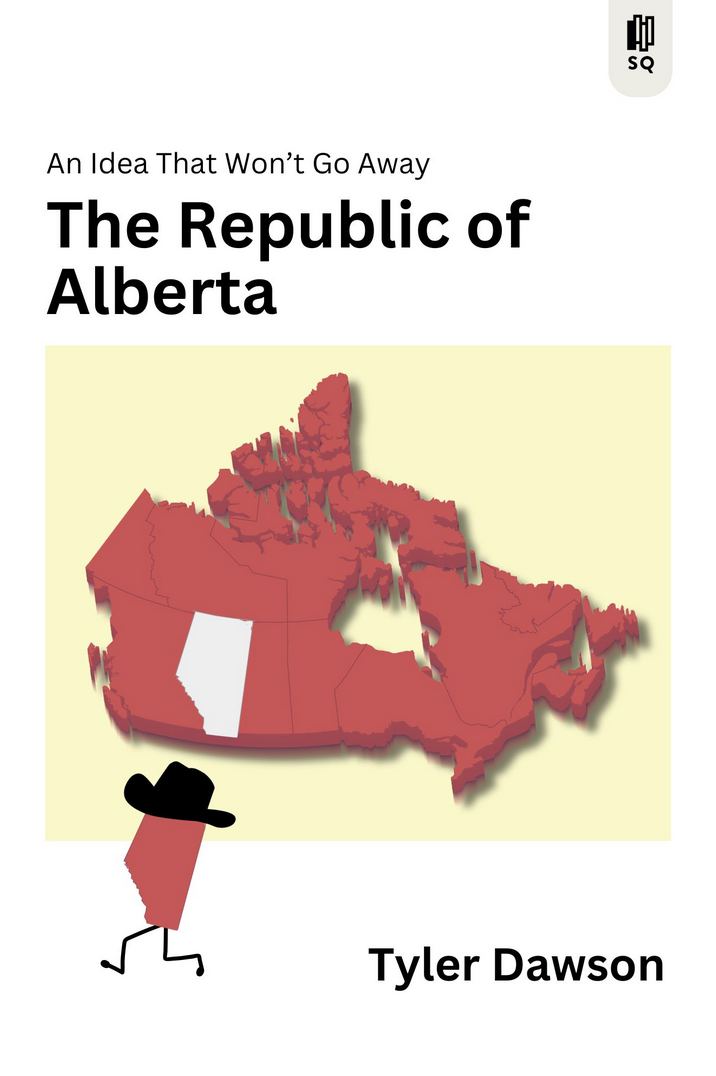
By Tyler Dawson
Sutherland Books, April 2026/100 pages
Reviewed by Robin V. Sears
May 28, 2026
There are few subjects more difficult to write a fair and balanced analysis of than efforts to break up a nation — especially if it’s your own.
Globe and Mail journalist Tyler Dawson, in his new Sutherland Quarterly essay The Republic of Alberta: An Idea That Won’t Go Away, pulls it off superbly. Dawson has deep experience covering Alberta, and he uses it to trace the century-old roots of the Alberta separatist cause with balance and fairness.
Many countries have perennial “splittist” movements, per the Chinese term. It is, however, very hard to find any commonality or thread that connects them. Nor why some have chosen a separatist agenda and others not.
Why Corsica? Why the Basques and the Catalans? Why the Scots but not the Welsh?
Alberta has had, since its creation as a province, a portion of residents unhappy with the rest of Canada. Why not Saskatchewan? The people of that province have been arguably as mistreated by Ottawa and corporate Canada as those of Alberta. And they were not blessed with oil to keep them afloat.
Often, there are different languages involved. Frequently, as well, there are claims of economic unfairness. Alberta’s grievances include the latter but not the former.
Dawson cites examples from the province’s very earliest history of efforts to break away from Canada. He quotes the lead editorial in the Calgary Herald the day before Alberta became a province in 1905.
Albertans, the paper claimed, were “robbed… for the benefit of the horde of grafters connected with the Ottawa Liberal machine.” Some things don’t change.
Dennis Modry, a prominent Alberta separatist today, is quoted by Dawson: “And 120 years later, we continue to be pillaged and plundered… for our wealth…” (Modry was convicted of misappropriating $1.3 million dollars from his elderly relatives last year.)
The claim of economic hardship is dubious. Albertans are by far the wealthiest Canadians, with a median after-tax income for families and unattached individuals at $85,300, followed by Ontario at $79,500, against the national median at $75,500.
But as Dawson describes in painstaking detail, Alberta’s economic grievance began before they became a province, and has continued, almost every decade since.
The one successful contemporary secessionist referendum in a developed country won on a campaign of lies about — among other things — future economic prosperity.
Separatist movements typically collapse under their inability to outline a believable picture of a future republic. Dawson cites separatist leaders who offer Kosovo as a template. Others hint that the ultimate project would be to become the 51st state and use the U.S. dollar as currency.
But the absurdity of these notions alone may not be what is needed to defeat a referendum.
Dawson suggests that only seasoned Albertan politicians like former premier Jason Kenney or former prime minister Stephen Harper have the skill and the credibility to win the support of a majority of Albertans for Canada.
He is probably right, though Mark Carney has worked hard to remove many of the items on Alberta’s complaints list. He has made great progress, whether one approves of new pipelines or not.
Dawson has undercut many of Premier Danielle Smith’s grievances. However, since his book was published only weeks ago, Carney has criticized Smith for her foolhardy gamble of a referendum-on-a-referendum.
Dawson points out that the Alberta separatists have no credible political leadership, and that lacking a René Lévesque-type star to move the province could prove another serious strategic challenge.
None of the leaders of the various separatist organizations are anywhere close to being a Lévesque or even a Smith, for that matter, in either communications or political craft.
Fortunately, most separation referendums are blocked or fail. The Clarity Act passed following our near-death experience of the 1995 referendum will present a high mountain for any separatists to climb, starting with the wording of the question.
The deep Alberta Indigenous resistance that has already posed a legal obstacle to this process is likely to dog Smith to the Supreme Court.
The one successful contemporary secessionist referendum in a developed country won on a campaign of lies about — among other things — future economic prosperity.
The Brexit ‘Leave’ campaign was led by former Prime Minister Boris Johnson and possibly future PM Nigel Farage. However, Brexit has been a disaster for the UK, with one respected British think tank estimating it was costing the economy £100 billion a year.
The current Labour government of Keir Starmer has been quietly negotiating the terms for a re-connection with the EU. Many Europe experts say no meaningful deal is possible, except a return to full membership. EU members remain very angry about Britain’s withdrawal.
Carney, who spoke loudly and courageously against Brexit as governor of the Bank of England, is now facing an equally ill-advised exit referendum on his own watch.
There is still time for a Brexit-like folly to be avoided. But per the title of Dawson’s book, Alberta separatism is an idea that won’t go away.
Policy Contributing Writer Robin V. Sears is a longtime political strategist and former diplomat.