
International Law in the Taiwan Strait

June 2, 2026
This is a companion piece to an earlier Policy analysis of legal issues regarding the Strait of Hormuz.
On May 22-23, the Canadian warship HMCS Charlottetown made a transit through the Taiwan Strait, one of numerous warships from the U.S., the U.K., Australia and Japan doing the same thing over the last number of months.
These transits have long been considered a diplomatic flashpoint by the People’s Republic of China (PRC), which unilaterally claims sovereign rights and exclusive jurisdiction over the strait, whereas Canada and its democratic allies consider the strait as international waters under the United Nations Convention of the Law of the Sea (UNCLOS).
The Canadian foray came after a warning by China’s ambassador to Canada, Wang Di, on April 30th that any such transits would damage bilateral relations, being inconsistent with Beijing’s “One China principle” and would undermine his country’s sovereignty.
On May 15th, Canadian Defence Minister David McGuinty issued a statement reiterating Canada’s position that the Taiwan Strait is an international waterway, without addressing whether Canada would continue sending naval ships through the strait. One week later, HMCS Charlottetown transited the strait.
The back-and-forth on the Taiwan Strait during the month of May preceded the arrival in Ottawa on May 29th of Chinese Foreign Minister Wang Yi. In that sense, the sequencing of the rhetorical and navigational diplomatic narrative spoke for itself.
Still, what should have been made clear by Canada in more explicit terms was a strong, public and unequivocal position: not only that the strait is an international waterway and a high-seas passageway outside China’s jurisdiction but also that China must not threaten to impede future transiting by foreign vessels, including Canadian warships.
The status of the Taiwan Strait is separate from geopolitical questions regarding China’s claim to sovereignty over Taiwan itself. In fact, even if Taiwan were to become part of China, the Taiwan Strait would remain an international waterway, fully open to foreign- transit passage. It would not, by any stretch, be internal waters of China or somehow subject to Chinese territorial jurisdiction.
Geography
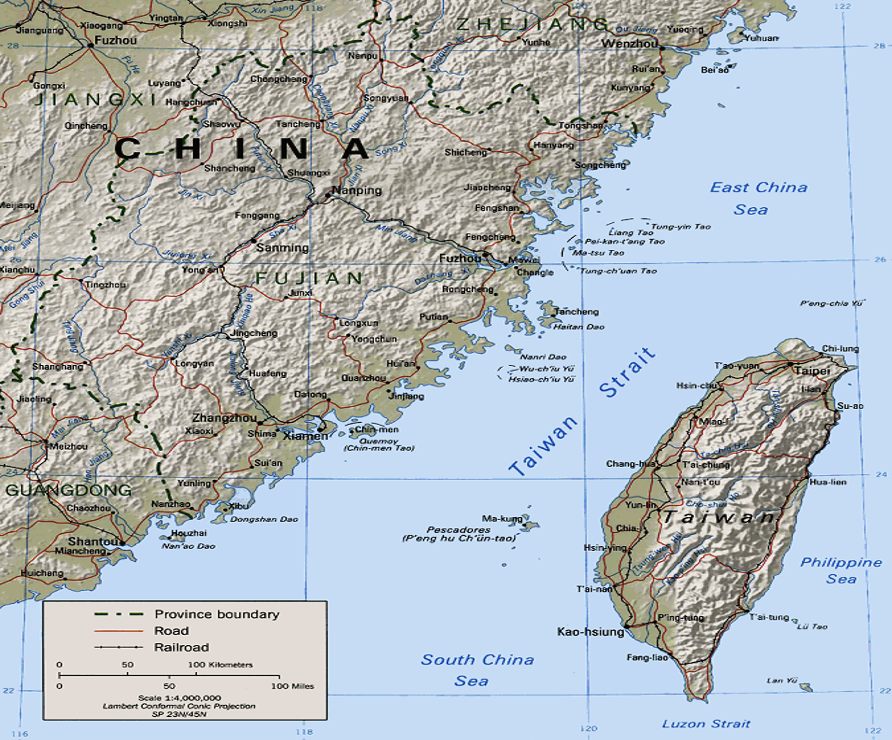
In combination with international law, geographical facts confirm the high-seas status of the strait — the “high seas” being a legal term describing waters outside the territorial boundaries and jurisdiction of any country. It is roughly 126-180 km (68-97 nautical miles) wide, far beyond the Chinese12-mile territorial sea, and thus outside China’s jurisdictional sovereignty. It connects two parts of the high seas, the South China Sea to the south, and the East China Sea to the north.
Even if the word “China” is used in the labelling of these waters, like the Taiwan Strait itself, they are high-seas areas. Geographic contiguity alone shows that these three areas are all part of the wider oceanic spaces beyond national reach.
 ICAS
ICAS
History
For well over 1,000 years, the Taiwan Strait has been an international shipping route. While used by Far Eastern trading communities for eons, Western countries began using the strait during the Age of Sail in the 17th and 18th centuries, when the Dutch East India Company and the Spanish Empire had major commercial operations in the Far East. By the early 19th century, the strait had become a major international sea lane. Its status as a transit waterway was reinforced with the advent of powerful commercial shipping during the 19th and 20th centuries.
In other words, international transit through these waters was an established fact for eons, an indelible part of maritime trade, well before the communist revolution in the 1940s and the recently manufactured sovereignty claims advanced by Beijing.
Legal Factors
Intertwined with the geographical and historical facts are legal elements that contradict the sovereignty claims advanced by the Chinese government. For one thing, as already noted, because the strait is 126 km (68 nm) wide even at its narrowest point, its central transit route lies well beyond China’s12-mile territorial sea. Even adding China’s additional 12-mile contiguous zone, the largest part of the strait lies well beyond Chinese maritime jurisdiction.
Moreover, under the LOS Convention, the 12-mile territorial sea and the adjacent 12-mile contiguous zone (Article 33) are measured from the coastal state’s baselines, meaning either the low-water line or “straight baselines” along the coast. In 1996, the PRC published straight baselines along the entire Chinese mainland, including the coastline in the Taiwan Strait. Because it is these baselines that define the outer limits of a state’s territory, they contradict the notion that the strait is somehow within China’s internal sovereignty. Moreover, the combined seaward area of 24 miles (12 miles of territorial sea and 12 miles of contiguous zone) of Chinese jurisdiction is well short of any assumption of maritime jurisdiction by China over the 68 to 97-nm wide strait.
Maritime Transit
First, under customary international law, codified in the LOS Convention, all vessels have a right of transit passage through international straits “which shall not be impeded”, a right that is close to being absolute as long as it is “continuous and expeditious” (Article 38). This right is available to warships or commercial vessels.
Second, according to news and other reports, Canadian and other foreign naval vessels have followed routes well outside China’s 24-mile coastal jurisdiction (i.e., territorial sea and contiguous zone).
Third, even where an international strait is actually within a state’s territorial sea — which is not the case of the Taiwan Strait, as explained above — a separate right of non-interruptible innocent passage applies, more limited but nonetheless a right available to foreign warships transiting from one area of the high seas to another.
There exists no shortage of analyses regarding the foregoing legal and geopolitical issues associated with this question. The basic point, however, is that the Chinese government’s egregious claims to exercise rights over this critical body of water are unfounded, totally contrary to both customary international law and the LOS Convention.
The Canadian government should be unequivocal in rejecting Chinese sovereignty claims, making it clear that in future, Canada will continue to exercise rights of warship transit through this waterway as it sees fit.
Policy contributor Lawrence Herman is an international lawyer with Herman & Associates, a senior fellow at the C.D. Howe Institute in Toronto and a member of the Expert Group on Canada-U.S. Relations. He is a former foreign service officer, having served in Canada’s Permanent Mission to the United Nations and the GATT.