
‘Inflection Point’: Reflections on a World Order in Transition
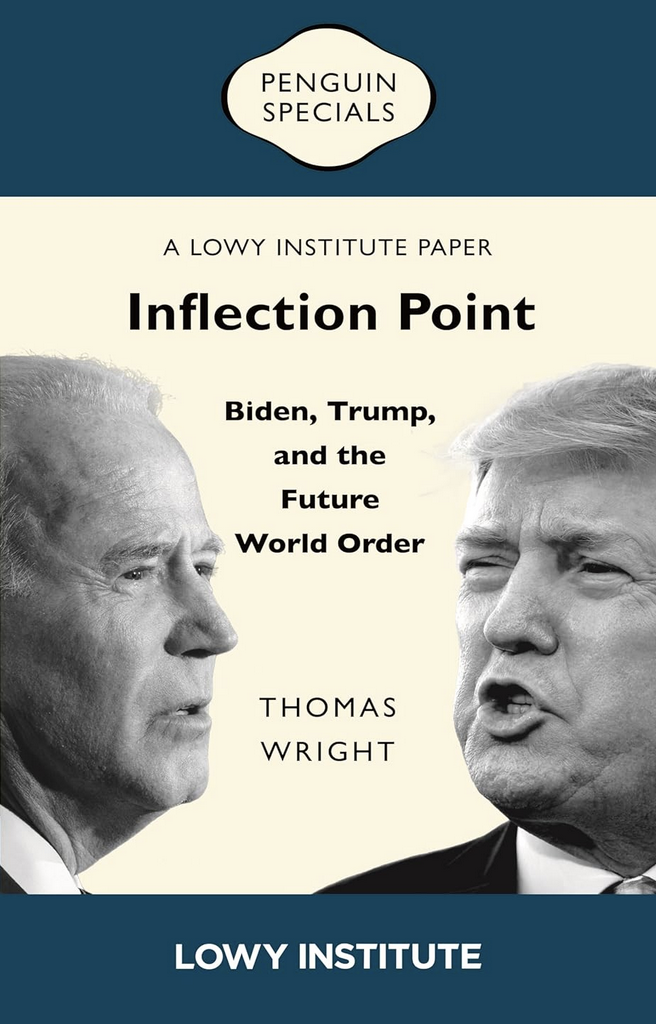
Inflection Point: Biden, Trump, and the Future World Order
By Thomas Wright
Penguin Random House, April 2026/176 pages
Reviewed by Colin Robertson
June 2, 2026
For most of the postwar era, Canadian foreign policy rested on a simple strategic assumption: while U.S. presidents changed, America’s role in the world did not.
Democrats and Republicans argued over tactics but in government, both broadly supported NATO, free trade, alliances, continental defence, and the liberal international order.
That assumption is now dead.
In Inflection Point: Biden, Trump, and the Future World Order, Brookings Institution scholar Thomas Wright argues that the world has entered a new era defined not simply by geopolitical rivalry, but by a profound fracture within the United States itself.
The book is both diagnosis and warning: the era of post-Cold War American primacy has ended, but no stable replacement order has emerged.
Instead, the world faces, according to Wright, an inflection point at which rivalry among major powers coexists with profound economic interdependence, technological disruption, democratic decay, and nuclear danger.
At the same time, America’s allies, adversaries, and trading partners are no longer dealing with one coherent American grand strategy. They are dealing with two rival Americas.
One remains committed to alliances, deterrence, multilateralism, and strategic competition with authoritarian powers.
The other embraces a more transactional, nationalist, and “America First” worldview skeptical of alliances, trade liberalization, and international institutions.
For Canada and the allies, adjusting to this as the new geopolitical reality is not optional. It is existential.
Where once the challenge for Ottawa was how to influence Washington, today it is how to survive the swings and oscillations of successive administrations.
It cuts deeper than personalities.
Donald Trump has exposed the fact that the American consensus itself has fractured. The divide now runs through both parties, though in different ways.
For Wright, who also served as strategic policy planning senior director in President Joe Biden’s National Security Council, today’s Democrats are no longer the free-trade globalizers of the Clinton years.
While Barack Obama endorsed both trans-Atlantic and trans-Pacific trade, neither the Trans-Pacific Partnership (TPP) nor the Transatlantic Trade and Investment Partnership (TTIP) were finalized. President Trump repudiated the TPP on his first day in office and neither TTIP or TPP was revived under President Joe Biden.
Instead Biden embraced industrial policy, subsidies, strategic competition with China, and economic nationalism. Tariffs stayed. “Friend-shoring” replaced globalization. Buy American provisions multiplied. The language of democratic solidarity returned, but so did protectionism.
Meanwhile, the Republicans, writes Wright, have moved from Reaganite internationalism toward an “America First” worldview that sees alliances less as strategic assets than as expensive obligations. Trade deficits are treated as exploitation. Multilateral institutions are viewed skeptically. Foreign policy becomes transactional rather than institutional.
Colin Robertson’s interview with Thomas Wright for Global Exchange/CGAI
At the same time, observes Wright, within each party, the fractures are widening. Among Democrats, progressive skepticism about military power competes with hawkish attitudes toward China and Russia.
Among Republicans, traditional defence internationalists increasingly battle populist nationalists who question U.S. support for Ukraine, NATO, and long-standing alliances.
The result is a United States whose foreign policy can swing dramatically every four years.
For decades, Canada and the allies built national strategies around American predictability. Trade integration deepened because American-endorsed rules, ratified at the GATT and then WTO, were assumed to be stable.
Defence cooperation expanded. Even if allies’ commitments were less than expected, most allies bought from American defence suppliers. Canadian governments were confident that America would remain broadly committed to the Western order it built after 1945.
No longer.
As Wright points out, the Biden administration championed NATO and climate cooperation while the Trump administration imposes tariffs against allies and demands transactional concessions. Biden saw Canada as an indispensable partner while Trump treats Canada as a trade competitor and a defence freeloader.
When the allies lose confidence in American continuity, behaviour changes.
Investment decisions change. Defence planning changes. Trade diversification accelerates. Governments prepare contingency plans for tariff shocks and policy reversals. Strategic autonomy, once mostly a European phrase, enters Canadian thinking too.
Democratic countries, argues Wright, can no longer separate economics from national security. Globalization has become geopolitical. Supply chains are strategic assets. Energy security matters again. Industrial policy is back.
This instability is reshaping the behaviour of middle powers around the world. Europe is increasing defence spending not only because of Vladimir Putin, but because of doubts about future American reliability. Asian democracies are diversifying security
Allies, says Wright, are hedging. According to that thinking, Canada must hedge too.
That does not mean abandoning the United States, Geography makes that impossible. Defence collaboration makes it impractical. Economic integration makes it irrational.
As Prime Minister Mark Carney recently told the New York Economic Club, “Canada Strong will help make America great again.”
But it does mean reducing vulnerability to American political volatility.
Wright notes the Carney approach to “values-based realism” and “variable geometry” as an insurance policy against uncertainty. He would likely endorse Carney’s idea of flexible coalitions built around resilience, democratic cooperation, trusted supply chains, and defence investment.
The deeper problem for Canada is psychological as much as strategic.
For generations, Canadian diplomacy relied on a stable America: occasionally frustrating, sometimes overbearing, but fundamentally committed to an open world order. That certainty no longer exists.
Canada cannot decouple from the United States. But neither can it afford strategic complacency. Ottawa must strengthen its own economic resilience, defence capacity, Arctic sovereignty, and diplomatic partnerships precisely because the U.S. political system has become more volatile.
This is the real lesson of Wright’s Inflection Point. The greatest uncertainty in world politics may no longer come from Beijing or Moscow. It may come from the alternating visions emerging from Washington itself.
Wright’s world assumes fragmentation, rivalry, and ideological swings inside the West itself. That may be the defining geopolitical reality of the coming decade.
For Canada, the age of passive middle-power diplomacy is over. In a world of two Americas, agility becomes strategy.
Ultimately, Inflection Point is a work about strategic ambiguity in every sense: geopolitical ambiguity, ideological ambiguity, and domestic political ambiguity.
Wright does not offer a neat solution because he believes no such solution exists. Instead, he calls for prudence, alliance-building, and democratic renewal. The liberal order will not survive through nostalgia alone. It must evolve.
For readers in Canada and other middle powers, Wright’s message is especially relevant. The age of comfortable assumptions is over. Geography no longer guarantees security. Economic integration no longer guarantees stability. American leadership can no longer be taken for granted.
Yet the future is not predetermined.
Strategic choices still matter. Democracies still possess enormous strengths: innovation, alliances, legitimacy, adaptability.
Whether Canada and like-minded democracies can mobilize those strengths effectively will determine the shape of the next world order.
Policy Contributing Writer Colin Robertson, a former career diplomat, is a fellow and host of the Global Exchange podcast with the Canadian Global Affairs Institute in Ottawa.