
‘Technical Recession’, the Backstory: Why has the Canadian Economy Flatlined?

By Kevin Page
June 3, 2026
On May 29th, Statistics Canada released the data on Canada’s Gross Domestic Product (GDP) for the first quarter of 2026.
GDP is the monetary value of finished goods and services produced within a country. It is an important indicator of the size and health of an economy. The latest release indicates that the Canadian economy has flatlined.
There was no economic growth in the first quarter of 2026, following a slight decline (0.2%) in the fourth quarter of 2025.
Because the “technical” definition of a recession is two consecutive quarters of negative growth, the headline that Canada had experienced a second quarter absent growth coupled with its political context — coming as it did a day after Prime Minister Mark Carney’s speech to the Economic Club of New York touting Canada as a stable economy and investment destination — have made this the most hotly debated GDP news in many, many quarters.
There is now an ongoing discussion about whether Canada is in a (technical) recession. The first quarter results took many economic analysts and institutions (e.g., Bank of Canada) by surprise. Some are saying the results reflected unanticipated developments, like an increase in imports or a decline in government spending (goods and services and capital).
Bottomline, the Canadian economy is weak.
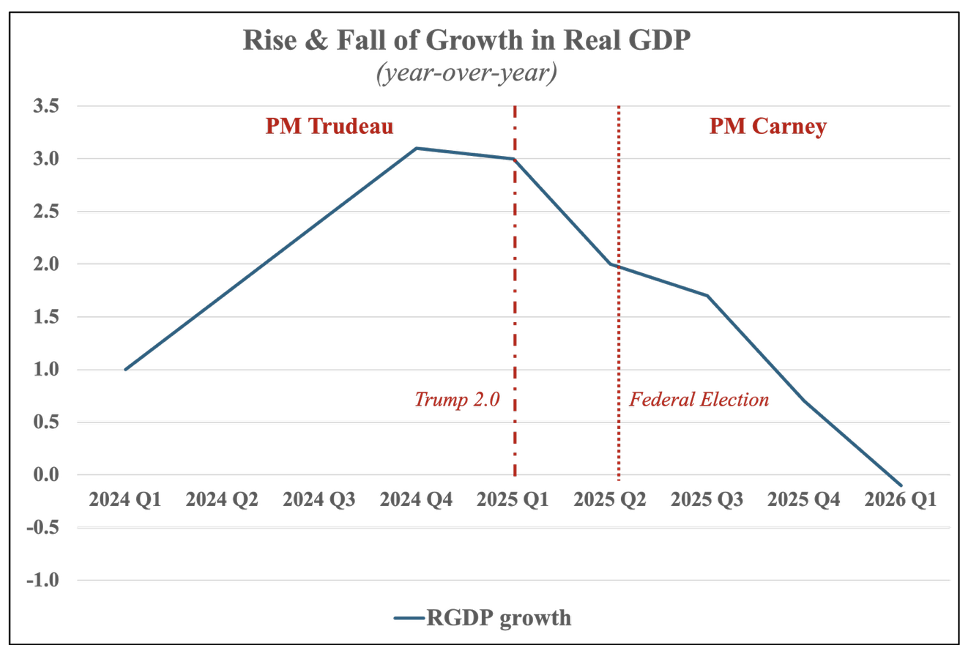
Chart 1: Growth
Source: Haver Analytics, Statistics Canada
Chart 1 illustrates that on a year-over-year basis there was no growth in the Canadian economy. The GDP growth rate rose through 2024 to a healthy 3% just before the inauguration of President Trump in January 2025 and the Canadian federal election in April 2025, and has trended downward since, including as a result of Trump’s second-term trade war, still being waged at this writing.
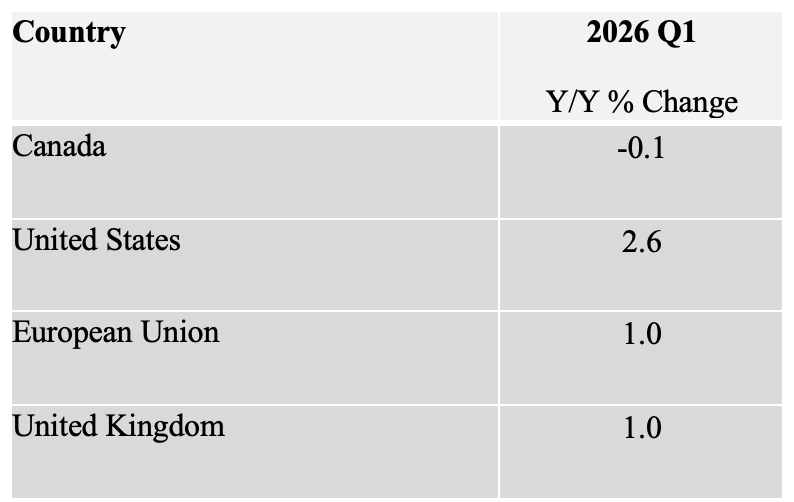
Table 1 illustrates that the current performance of the Canadian economy is very weak relative to the US and Europe.
Table 1: International Comparisons of Real GDP Growth
Source: Haver Analytics
The US economy has experienced strong growth supported by a large fiscal expansion (US budgetary deficit about three times larger than Canada’s as a share of GDP) and significant capital investment in AI. European growth has proven to be resilient, underscored by strength in their labour markets that has supported domestic demand in the face of a weaker export market.
Why has the Canadian economy flatlined?
In response to queries from the media on the weak economic performance, Prime Minister Carney suggested that we are in an interregnum period.
“This government’s been in the process of laying the foundations for a stronger, more resilient, more independent Canadian economy. That process is settling in as we make major investments, major changes to how the government operates, how we do major projects, how we have new trade agreements with other countries.”
The data suggest there are two principal reasons why the economy has flatlined over the past year – weak capital formation and weak exports. Personal consumption has largely held up with supports from the federal government on affordability and efforts by consumers to manage debt (higher interest cost on mortgage debt offset by restraint in use of credit cards).
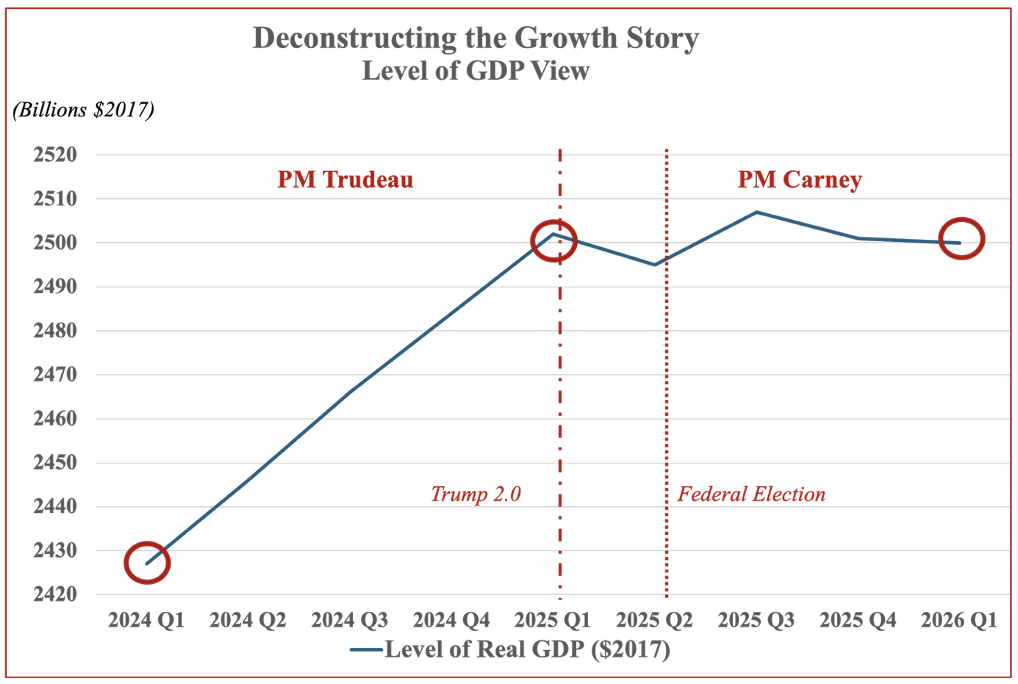
Chart 2: The Economy (Real GDP)
Source: Haver Analytics, Statistics Canada
Chart 2 illustrates what the economy looks like over the past two years as measured by (real) GDP in constant 2017 dollars. Real GDP flatlines from the first quarter of 2025 – coinciding with the inauguration of President Trump (2.0) and the launch of the America First trade policy involving frequent changes in tariffs and derogatory comments towards Canadian sovereignty. No country is more economically integrated with the U.S. than Canada.
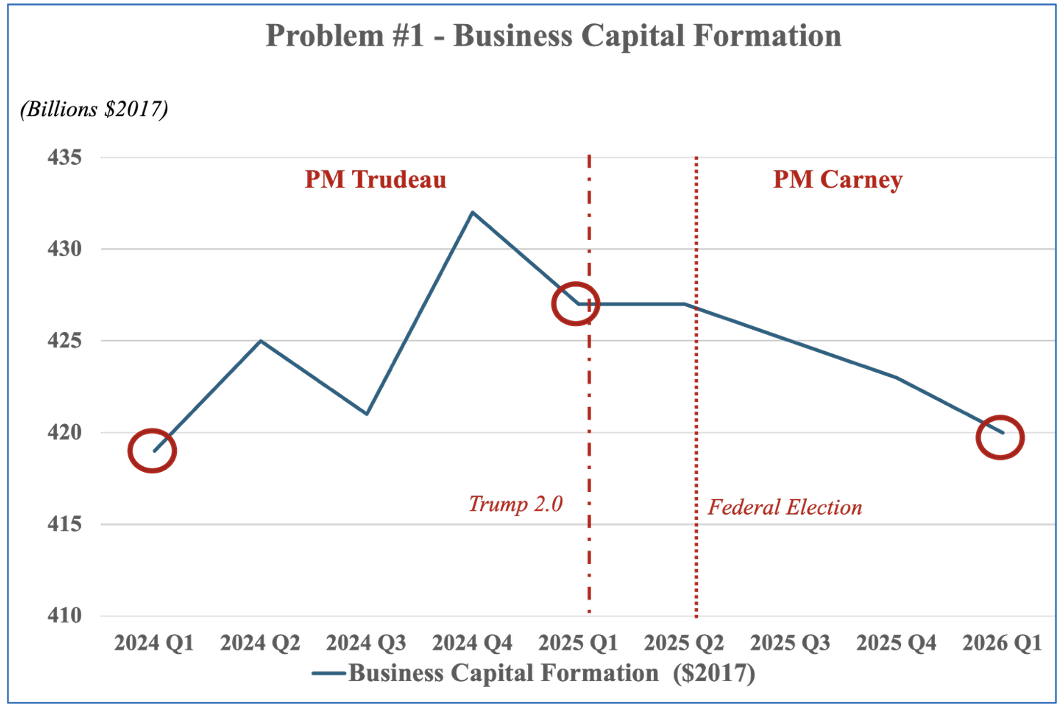
Chart 3: Investment
Source: Haver Analytics, Statistics Canada
Chart 3 illustrates the profile of (real) business fixed capital formation in constant 2017 dollars. Spending gyrates upwards in 2024 and then trends down. In the first quarter of 2026, it is at effectively the same level as two years earlier. The size of the Canadian economy is being pushed down (current and future) by weak business investment.
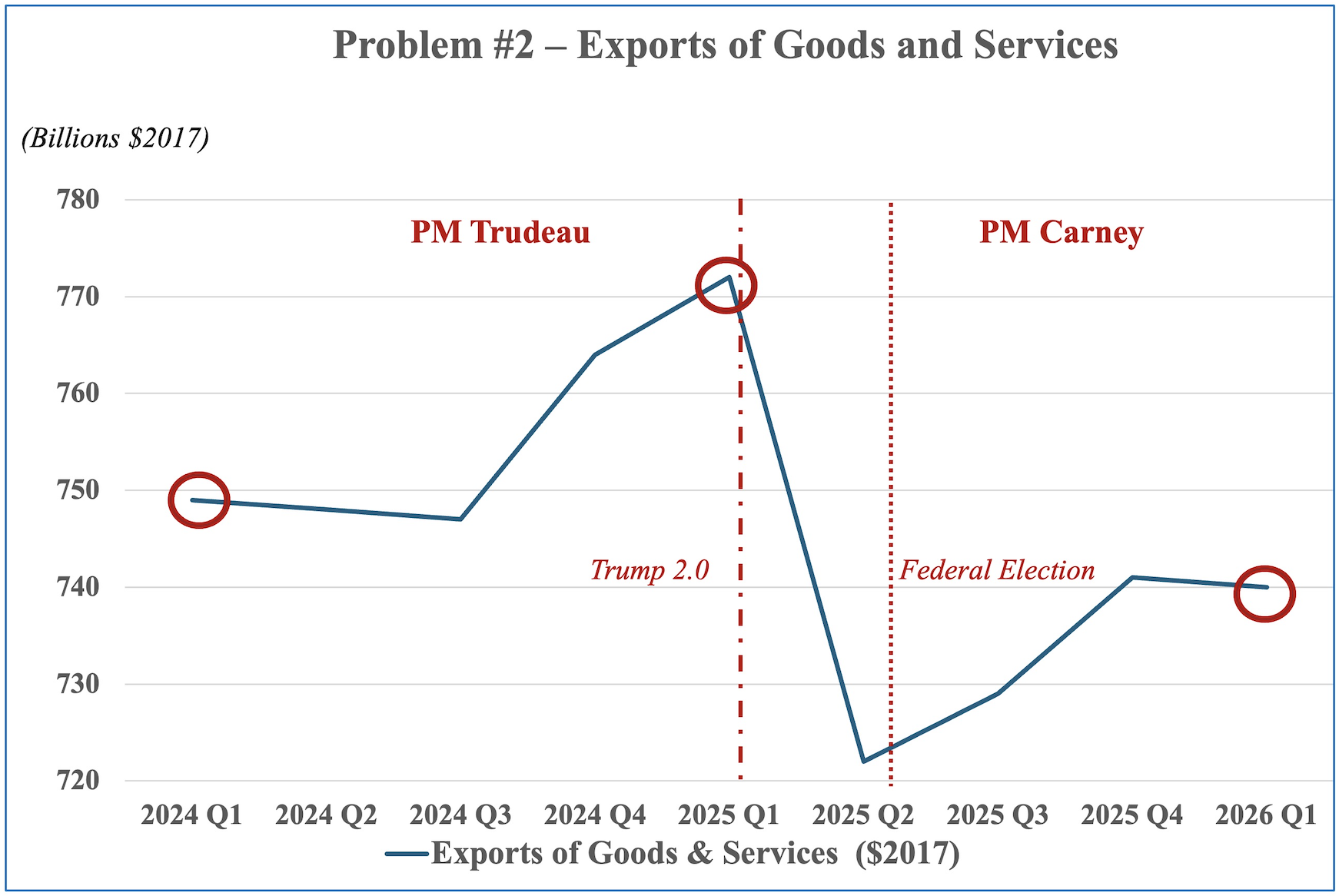
Chart 4: Trade
Source: Haver Analytics, Statistics Canada
Chart 4 illustrates the tumble in (real) exports of goods and services in constant 2017 dollars. The decline coincides with the 2025 inauguration of President Trump and the unveiling of his trade and tariff policies. The level of exports stabilizes in recent quarters but remains below the level of two years prior.
So, what does this all mean with respect to the weakness of the Canadian economy and the policy path forward?
When my colleague Sahir Khan looks at these charts, he says two things come to mind.
One, the song Comfortably Numb by Pink Floyd. Businesses and investors are in a holding pattern. The lyrics resonate: “I can’t explain. You would not understand. This is not how I am; I have become comfortably numb.”
Two, Mr. Khan pictures the movie Apollo 13. The character of Chief Flight Director Gene Kranz (played by Ed Harris) utters the memorable quote after the spaceship loses control: “Let’s work the problem. Let’s not make it worse by guessing”.
The data show that the Canadian economy has flatlined because of a decline in business investment and trade. The government’s Canada Strong plan is focused on investment and trade.
To quote the Robert Frost poem A Servant to Servant, “the best way out is always through”. The challenge will be execution, and maintaining the trust and confidence of the Canadian people along the way.
Kevin Page is the President of the Institute of Fiscal Studies and Democracy (IFSD) at the University of Ottawa, former Parliamentary Budget Officer and a Contributing Writer for Policy Magazine.