
Policy Q&A: Sen. Peter Boehm on the Evian G7
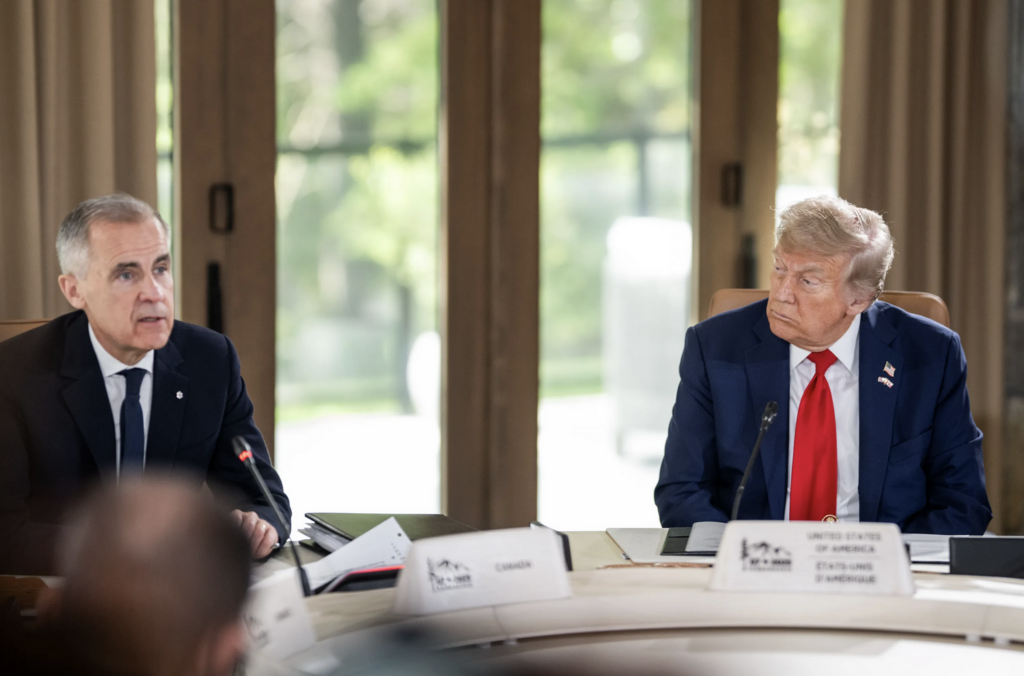 Prime Minister Mark Carney and President Donald Trump at the Kananaskis G7 in June, 2025/PMO
When last we left the annual G7 Leaders’ Summit, Prime Minister Mark Carney was hosting the group in Kananaskis, Alberta. This year, as the leaders, their delegations, hundreds of journalists and Donald Trump prepare to descend on Evian-les-Bains, France, Policy Editor and Publisher Lisa Van Dusen chatted by email with former G7 Sherpa Peter Boehm, chair of the Standing Senate Committee on Foreign Affairs and International Trade, for their latest Policy Q&A.
Lisa Van Dusen: Senator Boehm, as someone who served as Canada’s Sherpa for 6 G7s — your last tour of duty the legendary Charlevoix summit — you watch the group pretty closely. What’s your sense of how things have evolved since Kananaskis a year ago?
Sen. Peter Boehm: There has been significant evolution on several fronts during the past year: the dramatis personae, the geopolitical picture, the hardening of the Trump administration’s approach to world affairs and the state of the global economy. Japanese prime minister Sanae Takaichi will attend her first G7 summit, joining Italian prime minister Giorgia Meloni and European Commission President Ursula Von Der Leyen as the women leaders at the table. British Prime Minister Keir Starmer and German Chancellor Friedrich Merz both have their domestic political challenges. Host President Emmanuel Macron sees this summit and indeed the French G7 presidency as a legacy item but there is the prospect that his country could move much further to the right following the elections next April.
There has been a year and some for President Donald Trump to exercise his “transactional” diplomacy by taking a less-engaged posture on the war in Ukraine. With Israel, he initiated hostilities with Iran which were extended into Lebanon to counter Hezbollah. For Gaza, he established a Board of Peace which appears moribund but from which he pointedly excluded Canada (sparing us the $1billion membership fee which others have not paid in any event). In attacking Iran, he expected ex post facto support and fealty from his traditional allies without consulting them and they, including Canada, remain estranged.
He removed the leader of Venezuela and is squeezing Cuba. Truth Social has become his public policy pronouncement vehicle. Despite legal setbacks and rulings, the weaponization of tariffs by the Trump administration continues. Disruption and uncertainty rule. Despite it all, the global economy is not in tatters although oil/gasoline prices have risen substantively as has inflation. Bond markets react to any and every suggestion of a ceasefire in the Persian Gulf.
The US Congress is not in the picture, whether on tariffs or a declaration of casus belli. TACO has taken on new meaning. The North American free trade agreement, CUSMA, is being reviewed. For Canada, a successful G7 presidency last year, culminating in the Kananaskis Summit and a still-resonant speech by Prime Minister Carney at the World Economic Forum in Davos, suggest global expectations that may be difficult to live up to for a middle power. Canada’s pragmatic global vocation may indeed be put to the test. But Prime Minister Carney seems to be giving it his best shot.
LVD: With the United States — whose treasury secretary, George Shultz, launched the G6 in 1975 as an economic summit, with the addition of Canada the next year to make it the G7 — now an effective G7 geopolitical and economic outlier based on the presidential stylings of Donald Trump, how do you envision that tension playing out this year?
SPB: Ironically, this type of informal international organization (i.e. without a secretariat or a headquarters), came to be through a wish by the major economies to deal with oil price volatility induced by the OPEC countries in the 1970s. We may be there again, but differently — with price volatility stemming from US actions. The tradition at G7 summits is to begin with a discussion on the global economy, with the U.S. president often invited to speak first. We did that at Charlevoix; President Trump warmed to the theme but lost interest when the other leaders took their turn to chime in.
Donald Trump does not like multilateralism. He leaves most summits early (as he did at both Kananaskis and Charlevoix), not because he doesn’t like the host country, but because he gets bored. He likes to wing it (his rhetorical “weave” of bringing different subjects together into an apparently cohesive whole). If one reads closely his autobiography, The Art of the Deal, it is all about getting the upper hand in vanquishing a single adversary through skill, persuasion and the inducement of fear.
That said, the US took part in all preparatory meetings for Evian, whether those of ministers (finance, foreign, AI, international development, education, etc.) or the planning meetings of Sherpas. Much work has transpired below the waterline. This work, whether on online regulation, safeguards for AI, humanitarian and other international aid, will not interest the U.S. president. He may very well bring forward some of us his perennial ideas such as inviting Russian President Vladimir Putin to participate.
Considering that Trump has berated, insulted and/or praised almost all of his participating colleagues, it is difficult for me to imagine how a conversation between leaders could flourish along traditional lines. It will be up to President Macron, with his 10 years of experience leading his country (and having been a Sherpa before that — great credentials) to steer the discussion away from any policy shoals but still cover the essential points.
LVD: Because of the asymmetrical attention paid to the summits as an organizational stress test and potential conflict zone based on the volatile element of Donald Trump’s presence, have the ministerial meetings and communiqués that precede the leaders’ summit become a more accurate representation of the group?
SPB: I believe this to be the case. There are many permanent working groups in the G7, some that have been around for years. The G7 finance ministers’ track is almost untouchable. The foreign ministers demonstrated a remarkable solidarity while still appearing credible. Kananaskis last year was the same. At Charlevoix in 2018 and since, host countries have worked through a number of straight-up initiatives for further work either domestically, bilaterally or through international organizations.
AI is a good example. At Charlevoix, the leaders endorsed the first AI development framework and collaborative discussion on AI and joint initiatives has become more sophisticated and deeper since then as the rapid evolution of the subject would suggest.
The idea of having a consensual communiqué to demonstrate solidarity and common purpose, long a feature of G7 summits, has been all but abandoned in favour of short subject declarations. There is no use negotiating until you lose all credibility with a weak and unremarkable communiqué that signifies very little.
With many thematic ministerial meetings, G7-themed conferences, meetings with engagement groups (Business 7, Labour 7, Youth 7, Think 7, Women 7 to name a few), France has managed to flood the summit zone (to coin a phrase). Some of this activity and its outcomes will and should have permanence in the pantheon of G7 initiatives. I see the emphasis on the protection of minors and addressing online harms as particularly valuable. Some G7 countries, including our own, are introducing pertinent legislation. Time will tell.
LVD: If you were still Canada’s Sherpa, what would your ideal takeaway headline from Evian be?
SPB: My ideal takeaway, and this year is no different, is usually the concluding line of the traditional communique: “We thank France for its effective presidency and look forward to meeting in the United States of America next year.” This informal organization has been around for over half a century. Pundits ask every year why it still exists. The answer is simple: leaders enjoy an opportunity to have unscripted conversations with each other, to launch initiatives and to express solidarity.
The G7 has spawned much work in financial institutions, multilateral bodies like the UN and within national governments. With the NATO Summit next month and the forthcoming G20 Summit in Miami in December, we may very well see short-term stressors in the near future and perhaps an eventual “make or break” moment. I hope not.
Senator Peter M. Boehm, a regular contributor to Policy magazine, is chair of the Standing Senate Committee on Foreign Affairs and International Trade. He served in a number of senior diplomatic postings, as a deputy minister, and as Canada’s Sherpa for six G7 summits.
Policy Magazine Editor Lisa Van Dusen has served as a senior writer at Maclean’s, Washington columnist for the Ottawa Citizen and Sun Media, international writer for Peter Jennings at ABC News and an editor at AP National in New York and UPI in Washington.