The Summer Summits: Canada and the New Multilateralism
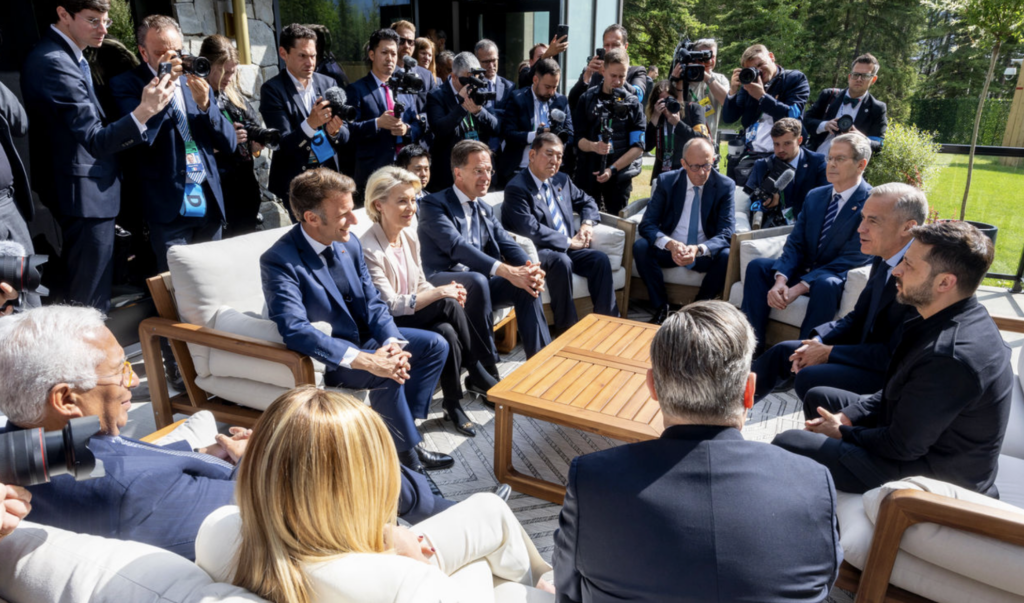 A leaders’ photo-op during the Kananaskis G7 in June, 2025/NATO image
June 11, 2026
The 2026 summer summits — the G7 in Evian June 15th to 17th and the NATO Summit in Ankara July 7th and 8th — are more than diplomatic set pieces.
This year, more than in the past decade, they are a test of whether like-minded democracies can adapt multilateralism to a world in which great-power rivalry is back, economic interdependence is increasingly weaponized, and American leadership can no longer be taken for granted.
For Canada, the stakes are especially high.
Prime Minister Mark Carney has framed Canada’s foreign policy around a simple proposition: in a more dangerous and divided world, Canada must build strength at home while forging “a dense web of new connections” abroad.
The objective is not multilateralism for its own sake, but practical cooperation with allies and partners to address global challenges, deepen economic resilience, and create new opportunities for growth and security.
That approach reflects a larger reality. The post-Cold War assumption that rules, institutions and markets would steadily produce convergence has been broken. Russia’s invasion of Ukraine, China’s growing assertiveness, conflict in the Middle East, pressure on global trade, and doubts about the reliability of American leadership have exposed the limits of the old order. Yet the answer is not to abandon multilateralism. It is to modernize it.
Multilateralism is often dismissed as diplomatic jargon but, at its core, it is one of the great civilizing achievements of international relations. It is the idea that nations, large and small, agree to operate through shared rules, norms and institutions rather than raw power alone.
For middle powers such as Canada, multilateralism has long been both a principle and a practical necessity. It helps level the playing field by giving smaller and medium-sized states a voice that would otherwise be overwhelmed by great powers.
It complements Canada’s traditional commitment to functionalism — the belief championed by Lester Pearson and other post-war Canadian diplomats that countries with the expertise, capacity, and capability to contribute to solving a problem should earn a seat at the table regardless of their size.
Over the past 80 years, multilateralism has become the operating system of global diplomacy, underpinning agreements and institutions that govern trade, aviation, telecommunications and maritime law, as well as conventions on climate change, pandemics, chemical, biological and nuclear weapons, forced labour, modern slavery and human rights.
The system is imperfect and often frustrating but, without it, as we’re beginning to see, the world is governed less by rules than by coercion, with smaller countries left to navigate a far more dangerous international environment.
The challenge today is not that multilateralism has failed. It is that the strategic environment in which it operates has changed. The return of great-power competition, the rise of economic nationalism and growing doubts about American leadership require democracies to adapt existing institutions while building new forms of cooperation.
Multilateralism reinforces a distinctly Canadian foreign-policy tradition running from Pearson and St. Laurent through to Carney: rules where possible, coalitions where necessary, and pragmatism anchored in democratic values throughout.
The G7 and NATO remain the most effective forums for advanced democracies to coordinate action. The G7’s agenda — strengthening security, protecting critical supply chains, accelerating the digital and energy transitions, supporting Ukraine, and building partnerships with trusted countries — demonstrates why these institutions still matter.
The challenge is that multilateralism can no longer operate on autopilot.
Both summits will reveal the multilateral response to the evolving agendas of the world’s two most consequential leaders: Donald Trump and Xi Jinping. China will not be present, but its influence will loom over every discussion, from trade and technology to critical minerals and military security.
Trump, meanwhile, will be a present and unpredictable force. The question is less whether he disrupts the proceedings than how much disruption allies are prepared to take.
The lesson of recent years is that democracies can no longer outsource responsibility for the international order to Washington. Europe has begun to recognize this reality. Defence spending is rising. Strategic autonomy is increasingly part of the European vocabulary. NATO allies are assuming greater responsibility for their own security. Canada must do the same.
This is where Carney’s concept of “values-based realism” becomes relevant. The approach accepts that power still matters but insists that values matter too. It rejects both naïve idealism and crude transactionalism. Instead, it seeks to build flexible coalitions among countries that share interests and, where possible, democratic values. In Carney’s language, we are entering an era of “variable geometry” — overlapping partnerships assembled around specific challenges rather than relying solely on large international institutions.
That does not mean replacing NATO, the G7, the United Nations or the World Trade Organization. It means supplementing them. Critical mineral partnerships. AI governance coalitions. Arctic security arrangements. Clean-energy alliances. Defence industrial cooperation. The future belongs to networks that are agile enough to respond to crises while remaining anchored in democratic principles.
For Canada, this is familiar terrain. Canadian diplomacy has long excelled at coalition-building. Lester Pearson helped create peacekeeping. Brian Mulroney assembled international pressure against apartheid. Jean Chrétien used the G20 and other forums to broaden international cooperation. Canada’s comparative advantage has never been raw power. It has been convening power.
Today that role is more important than ever.
Canada sits at the intersection of the Atlantic and Pacific worlds. It is a founding NATO member, a G7 country, a Pacific nation, an Arctic power, and a transatlantic ally and trusted partner for Europe and many countries in the Indo-Pacific. As middle powers search for ways to preserve sovereignty and prosperity amid intensifying competition between Washington and Beijing, Canada can help shape the networks that connect them.
The objective should not be to choose between the United States and the rest of the world. The United States remains Canada’s indispensable ally, largest trading partner, and principal security partner. But prudence requires diversification. Stronger ties with Europe, the Indo-Pacific, and emerging economic partners are not alternatives to the American relationship; they are insurance policies that make Canada and its allies more resilient.
Multilateralism reinforces a distinctly Canadian foreign-policy tradition running from Pearson and St. Laurent through to Carney: rules where possible, coalitions where necessary, and pragmatism anchored in democratic values throughout.
The deeper question facing the leaders gathering in Évian and Ankara is whether democracies still possess the confidence to lead.
The answer should be yes.
Multilateralism is not dead. It is evolving. The old order may be fraying, but the need for cooperation among democracies has never been greater. In a world of uncertainty, the task is not to nostalgically reconstruct the past. It is to build new partnerships, strengthen old alliances, and adapt institutions to new realities.
That is the opportunity before the G7 and NATO.
And it is a moment Canada is uniquely positioned to seize: not as a bystander, but as a builder of coalitions, a champion of democratic values, and a practitioner of the values-based realism required for an age of variable geometry. The future will belong not to those who retreat from multilateralism, but to those willing to renew it.
Policy Contributing Writer Colin Robertson, a former career diplomat, is a fellow and host of the Global Exchange podcast with the Canadian Global Affairs Institute in Ottawa.