Quebec’s Hot Political Summer

June 27, 2026
With Quebec’s fête nationale of Saint-Jean-Baptiste having launched the province’s pre-election political summer on June 24th, the phoney-war phase of mudslinging and burger flipping ahead of an October 5th election is now underway.
While the campaign will not officially begin until August 29th (if the election isn’t called sooner), Quebec will have a hot political summer of pre-campaigning during which the main parties fortify their troops for the upcoming battle while courting voters ahead of Election Day.
The sheer complexity of Quebec’s party system creates a sense of electoral volatility but also the possibility that the Parti Québécois (PQ), even with barely 30% of popular support, could win a majority government, as its disproportionate support among francophone voters favors the party in terms of seat count.
This is crucial because, in order to organize a referendum by 2030 as its leader, Paul St-Pierre Plamondon, has pledged, the PQ needs to form a majority government after the October 5th election.
The paradox here is that the PQ could achieve this with barely 30% of the voters while the large majority of the electorate clearly opposes the idea of both independence and a referendum that could unleash it, but the federalist vote is largely split between the governing Coalition Avenir Québec (CAQ) under new leader Christine Fréchette and the provincial Liberals under pharmacist and former Quebec Federation of Chambers of Commerce President Charles Milliard.
That this drama is unfolding toward an early-October resolution as Albertans prepare to vote October 19th on whether to unleash an independence referendum of their own only adds to the hothouse atmosphere.
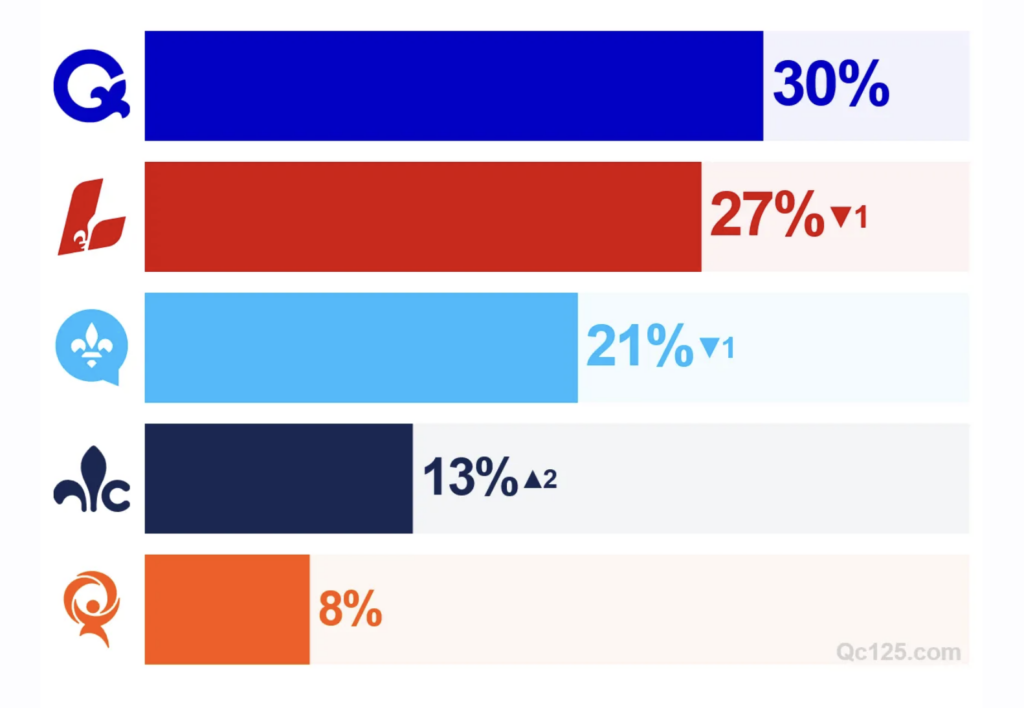 The most recent Léger poll, published on June 17th, has the parties ranked as follows: The Parti Québécois leads with 30% among decided voters, followed by the Liberals at 27%, the (CAQ) at 21%, the Conservatives (PCQ) at 13%, and Québec Solidaire (QS) at 8%.
In that context, five parties have a clear chance to win seats in the National Assembly come October, and the number of three-way races could have a direct impact on the election’s outcome.
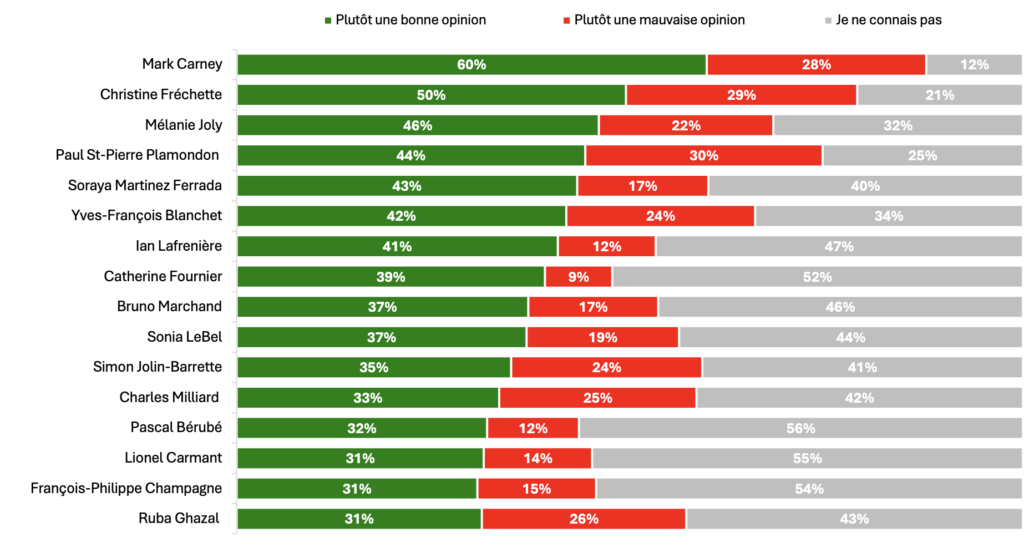
Interestingly, the Léger Political Barometer (above) released five days after those numbers ranks Fréchette as second only to Mark Carney in positive opinions (green bar) vs. negative opinions (red bar) vs. “I don’t know” (grey bar).
So, the Liberals and the CAQ are each trying to attract the votes of those who want to avoid that hypothetical third referendum. Here, the Liberals are struggling because of their low level of support among francophones, and the CAQ because of l’usure du pouvoir (wear and tear of power, or the political version of “familiarity breeds contempt”) tied to the fact the party has been in power for eight years, and many voters and constituencies have accumulated grievances toward the government during that time.
The current political situation in Quebec contrasts vividly with the one witnessed four years ago, during the months preceding the 2022 provincial election. At the time, according to polls, the Coalition Avenir Québec (CAQ) was smoothly sailing toward re-election.
For example, Léger polls from mid-June, late July, and late August 2022 showed the party had more than 40% of popular support, and an average lead of about 25 points vis-à-vis the Liberal Party of Quebec (LPQ), which clearly sat in second place at the time.
In the end, in the October 3 election, the CAQ won 41% of the votes and 90 seats out of 125. As for the Liberals, they only won 14% of the votes and 21 seats, a tremendously poor outcome for the party.
Since then, many things have changed in Quebec politics, as support for the CAQ in the polls fell sharply between April and November 2023, a situation related to François Legault’s declining popularity.
The party that has benefited the most from that decline of support for the CAQ is the PQ, which only won three sets back in 2022 but has since added four seats to its caucus through a series of by-election victories.
Strongly ahead in the polls in 2024 and during the first half of 2025, the party’s popularity now stands at around 30%, slightly above the Liberals, whose popularity increased after Milliard was crowned leader in February, but has started to decline again in recent months.
As for the CAQ, which has been in power since 2018, its popularity has been on the rise since Fréchette won the leadership race and became premier in mid-April.
Overall, the question is which federalist party — the LPQ or the CAQ — will be able to draw most of the many voters who oppose independence and who wish to prevent a third referendum.
To add to the complexity of Quebec’s party system, as shown above, the CPQ and QS poll slightly above and below 10%, respectively.
As the new leaders of their respective parties, Milliard and Fréchette thus face different challenges. On the one hand, Milliard is trying to sway more francophone voters without alienating the LPQ’s anglophone and allophone base, which is not easy, especially with regard to the issue of how to protect the French language.
For instance, he recently faced pushback from members of the LPQ caucus over his plan to revise Bill 96, “An Act respecting French, the official and common language of Québec” adopted in May 2022, while keeping in place the notwithstanding clause the CAQ government had attached to it pre-emptively.
At the same time, Milliard is trying to counter corruption accusations targeting his party. For instance, in mid-June, he had party lawyers send a formal notice to Paul St-Pierre Plamondon after the latter alluded to potential ties between the LPQ and organized crime. After the PQ leader refused to retract his statement, however, Milliard decided his party would not sue.
On the other hand, taking a card for Mark Carney’s politically successful playbook, Fréchette is trying to convince voters that she is the best leader to navigate the uncertain economic and political environment Quebec is facing.
At the same time, she has distanced herself from controversial CAQ initiatives such as Bill 1, the Québec Constitution Act, which she refused to force through, and she even “resurrected” the Programme de l’expérience québécoise (PEQ), an immigration policy dismantled by the Legault government last year and designed to foster a faster path for permanent residency for selected people who already have education and/or labour market ties to the province.
It is far from certain, however, that a clear focus on the economy à la Carney, policy adjustments, and a more positive tone than Legault’s will be enough for Fréchette to convince former CAQ voters disenchanted with the Legault era to support the party again this time.
Overall, the question is which federalist party — the LPQ or the CAQ — will be able to draw most of the many voters who oppose independence and who wish to prevent a third referendum.
Right now, the PQ benefits from both the fragmentation of Quebec’s party lineup and the respective weaknesses of its two main opponents, who will spend the summer fighting over the split federalist vote.
Meanwhile, Albertans will spend the summer learning what it’s like to have a single question overtake your politics while witnessing the time-machine lessons unfolding four provinces away, 50 years later.
A Fellow of the Royal Society of Canada, Daniel Béland is professor of political science and director of the McGill Institute for the Study of Canada at McGill University.