
On Being American: 250 Years On, Our New Self-Evident Truths
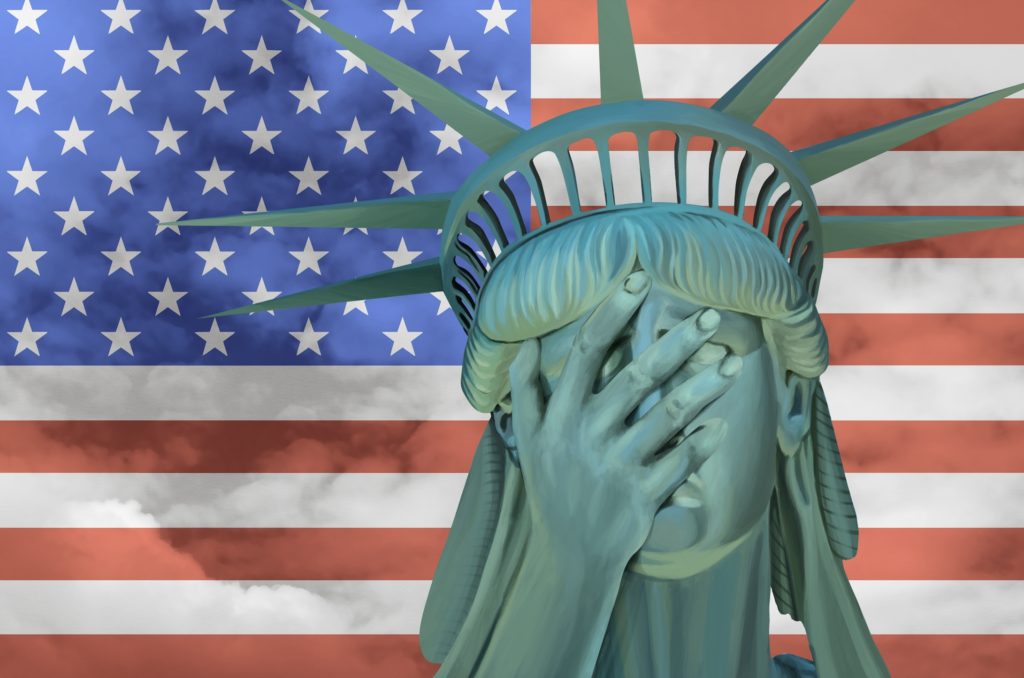
Shutterstock
By Kevin Nealer
July 2, 2026
A recent international poll revealed that global respect for the U.S. is at its lowest point ever, with America the only western democracy suffering a net negative perception, scoring between Iran and Iraq and two notches above North Korea.
The same poll showed that Canada enjoys the second-highest overall rating, after Switzerland.
Happy Canada Day indeed! Well earned.
This is not the product of mere indolence or indifference; the Trump administration has worked hard to achieve this status.
From an unprovoked and economically ruinous war in the Middle East, to forfeiting American global leadership in science and health research, to undercutting premier American institutions of higher learning, to ending international development assistance, and to threatening the sovereignty of other states (including Canada), Team Trump has done an epic job of undermining trust and confidence in U.S. leadership across a dizzying array of domains. And there are two more years to go.
Where does this leave America’s legacy on its 250th anniversary?
Cycles of failure in U.S. policy are not new. What is different now is the willful repudiation and rewriting of history, and the celebration of cruelty and ignorance as a matter of policy. As Policy readers know, America actually had a splinter 19th century political party called the “Know Nothings” that celebrated xenophobia and conspiracy theories.
Nearly half of Republican voters now say they are MAGA; more than half the GOP identify as Christian nationalists. This is the evolution from Reagan’s “government is the problem” to Trump’s nativist, populist politics of grievance. It is not symmetrical.
Right- and left-wing populisms are different. Right-wing is based on national and ethnic identities; left-wing on economic class and social injustice. And the numbers on either extreme of the U.S. polity are very different. There are more than 40 House members of the anti-government Freedom Caucus of the GOP; a mere four of The Squad of hard left House Democrats. Sen. Bernie Sanders is the sole Senate Social Democratic.
The good news? Trump is not America. His brand of grievance politics is wearing thin and has simply become boring. That is evident in his dismal disapproval ratings, an epic reversal among Hispanic voters, and — citing the “Dow Jones of U.S. political polling indicators” — a majority of Americans sense the country is headed in the wrong direction.
The American system has a powerful capacity for self-correction every two years. This November will again test that proposition. But voters are becoming increasingly stratified and party loyalties imbedded to such an extent that few House and Senate seats are now in play.
Cycles of failure in U.S. policy are not new. What is different now is the willful repudiation and rewriting of history, and the celebration of cruelty and ignorance as a matter of policy.
Additionally, the Electoral College map means the presidency is seriously contested in only a half dozen states — the rest being solidly blue or red and voting their cultures rather than the national interest. America looks increasingly like a parliamentary system masquerading as a republic form of democracy.
This is no accident. The Supreme Court — now unapologetically political — has hastened this stratification by ruling that 1) money is speech and there are no limits on spending, 2) partisan gerrymandering of voting districts is fine, and 3) voting rights protection is a relic of the past.
What would the road back to less destructive politics look like?
Every one of these Supreme Court social experiments could be overturned by a Congress reaffirming centuries of precedents and rule of law. Ranked-choice voting — a tool increasingly used by state and local governments — would marginalize extreme candidates and advantage moderation.
Changing the Electoral College requires a constitutional amendment, but both major parties complain bitterly about its harsh, unrepresentative, and antiquated structure, so a consensus for reform is possible.
What won’t be cause for celebration is that Trump’s leap through the Overton Window of possible American foreign policy options has reset global expectations for allies and adversaries alike for years to come.
Those of us — Americans and foreigners — who imagined that support for alliances, resistance to rewriting borders by force, and opposition to corruption at home and abroad were immutable baselines in American policy have been educated in how little resistance there is to norm destruction if any political party abandons durable national interests in its devotion to one man and a craven bid for political dominance.
People are policy, and renewing confidence in America’s global role — and its promise — will take decades and corrective action on a grand scale.
But these corrective antibodies and the anniversary could work together. It is more than slightly possible that Trump fatigue and overreach in rewriting American history have started a resurgence of interest in the nation’s true origin story and the obligations to which it gives rise.
From the popularity of carefully researched documentaries to well considered national efforts at outreach and education, the powerful ideas of the American revolution are getting a fresh look in classrooms, book groups, and barber shops.
The renewed interest in nearly-lost icons, including Thomas Paine, Lafayette and the first casualty of American independence, Crispus Attucks, offer a legacy that should be grounding and ineluctable to any who imagine they are proud to be Americans.
The repair work will be long, non-linear and painful. But it is not optional, and it is already underway.
Policy Contributing Writer Kevin Nealer is a principal of The Scowcroft Group, a member of the Council on Foreign Relations and a former member of the President’s Intelligence Advisory Board.