
‘Chokepoints’: Money Makes the World Go Round. Or Not.
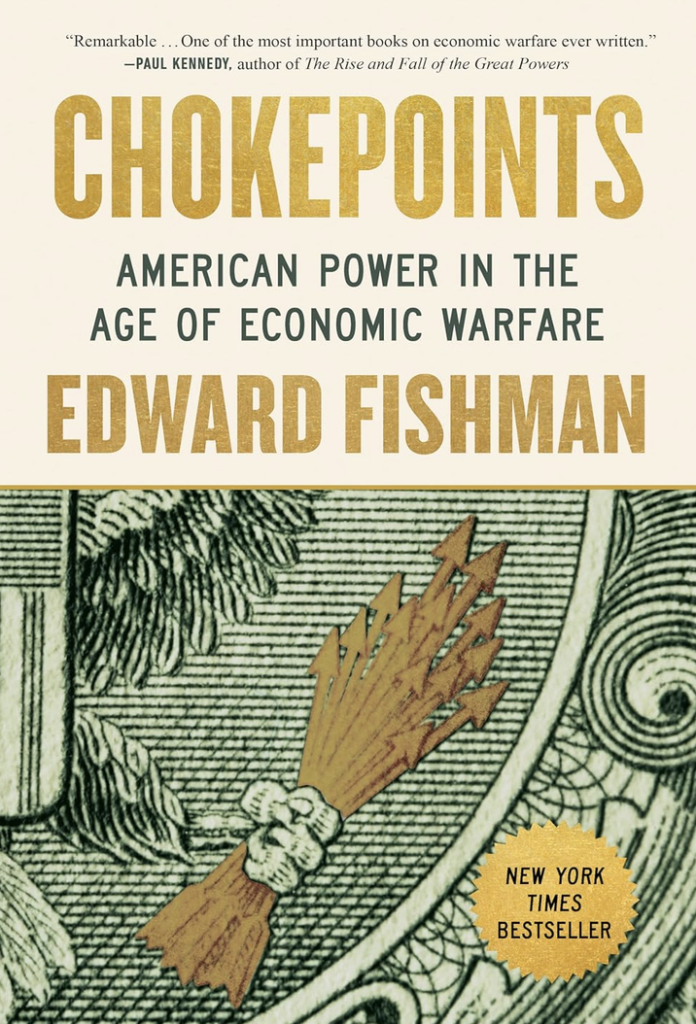
Chokepoints: American Power in the Age of Economic Warfare
By Edward Fishman
Penguin Random House, February 2025/560 pages
Reviewed by Colin Robertson
July 2, 2026
Edward Fishman’s Chokepoints: American Power in the Age of Economic Warfare explains how globalization — once celebrated as a force for prosperity and peace — has become an arena for coercion, competition, and conflict.
Chokepoints is part history, part memoir, and part strategic manifesto.
Fishman — who served in the Pentagon, the State Department, and the Treasury Department and who now teaches at Columbia University — argues that control of critical nodes in the global economy can confer power comparable to that once derived from control of strategic waterways.
Chokepoints is both an explanation of how this system emerged and a warning about its consequences.
In the 21st century, nations increasingly pursue geopolitical objectives not through armies and navies but through covert operations and narrative warfare, economic warfare, trade coercion, financial and technology controls, supply chain dominance, insurance markets, and payment systems.
The United States has become the master practitioner of this form of power. As Fishman writes, “The world economy has become a battlefield. Its weapons take the form of sanctions, export controls, and investment restrictions. Its commanders are not generals and admirals but lawyers, diplomats, and economists. Its foot soldiers are not brave men and women who volunteer for military service but business executives who seek to maximize profits yet often find they have no option other than to obey Washington’s marching orders.”
Under Trump, this form of warfare has also weaponized tariffs.
Fishman begins with the classical understanding of chokepoints.
Throughout history, narrow passages such as the Bosphorus, the Dardanelles, the Strait of Hormuz, and the Suez Canal have served as gateways through which trade, food, and military power flowed.
Fishman’s innovation is to extend the concept beyond geography.
Modern chokepoints are often invisible. They include the U.S. dollar payment system, the Clearing House Interbank Payments System (CHIPS), the SWIFT financial messaging network, maritime insurance markets, advanced semiconductor production, critical intellectual property, and strategic technologies such as artificial intelligence chips.
These allow governments to exert influence over actors far beyond their borders. Unlike traditional military power, these instruments operate through economic dependence.
Globalization, writes Fishman, unintentionally created these vulnerabilities. The architects of globalization believed economic integration would weaken state power as multinational corporations and financial markets knitted together a borderless world.
The opposite occurred.
Globalization created networks. Networks created central nodes. States discovered they could weaponize those nodes. The result is what Fishman calls the “Age of Economic Warfare” that Nobel laureate Thomas Schilling defines as “economic means by which damage is imposed on other countries or the threat of damage used to bring pressure on them.”
A sanctions regulation posted online in Washington can have consequences more immediate than military action.
In the case of Iran, the Obama administration isolated Iran from global finance, froze more than $100 billion in oil revenues, and generated pressure that ultimately contributed to the signing of the 2015 nuclear agreement. As President Obama later observed, the United States achieved this without firing a shot.
By calibrating economic tools, a government can target a specific company, such as Huawei or ZTE, or an entire economy, as in the case of Iran or Russia. This flexibility makes economic warfare attractive to policymakers seeking options between diplomacy and war.
The more hegemons weaponize interdependence, the more middle powers and smaller states will seek alternatives. Chokepoints generate counter-chokepoints; sanctions generate resilience; coercion generates fragmentation.
Fishman’s book is fundamentally about American power. This is the book’s strength but also its weakness. Attention to the role of allies in the development, application and effectiveness of sanctions would have been useful.
American primacy today rests less on aircraft carriers than on financial and technological infrastructure. As Fishman writes, “American power in the globalized economy relies on chokepoints of a different kind.”
The United States enjoys this unique position because globalization evolved around American institutions. The dollar remains central to trade and finance. American capital markets remain the deepest and most liquid in the world.
U.S. firms dominate key technologies. American allies control complementary chokepoints, especially in semiconductors, insurance, and advanced manufacturing.
Fishman acknowledges economic warfare imposes domestic costs and cannot always compel outcomes.
Sanctions weakened Russia, but in response to the oil embargo, Vladimir Putin developed a “shadow fleet” of tankers to bypass maritime restrictions.
Export controls slowed China’s technological development but have not halted it. China has also created alternative payment mechanisms and accelerated semiconductor self-sufficiency efforts.
Sanctions damaged Iran but did not transform its regime.
Chokepoints has relevance for Canada but it also raises questions.
Ottawa’s sanctions generally operate through asset freezes, travel bans, export restrictions, and prohibitions on dealings with listed persons under the Special Economic Measures Act (SEMA), Magnitsky legislation, and UN sanctions regimes. The official Canadian view is that sanctions are intended to compel, constrain, and signal disapproval of unacceptable behaviour.
According to testimony before Parliament, Canada spends considerable effort deciding whom to sanction but far less evaluating whether sanctions remain effective, whether targets have changed behaviour, or whether listings should be revised. University of Manitoba scholar Andrea Charron described Ottawa’s approach as “Fire and forget…We put a name on the list, and then that’s the last we hear from it.”
Canada must remain integrated into global markets, but have we identified and reduced our vulnerabilities to coercion from larger powers?
We depend on open trade, secure financial networks, trusted supply chains and technological cooperation with allies. But do we possess sufficient expertise in economic security?
Diplomacy in the twenty-first century will increasingly revolve around the control, protection, and contestation of chokepoints.
The more hegemons weaponize interdependence, the more middle powers and smaller states will seek alternatives. Chokepoints generate counter-chokepoints; sanctions generate resilience; coercion generates fragmentation.
Fishman’s central insight is that globalization created structures of dependence that can be transformed into instruments of power. The result is a world in which economic relationships increasingly resemble strategic relationships.
For diplomats, policymakers, and business leaders, this reality demands a new vocabulary of statecraft. Financial systems, technology platforms, supply chains, maritime insurance, critical minerals, and data networks are no longer merely economic phenomena. They are strategic assets.
Understanding them is therefore no longer a specialist concern. It is essential to understanding power itself.
Contributing Writer Colin Robertson, C.M., C.D, a former career diplomat, is a fellow and host of the Global Exchange podcast with the Canadian Global Affairs Institute in Ottawa.