
Leadership and the Character of Canada
 Shutterstock
By Dusya Vera and Kimberley Young Milani
July 9, 2026
“In Canada, we are strongest when we are united — when we look out for each other and ensure that no child, no family, no one is left behind.” So Prime Minister Mark Carney told the country in January from the Citadelle de Québec, calling that spirit of solidarity part of what defines our nation.
Prime Minister Carney spoke at a moment that, only days earlier in Davos, he had described as “a rupture, not a transition” — the assurances that once steadied the world had fractured, and stability had given way to something more demanding.
His word choice was noteworthy. He did not overpromise, as leaders so often do, that he would protect Canadians. Rather, he simply described what he assumed Canadians do and who Canadians are. The character he invoked belonged not to the leader but to the led. And he pointed to an essential truth: character is not only a core component of the individual; it can define a culture.
This is the foundation of the Ivey Leader Character Framework developed and taught at the Ian O. Ihnatowycz Institute for Leadership at the Ivey Business School by scholars Mary Crossan, Gerard Seijts, Jeffrey Gandz, and colleagues.
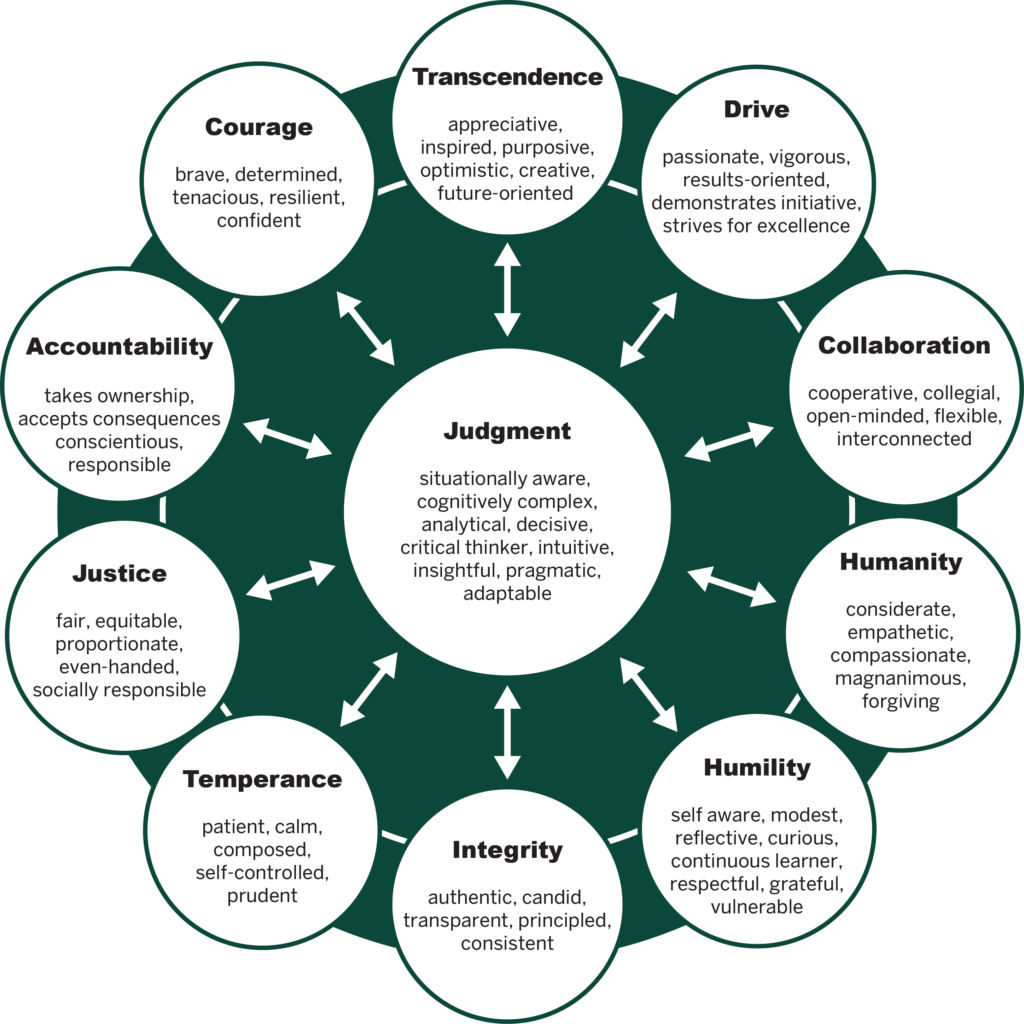
The framework maps character as 10 interdependent dimensions or virtues: Courage, Transcendence, Drive, Collaboration, Humanity, Humility, Integrity, Temperance, Justice, and Accountability, that constellate around the central, 11th dimension of Judgment.
The framework’s unique and powerful insight into character is that these virtues are not a menu of separate strengths but the recipe for an interconnected system where each “ingredient” matters. The strength of character is defined by the integration, not the inventory. While the framework was designed for the individual leader, we can also adapt the lens to examine a country.
Canadians, it seems, believe we have strength of character. In the Pew Research Center’s Spring 2025 Global Attitudes Survey, released this past March, 92% of Canadians said their fellow citizens are morally good and only 7% said they are bad. This places Canada as the most positive of the 25 nations surveyed, and the inverse of the United States—the only country where more people judged their compatriots bad than good.
Whatever else it measures, the survey reflects an exceptional degree of social trust, as well as the shared story we tell about ourselves.
The content of that story is familiar: resilience, a hardiness the national imagination credits to the climate; the much-advertised courtesy, the pride in being kind, polite and respectful; and, alongside that, a refusal to be pushed around.
The country found its emblem for that combination in the winter of 2025, when, facing tariffs and annexation talk from Washington, it adopted the rallying cry “elbows up” — a phrase from the hockey legend Gordie Howe, who raised his elbows in the corners of the rink to ward off opponents.
The key detail is that Howe’s elbows were defensive: Canadians will not strike first but will make anyone who comes at them regret it. Howe himself embodied the pairing: gentlemanly off the ice, ferocious on it.
In the framework’s terms, “elbows up” is not one virtue but several in equilibrium: the Courage to stand, restrained by the Temperance that refuses to strike first, animated by the Justice of defending one’s own, and softened by the Humanity that shares a beer once the game ends.
Politeness without spine is not character strength; belligerence without warmth is not character strength; strength of character is the integration of those dimensions, combined with the judgment to know when to call on each one in a contextually commensurate measure.
And yet, a culture certain of its own goodness is the one most tempted to stop examining itself. An honest account must look for the dimensions that become overextended and the counterweights that are missing. This is because any virtue in deficiency, or in strength but cut off from its complements, stops being a virtue and curdles into a vice: Courage without Temperance becomes recklessness; Humility without Drive becomes passivity.
Canada’s weaknesses are not the absence of its virtues, but those same virtues unbalanced.
The first is courtesy itself. Humanity and Temperance unbalanced by Courage and Accountability become avoidance: the difficulty of delivering hard feedback or holding others to account, the syndrome organizations know as death by politeness.
Unbalanced by Humility, courtesy slides into moral self-congratulation: that 92% of us who believe our neighbours are morally good is virtue and temptation at once, since a nation convinced of its own goodness may quietly stop checking.
The framework’s unique and powerful insight into character is that these virtues are not a menu of separate strengths but the recipe for an interconnected system where each ‘ingredient’ matters. The strength of character is defined by the integration, not the inventory.
The second matters most for those who study business. The same Temperance and resilience that make the country civil and stable can — without Drive — stiffen into caution. “Elbows up” is defensive courage, but a nation can be brave when attacked and strikingly timid when it comes to building, betting, and disrupting.
The evidence is in plain view: a chronic productivity gap, underinvestment in research, comfortable oligopolies, a recurring difficulty scaling ambitious firms. Fierce before a threat, cautious before an opportunity: a real and costly weakness of collective character.
The third is the hardest to say. Character built on a flattering story risks letting the story stand in for substance. Canada’s history carries deep wounds where professed and lived values diverged. Perhaps the gravest example of this is in the legacy of residential schools, and in the gap between the language of reconciliation and its practice. In the Leader Character Framework’s vocabulary, this is a failure of Integrity sustained by a deficit of Humility.
It is telling that the Prime Minister’s same Citadelle address, recasting the British conquest as the hopeful start of a partnership, drew sharp criticism in Quebec for smoothing the harder history.
The fourth presses on the whole idea. Can a country whose central value is diversity — the mosaic, not the melting pot — claim a single character at all? The independence tensions of Quebec and Alberta are reminders that the “we” is contested. And the “elbows up” spirit was switched on by an external threat; a character that needs an antagonist to ignite is, at best, latent.
These cautions matter more than ever as a new, previously unfathomable source of power is testing leadership across politics, governance, business, education, art, and religion.
That same Citadelle speech named artificial intelligence among the capabilities on which Canada is staking its future, and this is where the question of character takes on new salience. AI’s promise is that it can allow us to be more human, not less, freeing us from routine so we can focus on what machines cannot replicate: judgment, moral discernment, empathy, genuine connection.
But AI systems are built by humans, and as such, reflect who we collectively are. They amplify our biases and optimize relentlessly for whatever we instruct them to value, indifferent to whether it serves human flourishing or quietly undermines it. AI cannot weigh justice against compassion or know when courage must dampen prudence.
The defining question is whether AI will elevate human potential and flourishing or merely automate our existing patterns, including our worst habits — a choice that rests squarely on the character of those who decide how the tool is used. Will its cost to humanity be calculated based on — to borrow a double entendre from Prime Minister Carney — values or value?
Which returns us to where we began. Character, for a person or a country, is never an asset to be claimed; it is the unfinished work of keeping virtues strong and supported. The Pew figure tells us that, as Canadians, we believe we look out for each other.
The harder question, the one leadership exists to answer, is how that belief can be continually re-learned and strengthened in practice.
In an age of unprecedented challenges, the answer is character. It can be collective, and it is never finished. Elbows up, and eyes open.
Dusya Vera is a Professor of Strategy and the Executive Director of the Ian O. Ihnatowycz Institute for Leadership at Ivey Business School, Western University.
Kimberley Young Milani is the Director of the Ian O. Ihnatowycz Institute for Leadership at Ivey Business School, Western University.