Unpacking Ankara: Can the New ‘Hour of Europe’ Forestall a New Age of War?
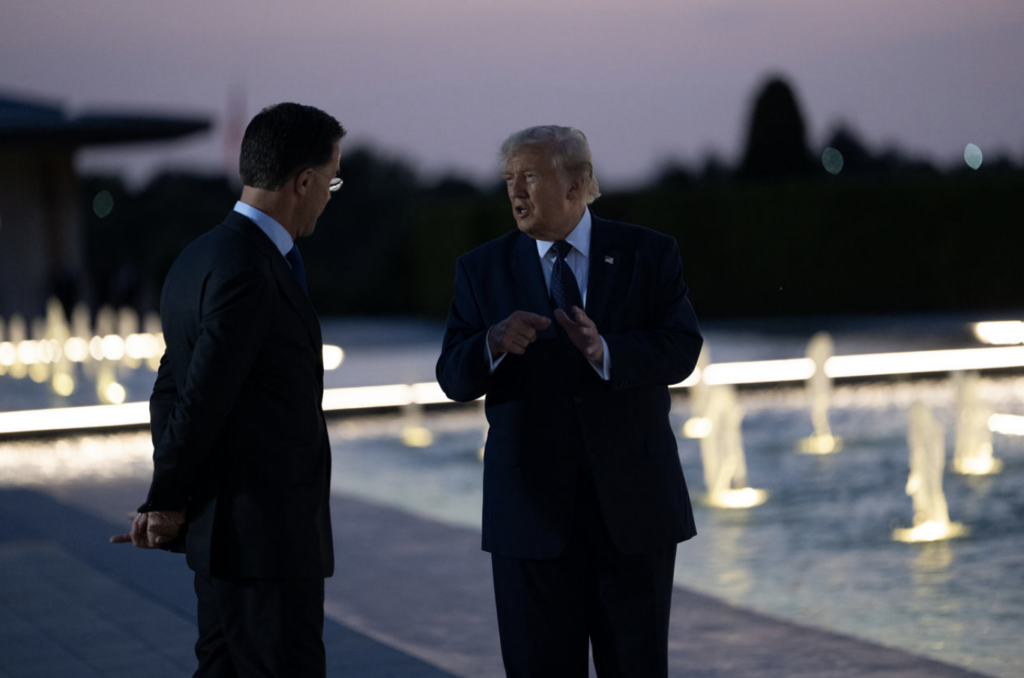 NATO Secretary General Mark Rutte and President Donald Trump at the 2026 NATO Summit in Ankara/NATO
July 11, 2026
Per a catalogue of quotations — from Winston Churchill’s “Jaw-jaw is better than war-war” to Albert Einstein’s line that “Peace cannot be kept by force; it can only be achieved by understanding” — diplomacy has long been recognized as the civilized alternative to war as a means of settling disputes between nations.
But in today’s de-globalizing and multipolar world driven by competitive nationalistic great powers, diplomacy is being marginalized.
In this new security context, transformed by America’s evident capture as a hugely consequential candidate for the next country to shift from democracy to autocracy, what happened in Ankara at this year’s NATO Summit was less diplomacy than multilateral disaster brokerage.
Though Donald Trump ran for the presidency on a pledge to keep the U.S. out of wars, he risks instead launching a new age of war: brandishing threats and coercion to secure corrupt and otherwise unachievable outcomes; pointedly rebranding the U.S. Department of Defence the Department of War; repeatedly ignoring or violating international norms and laws governing the rules of warfare; and assaulting America’s domestic peace with a steady stream of incendiary belligerence.
The United States has a long tradition of diplomatic acuity dating back to Franklin and Jefferson, who proved to the world in the wake of a war of independence that America’s political and intellectual leaders were much more than rebels.
They knew that the first necessity of diplomacy is to understand where other parties to a negotiation are coming from. But today, U.S. “diplomacy” is conducted not by professional diplomats but by property developers, who seemingly possess little interest and even less expertise in the perspectives, beliefs, and motivations of others, evidently relying on mostly on the gut instinct extolled by Trump in The Art of the Deal to calibrate the carrots of cash against the sticks of violent force.
Catastrophic US wars in Vietnam, Iraq, and Afghanistan, made clear that superior expeditionary military force alone does not bring victory. The Iran debacle has been a policy failure on every level. Precision-guided weapons of destruction cannot alone achieve US objectives. This is why international norms on warfare exist, and when they are ignored and violated with predictable results, it’s usually a sign of a much greater problem.
Putin’s Russia, pursuing a delusional “civilizational” mission of reassembling by force its old empire, replicates the USSR’s legacy of failure to grasp or credit the motivations or resilience of anybody else. Spectacularly underestimating both the indomitability of the Ukrainian spirit and Volodymyr Zelensky’s strategic and tactical skill, Putin evidently hoped a successful war economy could compensate for outsized human battlefield losses in Ukraine. But Russians are tiring of the extravagant folly, increasingly contemptuous of the Kremlin’s Orwellian exultation of war.
The similar failure of the U.S. to understand either Putin or the Ukrainians made Trump’s “diplomacy” to end the fighting ludicrous. After grandstanding performances from both Alaska and the Oval Office reality-TV set, Trump resorted to washing his hands of the notion that Ukraine’s fight to defend its freedom and sovereignty meant anything to the U.S., “thousands of miles away.”
The Ukraine chapter is one of many episodes of chaos in Trump’s second term that Maggie Haberman and Jonathan Swan chronicle in their new book Regime Change, a devastating and uncontested account of volatile grievance-driven policy initiatives and choices, reportedly originating mostly from the seat of Trump’s pants: the costly tariffs against the world, the dismissal of international cooperation of almost any institutional kind: and, the animosity to established allies and partners over longstanding U.S. strategic adversaries Russia and China, to predicable effect on the global order.
Disrupted NATO allies intended last week’s Ankara summit to mollify Trump’s destructive unilateral impulses by impressing upon him that increased core military spending by European allies and Canada of $154 billion in 2025-6, is a “win” per his efforts to effect more equitable transatlantic burden sharing. Allied leaders cooperated with the game plan of NATO Secretary-General Mark Rutte (a solid American hire) to avoid argument with the U.S. president, lest he walk out.
Nevertheless, Trump turned the NATO Summit into another episode of the Trump show. His antics, reiterating his toxic intention to “have” Greenland, his accusation that Europe “failed” the U.S. in not supporting his impulsive, stalemated war on Iran, and derisive commentary on Europe and its leaders in general.
A recent European Council on Foreign Relations poll showed that only one in 10 people across 15 countries still see the U.S. as an ally and majorities in all doubt that it would come to their aid if they were attacked.
Partly in consequence, European NATO members and Canada do accept the immense challenge of building costly collective defence capability in the event that Putin does move militarily against NATO while they are still unprepared.
They still need U.S. strategic assets while they build up resilience. Their hope that the U.S. will re-commit to support for Ukraine and mutual defence commitments to Europe under Article 5 is reflected in the Ankara Summit Declaration.
Events in Ankara enabled NATO to escape without a major Trumpian disaster, but they did not repair the transatlantic trust deficit.
The wider ambit of European (and Canadian) concern extends to the need to protect the international rule of law from the vandalism wrought by the Trump administration on multilateral governance.
Convinced that the multipolar world needs cooperation to meet governance challenges posed by climate change, artificial intelligence, migration, and financial instability, Canada and Europe sense that the cartoon of corruption that is Trump’s presidency reflects a larger problem, and that America has lost belief in the common good, domestically and internationally, privileging profit above all else.
(A concern supported, interestingly, by Senator Chris Murphy’s recent essay in The Atlantic on the takeover of kids’ minor league hockey by profit-seeking hedge funds, My Son’s Hockey Team and the Crisis of American Resentment).
Events in Ankara enabled NATO to escape without a major Trumpian disaster, but they did not repair the transatlantic trust deficit.
The EU forms the core of a necessary democratic coalition of the kind Prime Minister Mark Carney has described, engaging Canada, Australia, Japan and others in pursuit of effective multilateralism. As a union of sovereign states, the EU is, by definition, a multilateral organization, but one that is harder to unify on political, military, and institutional governance issues than on trade, where treaty-pooled sovereignty qualifies Europe as a global trade superpower.
Yet, the EU conceded in July 2025 to a one-sided tariff deal with the U.S. The EU Commission, unequipped to cope with U.S. coercion based on continued US military support for Europe as leverage, prioritized economic predictability. Having encountered enduring hostility from the Trump administration since, they now rue their naïveté.
The historic European project to create and expand the EU to “End Europe’s murderous wars forever” (Amos Oz), had always been supported by successive American presidents. That is, until Trump, who is antagonistic toward its very premise of limiting the prerogatives of national sovereignty, and possibly toward its status as a bulwark of democracy. The prospect of Marine Le Pen winning the presidency of France in 2027 may buoy the hopes of MAGA America to hasten the break-up of the Union.
That is unlikely, but Europe has to refresh its sense of purpose. Public support is drained by significant constituencies of populist nationalism in several EU countries. Unprecedented military spending commitments for the next decade ($540 billion for Canada) will attest to how the world’s major democracies, thanks to Russia, China, and the U.S., have prioritized guns over butter and swords over ploughshares, portending an age of war.
While European leaders nonetheless accept the need for increased and more efficient military spending, U.S. insistence on spending 5% of GDP by 2035 does threaten financing of the “European social model’s” safety nets, weakening the endurance of liberal democratic governments, just when Trump’s tariffs and a sluggish EU economy are compressing spending.
Playing the “Trump transactional game” for 30 months until he is gone is an uncertain strategy, given his potential for disruption and the paucity of popular European leaders willing to stand up to him.
In the UK, Keir Starmer was edging toward re-alignment with EU foreign policy when the sequence of events that produced his slow-motion defenestration unfolded. His more charismatic and inspiring successor, Andy Burnham, is presumed to be more focused on British politics and economics.
Burnham’s political contest with Reform’s Nigel Farage is evolving as Farage faces public scrutiny over his Trumpist affectations and an investigation over a “gift” of £5 million from a British crypto tycoon, described by Farage himself as compensation for his service to Brexit. Farage is now running uncontested in a byelection for his own seat in an apparent attempt to divert the narrative.
This frees Burnham up to align with EU leaders. There is much the British can regret since their fateful Brexit decision a decade ago. But Burnham can perhaps restore some of the enhanced global influence the U.K. enjoyed as a driving force in EU external policy while providing the EU with an influence multiplier as well.
The European political family does show recognition that it must evolve in self-possession, anticipating a broader political-military community with associates such as the UK, Canada, Ukraine, Norway, and even autocratic Turkey, pragmatically lauded at the Ankara Summit. Its influence in favour of a more cooperative world should accrue in consequence to reassert the power of diplomacy to forestall a new great-power penchant for war.
The “hour of Europe” has been rung before with little effect. This time, the stakes are much higher.
Policy Columnist Jeremy Kinsman served as Canada’s ambassador to Russia, high commissioner to the UK, ambassador to Italy and ambassador to the European Union. He is a Distinguished Fellow of the Canadian International Council.