
Antisemitism and the Value of Solidarity
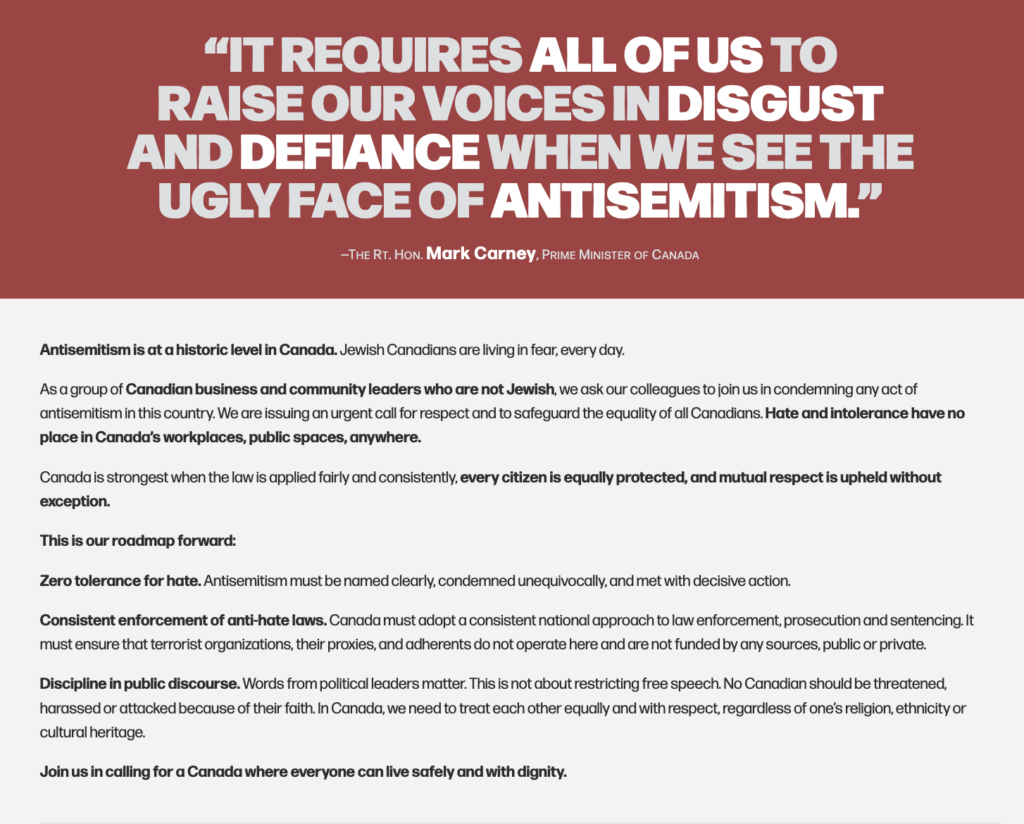 Ad signed by Canadian business leaders that ran June 7th, 2026, in major newspapers/Stop Antisemitism
By Martin Goldfarb
July 12, 2026
Like many Canadians Jews, the October 7, 2023, attacks in Israel left me shaken. Shaken that it happened. Shaken that it led to a rise in antisemitism and antisemitic attacks here in Canada. And shaken by the silence of too many non-Jewish friends.
As Martin Luther King, Jr. once said, “In the end, we will remember not the words of our enemies, but the silence of our friends.”
For anyone who did not grow up Jewish, the angst of Jewish Canadians like me may be difficult to comprehend.
My mom and dad were lucky enough to come to Canada as Jewish orphan immigrants to be trained as farmers. In 1946, after the extent of the Holocaust was exposed, my dad — who by then was a small grocer in Toronto — and others travelled to Ottawa in the hope that they could sponsor Jews to come to Canada from displaced persons camps in Europe. My dad came home feeling defeated and with the impression that antisemitism was still government policy.
The neighbourhood where I grew up — Grace and Dundas in downtown Toronto — was Italian and Jewish. It was a community where we helped each other. The priest from St. Agnes’s Church was a customer and he was my dad’s friend. While I was born a few years after the 1933 Christie Pits riot, I grew up hearing about how Italians stood together with Jews and fought Canadian Nazis.
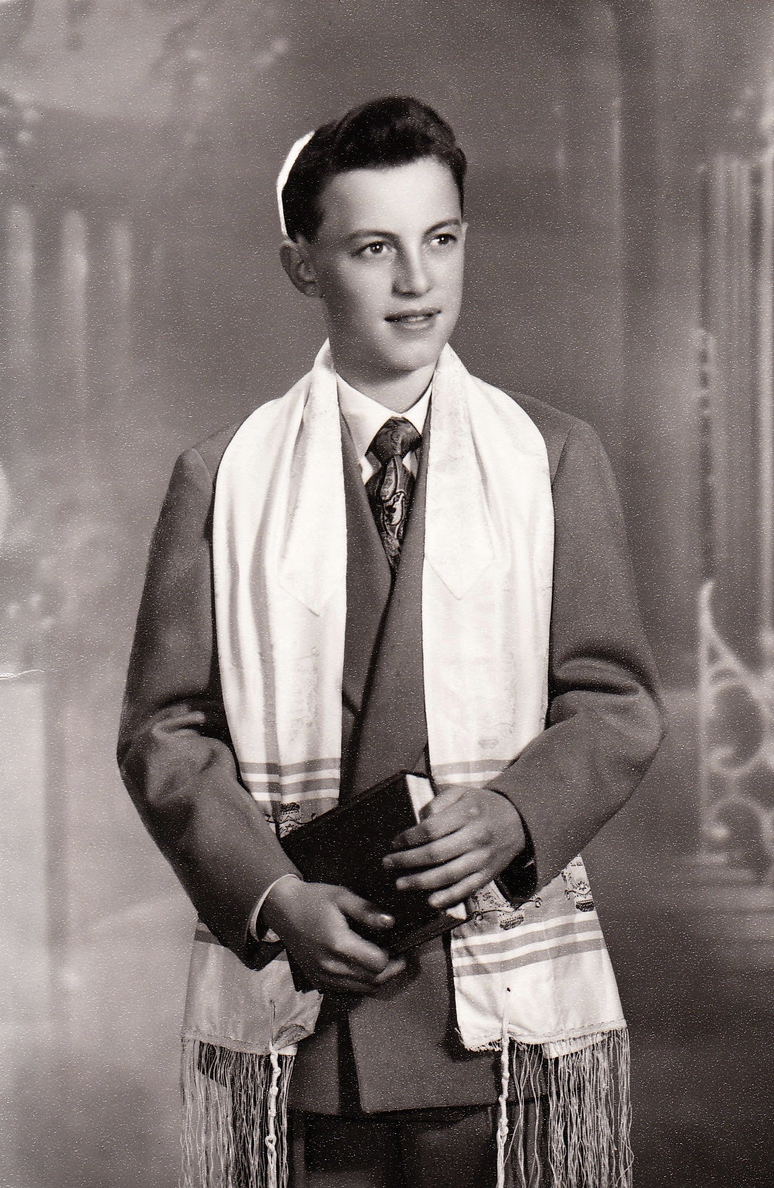
My Bar Mitzvah
I played hockey for a Catholic team — the Columbus Boys Club. I was good enough that the coach wanted me to go to St. Mike’s for high school, but I went to my local public high school instead. To the coach, it didn’t matter that I was Jewish. What mattered to him was outstanding performance.
When I was growing up, there were quotas on Jews in professions like law, medicine, and accounting. Jews formed their own law firms, accounting firms, and hospitals. Their outstanding performance was eventually recognized by the broader community, and historic systemic barriers came down.
Antisemitism became much more latent in the professions and in business, but in some ways more insidious for being more subtle or hidden. Which makes the overt incidents of vandalism and violence all the more important to condemn, by everyone, so that a line is drawn between what we — not as members of a group, but as a society — deem acceptable and unacceptable.
Since October 7th, I have been very concerned by the rise of antisemitism in this country that I have known and loved for nearly 90 years. It hit terribly close to home in March, when the quiet suburban synagogue where my family has worshipped for more than 50 years was attacked by gunfire.
History has shown us that antisemitism exists on a continuum. Individual acts of antisemitism can lead to collective persecution in a progression of normalized, irrational hatred and scapegoating that ends in genocide.
That continuum is not imaginary; it describes the social evolution of the worst crime against humanity ever committed. Indeed, that it was judged and prosecuted as a crime against humanity speaks to the nature of antisemitism as an offence against all of society.
History has shown us that antisemitism exists on a continuum. Individual acts of antisemitism can lead to collective persecution in a progression of normalized, irrational hatred.
Which is why the vigilance that is, understandably, intrinsic in the Jewish community against such individual acts is both wholly justified and worthy of the solidarity of non-Jews. Lack of solidarity isn’t a benign element. It carries weight within that same continuum because it enables any escalation that follows. Lack of solidarity is important not because it hurts our feelings, but because it has proven to be existential.
Which makes solidarity all the more valued.
In 2005, in response to a rise of antisemitic incidents in Montreal and Toronto, BMO Financial Group CEO Tony Comper and his wife Elizabeth founded Fighting Antisemitism Together, a coalition of pointedly non-Jewish community and business leaders who took a public stand against antisemitism, including with full page ads in major Canadian newspapers.
Amid the rise of antisemitism in Canada in the wake of the October 7th massacres and the subsequent war in Gaza, what has struck me most perhaps has been the relative silence of the broader community.
There have been very few voices from the political class who have spoken up. The major exception was the late Brian Mulroney, who delivered a landmark speech to the World Jewish Congress a month after the attacks.
The former prime minister reflected, “How could it be, I often wondered, that the progenitors of people demonstrably making such a powerful contribution to the economic, cultural and political life of Montreal and Canada were reviled over centuries and decimated in a six-year period, beginning in the year of my birth?”
Prime Minister Mulroney made the speech four months before his death after a long battle with cancer, and he clearly had not wasted time weighing the possible social media backlash his words might provoke. He knew he was at the end of a life spent taking principled positions on everything from minority language rights to apartheid to the investigation of Nazi war criminals.
His words stood out because, at a time when propaganda has both blurred the lines between right and wrong and become a weapon of not just censorship but pre-emptive self-censorship, Brian Mulroney — simply and eloquently — took a stand.
 With grandkids Jacob and Ellie Deegan
At the time, I sent the speech to each one of our 11 grandchildren because I wanted them to know that they were not alone.
In June, Prime Minister Mark Carney addressed congregants at Toronto’s Holy Blossom Temple and all Canadians: “Canadians must stand up for each other. This means all Canadians must speak out when we see antisemitism creep into our social media feeds, our classrooms, and our workplaces. Because history teaches us that hatred metastasises when a society grows indifferent to it, when intimidation becomes routine, when conspiracy becomes discourse, and when citizens choose to look away.”
The business community, which had also been largely silent, has now spoken up en masse. Similar to what Tony and Elizabeth Comper did more than 20 years ago, CEOs signed their names to full-page ads that ran on June 27th in major Canadian newspapers. That statement is also running on large digital boards in several bank towers in Toronto. It is a very powerful signal of solidarity.
Among the signatories, there were no fewer than 10 current and former leaders from BMO, Scotiabank, and CIBC. The chief executive officers of RBC and TD did not sign the ad. Instead, they condemned antisemitism on LinkedIn.
There is nothing more powerful than a chorus of leading voices coming together as a united front to set the standard for a community that antisemitism is both a cultural taboo and a collective problem that demands collective action.
Allyship matters. Advocacy matters. Above all, solidarity matters.
Martin Goldfarb, O.C. is Co-Founder and Chairman of Almada. He was official pollster of the Liberal Party of Canada.