
‘Coin of the Realm’: CUSMA, the Gordie Howe Bridge, and the End of Bilateral Trust
July 13, 2026
The Gordie Howe International Bridge should have been the easiest file in Canada-U.S. relations.
Canada paid roughly $6.4 billion to build the bridge. Michigan received a new international crossing, customs facilities and a direct Interstate 75 connection without paying the construction bill.
American workers, contractors and steel producers benefited. Automakers gained a badly needed alternative to the aging Ambassador Bridge, North America’s busiest commercial border crossing.
The bridge was finished. The agreements had been negotiated. The contracts had been signed.
Then Donald Trump threatened to stop it from opening unless Canada gave the United States more.
Canada ultimately accepted changes to future toll revenues and governance to secure a bridge opening that should have happened months ago. Mr. Trump manufactured a crisis over an existing agreement, extracted additional concessions and then declared victory.
This is not just a story about a bridge. It is a warning about the current CUSMA negotiations.
Mr. Trump cannot be trusted to honour any agreement negotiated in good faith, considered by all parties to be binding, or even celebrated by him and/or his own administration.
The evidence is overwhelming.
In 2020, Mr. Trump hailed the United States-Mexico-Canada Agreement as “the fairest, most balanced, and beneficial trade agreement we have ever signed into law.”
It was his agreement.
His negotiators agreed to it. His administration defended it. His supporters celebrated it as proof that he had secured a better deal for America. Yet only six years later, Washington refuses to renew the agreement and instead demands another round of concessions.
The United States will remain Canada’s indispensable economic partner. Our economies are simply too integrated for fantasies of economic divorce.
The United States wants tighter automotive rules, greater American content requirements, changes to Canadian dairy policy, digital regulations, their liquor back on our shelves, and further advantages for American producers.
Meanwhile, Mr. Trump has ignored the spirit — and, arguably, the letter — of the very agreement he once celebrated.
He has imposed tariffs on Canadian steel. On aluminum. On automobiles. On copper. He has threatened “reciprocal tariffs” against countries that already have free trade agreements with the United States. Tariffs have become not exceptional trade remedies but routine instruments of political pressure and economic coercion.
The message is clear.
Under Donald Trump, an agreement is not a settlement. It is merely the opening position for the next negotiation.
The implications extend well beyond CUSMA.
Canada and the United States are also modernizing the Columbia River Treaty, one of North America’s most successful examples of long-term bilateral cooperation. For more than 60 years, it has managed flood control, hydroelectric generation and shared water resources because successive governments accepted that negotiated commitments should outlast changes in political leadership.
If Washington now treats every agreement as simply another opportunity to demand additional concessions, Canadians are entitled to ask whether any bilateral arrangement—including those governing water, energy, borders or critical infrastructure—can be regarded as durable.
This knowledge should fundamentally shape Canada’s approach to CUSMA. There should be no rush to conclude a deal merely to meet a White House deadline or calm financial markets.
That does not mean walking away. The United States will remain Canada’s indispensable economic partner. Our economies are simply too integrated for fantasies of economic divorce. And, as Mark Carney told Wall Street in his speech to the Economic Club of New York, a deal with Canada will help ‘make America great again’.
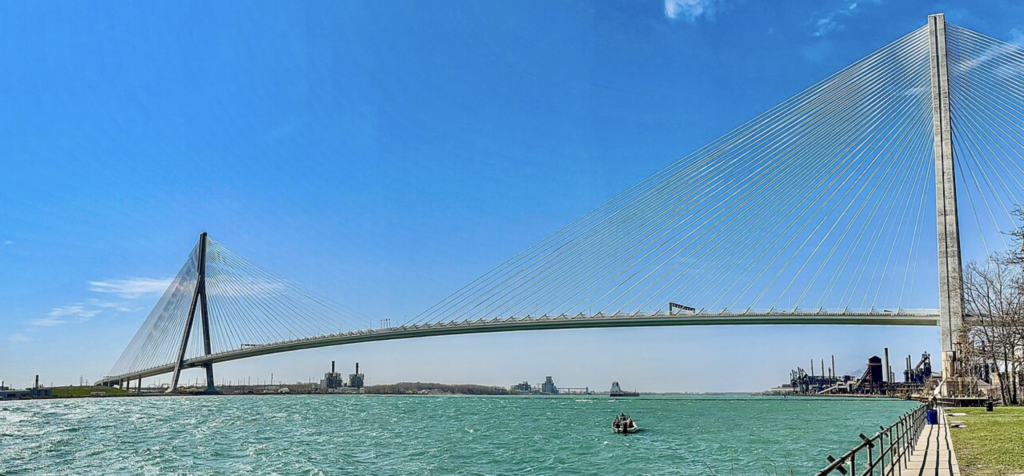 The Gordie Howe Bridge, April 21, 2026/Wikimedia
Canada should take the time necessary to understand exactly what Washington wants, exactly what it is prepared to give in return, and whether any American commitment can reasonably be expected to survive the next presidential eruption.
Every Canadian concession must produce something tangible, reciprocal and enforceable.
General assurances of goodwill are no substitute for legally binding commitments.
Nor should Ottawa negotiate issue by issue. The Trump administration’s preferred tactic is to hold hostage a Canadian asset — steel, aluminum, autos, dairy, lumber, and now, even a bridge — and demand ransom.
This is neither diplomacy nor modern bilateral relations. Indeed, it is more akin to random and arbitrary medieval rent-seeking. In other words, a ‘shakedown’.
Canada should insist on a comprehensive negotiation in which tariffs, automotive rules, energy, security, critical minerals, border management and dispute settlement are considered together with our increased defence spending.
Equally important, Canada must continue building leverage beyond the White House.
Michigan Governor Gretchen Whitmer, members of Congress, manufacturers, unions and logistics companies understood that delaying the Gordie Howe Bridge would damage American workers and businesses every bit as much as Canadian ones.
Those relationships matter. So do those with all governors, legislators, mayors and business leaders across the industrial Midwest. Our former consul general in Detroit and then Chicago, Roy Norton, wrote the playbook on effective advocacy in winning support for the original deal.
Shultz devoted his final public essay, published on his 100th birthday, to a single word: trust. ‘Trust is the coin of the realm,’ he wrote.
Canada should simultaneously reduce its own vulnerabilities by accelerating investment in ports, pipelines, electricity transmission, critical minerals, defence industries and trade diversification. None of these replaces the American market. Together, however, they reduce Washington’s capacity to hold individual Canadian industries hostage.
More than anyone, George Shultz, who served as Secretary of State under Ronald Reagan, understood the importance of treating neighbours with respect. With former Alberta Premier Peter Lougheed and former Mexican Finance Minister Pedro Aspe, Shultz created the North American Forum in 2005 to further strengthen continental cooperation.
Shultz devoted his final public essay, published on his 100th birthday, to a single word: trust.
“Trust is the coin of the realm,” he wrote. Without trust, he would tell us, negotiations become exercises in coercion because neither side believes promises will survive beyond the immediate moment. Trust, he argued, is not sentimental. It is the foundation upon which diplomacy, commerce, alliances and prosperity are built.
That insight applies directly to Canada-U.S. relations.
Mr. Trump’s conduct is not simply anti-Canadian, it is profoundly un-American.
For nearly 250 years, the United States has derived much of its influence from something more enduring than military or economic power: confidence that America respected contracts, upheld the rule of law, defended open markets and honoured agreements across changes in administrations. That predictability became one of America’s greatest strategic assets.
When agreements become temporary conveniences rather than lasting commitments, America weakens not only its partners’ confidence but one of the foundations of its own prosperity.
The Gordie Howe Bridge teaches Canada a simple but enduring lesson.
We should negotiate seriously. Patiently. Respectfully. In good faith.
But we should not negotiate with illusions.
When dealing with the Trump administration, Canadian governments need to keep the puck in play and their elbows up.
Contributing Writer Colin Robertson,C.M., C.D, a former career diplomat, is a fellow and host of the Global Exchange podcast with the Canadian Global Affairs Institute in Ottawa.