
Andy Burnham Takes the Wheel
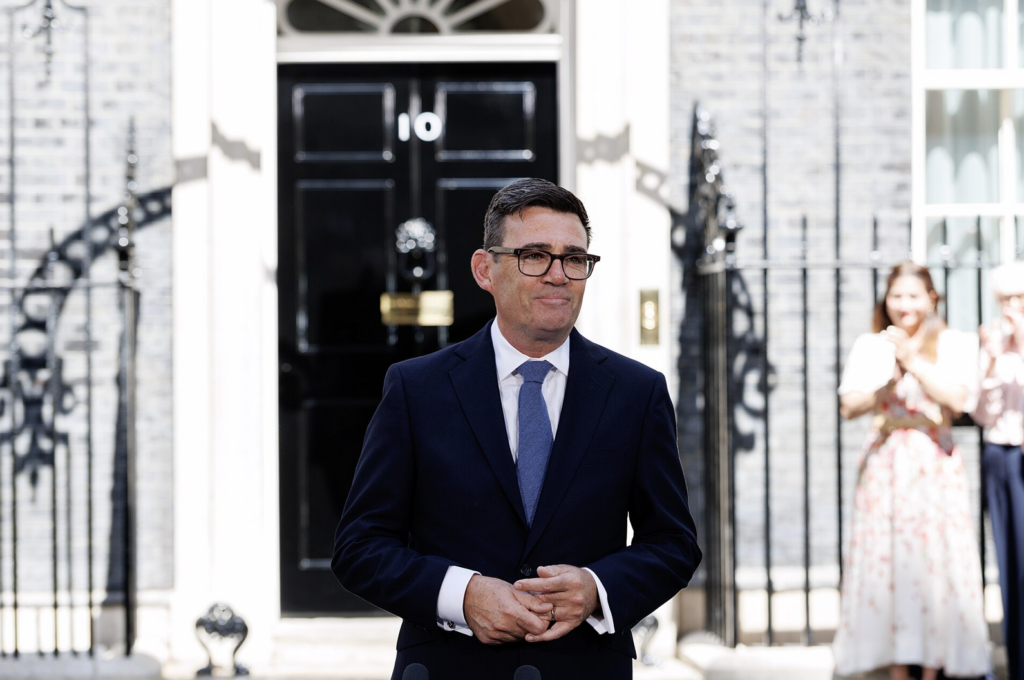 Andy Burnham on his first day as occupant of No. 10 Downing, July 20, 2026/No. 10 Downing Street
By Daniel Béland and Louis Massé
July 21, 2026
On Monday, Andy Burnham replaced Keir Starmer as Prime Minister of the United Kingdom.
Starmer’s resignation came on June 22, after weeks of anticipation as to whether the critical mass of agitation within the Labour caucus to replace Starmer with Burnham, the former mayor of Manchester and a junior minister under both Tony Blair and Gordon Brown, would deliver Monday’s outcome.
The central issue that catalyzed the internal dissent over Starmer’s leadership was the definition of change. Change was Labour’s election slogan in 2024 and, at Labour’s 2025 party conference, Rachel Reeves, chancellor of the exchequer, repeated “don’t ever let anyone tell you that there’s no difference between a Labour government and a Conservative government.”
Meanwhile, Nigel Farage’s Reform UK and Zack Polanski’s Green Party have told everyone that any Labour government is anathema to change.
In the months ahead of this year’s May 7th local elections, groups of Labour MPs published pamphlets suggesting new directions of change and that a more ambitious social and economic program was needed. The UK’s Labour Party is a party of factions: the hard-left, the soft-left, and the centrists.
These factions, while mostly united during elections, fight over the party’s raison d’être much of the rest of the time. After months of popularity depleting controversies ranging from Ambassador Peter Mandelson’s connections to the late élite sex trafficker Jeffrey Epstein to Starmer’s own fraught relationship with Donald Trump, Labour’s defeat in the local elections in May intensified the party’s pressure on Starmer to step down.
Per the classic trajectory of such narratives in UK politics and elsewhere, Ministers started to resign and former allies to criticize Starmer publicly. While other Labour frontbenchers from the centre or the soft left were seen as potential contenders to Starmer, Burnham was the consensus alternative that provided momentum to the party plotters.
Burnham became Mayor of Greater Manchester after leaving Westminster in 2017. He retreated to local politics, using his range of devolved powers to favor public control of utilities and public services. This is the basis of what he called Manchesterism: more nationalization, more devolution outside London, and a strong safety net.
As Starmer’s external and internal difficulties turned his tenure into a political gantlet lurching from one near-death defenestration experience to the next, Burnham’s status as leader-in-waiting prompted Labour executives to obstruct his candidacy in a Manchester by-election in January. Manchester MP Josh Simons resigned on May 14, after the local elections, to open up his Makerfield seat for Burnham.
Although he is unlikely to beat Farage, Binface exposes the circus-like, parody-inducing nature of a by-election in which most people in the country think Farage should not be running in the first place.
Burnham’s status as the pretender to 10 Downing Street was a theme throughout his Makerfield campaign, which both explicitly and implicitly leveraged the prospect of what unfolded Monday as an advantage to voters.
On June 18th, he won the Makerfield seat that would enable his return to Parliament, his ascension to Labour leader, and his replacement of Starmer, with a comfortable 55% of the vote.
On July 17th, Burnham was easily elected Leader of the Labour Party, and on July 20th, he entered Downing Street as Britain’s seventh Prime Minister since 2016. Burnham’s mission is no different than that of his predecessor: to convince a country disillusioned in Brexit’s aftermath and by a succession of leaders that he will be different, and reverse the fate of a British politics that saw far-right populist Reform Leader Nigel Farage become Prime Minister-in-waiting before Burnham did.
Support for Reform UK has declined steeply in recent weeks, reaching its lowest level since 2024. The same applies to Farage’s personal popularity, which is also falling amid a scandal surrounding a £5 million pound payment he received in 2024 from crypto billionaire Christopher Harborne — described by Farage as a “reward” for his pro-Brexit campaigning a decade ago.
In early July, it was also revealed that Farage had received support from fraudster George Cottrell. Now facing two parliamentary inquiries, on July 7th, Farage announced he was resigning as an MP so to trigger a by-election in his constituency of Clacton, and that he would be a candidate.
This attempted political diversion backfired when all the other major parties announced they would not run a candidate against Farage in that by-election and, simultaneously, Jonathan David Harvey, an Oxford-graduate comedian playing the role of Count Binface, the extra-terrestrial leader of the Recyclons, entered the race and the media depicted him as Farage’s main opponent.
Although he is unlikely to beat Farage, Binface exposes the circus-like, parody-inducing nature of a by-election in which most people in the country think Farage should not be running in the first place.
What the recent rise of Burnham and seeming fall of Farage tell us once again is that 10 weeks is an eternity in politics.
A Fellow of the Royal Society of Canada, Policy Columnist Daniel Béland is professor of political science and director of the McGill Institute for the Study of Canada at McGill University.
Louis Massé is a PhD candidate in Political Science at the University of Ottawa. His research compares the politics of industrial strategy in Canada and the United Kingdom in the last 15 years.