
A Wildfire Memo to Mark Carney: We Need New Water Bombers Now
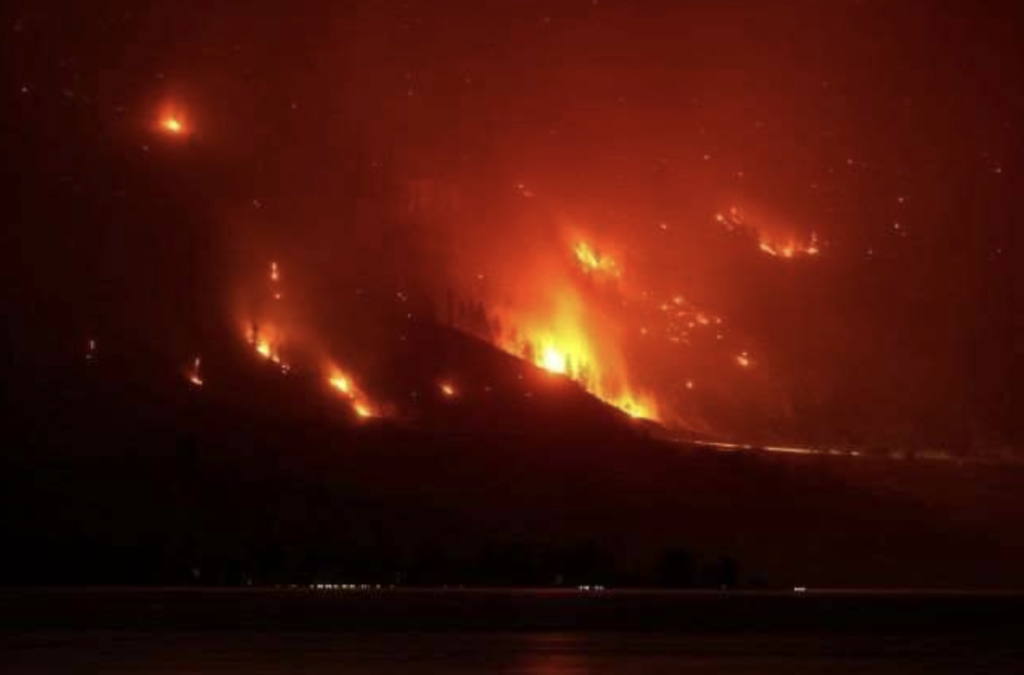 The view from Peachland, B.C., August 8th, 2026/Wikimedia
By Thomas Axworthy
August 14, 2026
The recent images from the Bald Range fire in the Okanagan Valley have a particular resonance for me. In the early 1960s, I spent summers visiting my uncle in Penticton, picking fruit in the valley, and came to know Summerland and Peachland, two of the communities most devastated by August’s fires. I remember an extraordinarily beautiful and seemingly idyllic place. Those memories give me no special insight into today’s fires, but they deepen my empathy for families watching homes, communities and familiar landscapes threatened or destroyed by fire.
In a Policy piece last December titled Fire, Water, and National Security: Why Canada Cannot Backslide, I argued that Canada had to start treating wildfire, drought, and water insecurity as questions of national security rather than episodic environmental emergencies.
That piece was based on an event we’d held at Massey College, Ensuring the Flow: Water Security for Canada and the World, at which John Vaillant, author of the bestselling Fire Weather: A True Story from a Hotter World, presented the case that we are not facing a “big environmental problem” but a civilizational pivot.
We now live, as Vaillant put it, in the Pyrocene Age—the fire equivalent of the Ice Age.
The terrible fire seasons of 2023, 2024 and 2025 demonstrated that extreme fire is becoming a permanent feature of the Canadian summer.
This summer, the wildfires of 2026 have already provided horrible confirmation that weather extremes are here to stay.
In 2023, nearly 70 per cent of the population of the Northwest Territories was displaced by wildfire. In 2024, some 25,000 people were evacuated from Jasper. In 2025, Manitoba and Saskatchewan experienced mass evacuations, with Winnipeg receiving thousands of evacuees from northern communities.
Now, it is British Columbia dominating the wildfire news.
On August 8th, British Columbia Premier David Eby declared a province-wide state of emergency with more than 20,000 people evacuated from their homes by the latest fires. Across Canada, more than four million hectares have burned this year.
The geography and intensity vary from year to year, but the pattern is unmistakable: destructive wildfire, mass evacuation and pressure on firefighting resources have become recurring features of the Canadian summer.
In B.C. this summer, what was especially notable was the dizzying speed of the fire. Detected on August 7th, within just three hours the Bald Range blaze exploded across 50 square kilometres, forcing police and firefighters to go door to door telling residents to leave immediately as the fire bore down.
This is not just a Canadian problem. France and Spain have suffered extraordinary fires this summer. Across Europe, governments are confronting the same problem Canada faces: fire seasons capable of overwhelming firefighting capacity built for a climate that no longer exists.
Ottawa Has Begun to Act
It is important to recognize progress. In my Policy piece last year, I argued that Canada’s approach to aerial firefighting was too fragmented. Provinces owned or contracted their own fleets, several fleets were aging, and orders for replacement aircraft stretched years into the future.
I proposed a National Water Bomber Strategy in which Ottawa would work with the provinces to assess Canada’s long-term requirements and create national capacity that could be deployed wherever the danger was greatest.
In Budget 2025, Ottawa committed $316.7 million over five years to the Canadian Interagency Forest Fire Centre to establish national aerial firefighting surge capacity. For the 2026 season, CIFFC has leased 10 firefighting aircraft and two support assets that can be moved around the country as provincial and territorial needs change.
That is sensible policy, and the government deserves credit for it. But we need much more.
We Need Water Bombers
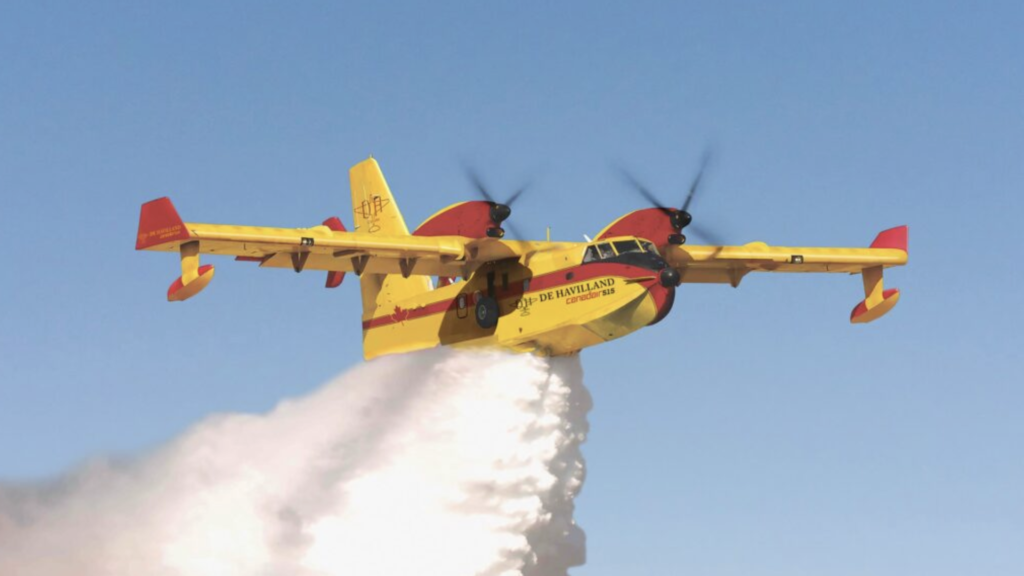 The De Havilland Canadair 515 ‘Super Scooper’/De Havilland
Canada possesses something most countries confronting wildfire do not: a domestic manufacturer of the world’s only purpose-built amphibious firefighting aircraft currently in production.
De Havilland Aircraft of Canada produces the iconic yellow-and-red Canadair 515 (the latest version of the legendary Canadair 415), which can scoop thousands of litres of water from a lake in 12 seconds, return rapidly to a fire, make a drop and repeat the operation.
The “Super Scooper” has become a symbol of Canadian ingenuity worldwide in battling wildfires from the 2025 Los Angeles fires to this summer’s conflagrations across Europe.
As CBC‘s Verity Stevenson reported recently, the world wants them. De Havilland is producing 22 aircraft for European customers and 14 combined for Manitoba, Ontario and Alberta, though our provinces are behind in the queue and will not receive planes until the 2030s. The problem is not finding customers. It is producing the aircraft, which must be hand-made to order, fast enough.
De Havilland is currently building a major facility near Strathmore, Alberta, that will begin delivering planes to Europe by 2028, but that first order is only a fraction of expected world demand for more than 300 aircraft.
What would it take to ramp up production? De Havilland has put a remarkably specific number on what expanded Canadian demand could accomplish. As Neil Sweeney, De Havilland Canada’s vice-president of operations, told Stevenson, the company would build another production plant if it could sell 50 planes to Canadian governments.
Ontario is spending more than $500 million for six DHC-515s. At approximately that unit cost, 50 aircraft would represent an investment of about $4 billion, plus the costs of recruiting and training pilots.
Canada could certainly use a new water bomber fleet. The current one is old: Alberta’s fleet, for example, entered service in 1986, hence its recent order for five DHC-515s. Provincial fleets are stretched. Ontario has a fleet of roughly 9 to 11 water bombers, and during the summer fire season a single region experiencing a surge can require the whole fleet, leaving the rest of the province unprotected.
Some provinces, such as Nova Scotia, do not own or operate any heavy bombers or scoopers and must borrow assets from neighboring provinces when emergencies occur. The path forward is clear: the Carney government should sit down with the provinces and territories to assess needs and identify enough genuine Canadian requirements to justify expanded production.
Nation-Building Opportunity
This is precisely the kind of opportunity Prime Minister Mark Carney’s nation-building agenda should embrace.
Canada has the technology, the manufacturer, the domestic demand and an expanding international market. Government would not be attempting to create an industry in the hope that customers eventually materialize. The customers are already here, and they are waiting.
There is also an important opportunity for federal-provincial cooperation. Provinces and territories know they need greater capacity to deal with fire emergencies. Helping provinces renew their fleets or creating a national water-bomber reserve to be deployed wherever the emergency is greatest, would demonstrate that federalism can work to protect citizens.
In particular, at a time when Ottawa and Alberta have struggled to find common ground, helping the province diversify its economy by attracting skilled aerospace jobs and export opportunities to the De Havilland manufacturing facility east of Calgary is far less contentious than the debate over pipelines.
With 50 Canadair water bombers at $4 billion and the proposed new West Coast oil pipeline at $35.2 billion to $43.7 billion — roughly ten times as much — the comparison is illuminating.
Canada is debating how much to invest in infrastructure to produce and export fossil fuels. Surely a nation-building strategy should also invest in the infrastructure increasingly required to cope with the consequences of a changing climate.
Nation building in the age of climate change must mean investing not only in industries that create wealth, but in the capacity to protect Canadians when weather extremes threaten their homes and communities.
From Fighting Fires to Building Capacity
Water bombers are not a substitute for prevention. Canada still needs FireSmart communities, better forest management, Indigenous fire stewardship, improved fire modelling and properly equipped ground crews.
But even the best prevention strategy will not eliminate wildfire. When fires threaten communities, governments need the capacity to respond immediately.
Canada should treat firefighting aircraft not just as an important Canadian industrial opportunity, but as a strategic investment in our national security.
We have the technology, the aerospace expertise, the domestic need and a growing international market. What is needed now is the production capacity to match them.
Prime Minister Carney wants Canada to build. This is something well worth building.
Policy Contributing Writer Thomas S. Axworthy is Public Policy Chair at Massey College.