
‘Statecraft’: Redefining Strategy for a Post-Normal World
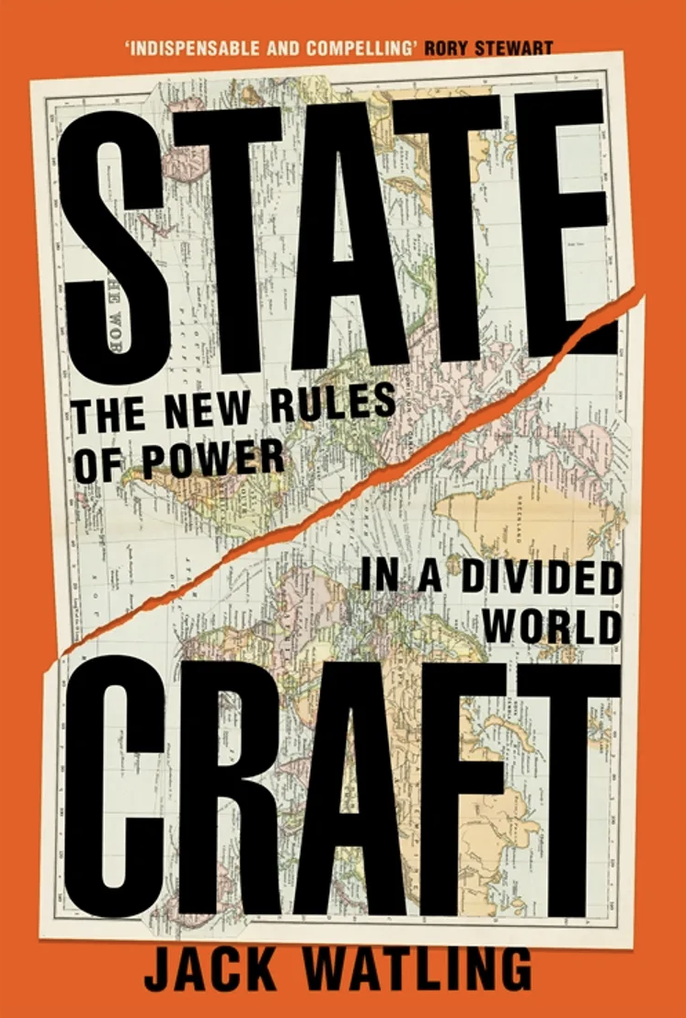
Statecraft: The New Rules of Power in a Divided World
By Jack Watling
Macmillan, March 2026/368 pages
Reviewed by Colin Robertson
August 16, 2026
Jack Watling begins Statecraft with an image from Ukraine. Before 2014, a field had been planted with crops; now, it is “planted” with land mines.
It is an economical introduction to Watling’s larger argument: Western governments still behave as though peace is the normal condition and war an occasional interruption. The world Watling describes offers no such pause.
Disorder now runs through trade, technology, intelligence, energy, infrastructure, information and armed force.
Western governments are organized to manage conventional emergencies.
They detect a crisis, convene committees, announce measures and hope eventually to return to normal. Watling’s warning is that the normality to which they wish to return no longer exists.
A senior research fellow at the Royal United Services Institute, Watling has spent much of the past decade examining war at close quarters, especially in Ukraine.
In Statecraft, he asks why democracies possessing greater wealth, military capacity and intelligence than most adversaries repeatedly fail to translate those advantages into favourable outcomes.
His answer indicts the structure of Western policymaking. Governments may recognize a threat and even articulate an appropriate strategy, but their institutions are poorly designed to act before danger becomes undeniable. “The institutions presume stability,” Watling writes, although the emerging multipolar order is inherently unstable.
Governments are trying to play chess against adversaries willing “at any moment to flip the board.”
Ukraine provides the most persuasive evidence for his argument.
Washington and London correctly warned that Russia intended to invade. Ukraine initially doubted them. Russia’s own planners spectacularly underestimated the tenacity of the country they were attacking.
Intelligence, Watling observes, matters only when it feeds “a system that is structured to receive and exploit it.” Western governments are better configured to respond to crisis, “when time is short and the picture is clear,” than to act early amid uncertainty.
That is Statecraft’s central lesson. Strategy is not another elegantly bound document. It is the ability to take consequential decisions when information remains incomplete, costs appear avoidable and political consensus is uncertain. By the time certainty arrives, choices have usually narrowed and costs risen.
Watling’s assessment of Donald Trump is similarly nuanced. In his Economist interview, Watling argues that Washington’s desire to focus on China and force Europe to assume more responsibility for defence predates Trump.
The strategic logic is real; the execution is often erratic. In an interview with Andrew Keen, Watling describes Trump as disruptive and impulsive, adept at forcing others to react on his terms but liable to “break the rubric” without knowing where he wants events to end or understanding the consequences.
For allies, the implication is stark: American power remains indispensable, but American predictability cannot be assumed.
Watling is equally useful in correcting enthusiasm for technological revolution. His earlier book, The Arms of the Future, anticipated much of Statecraft. Sensors, drones, artificial intelligence, precision weapons and electronic warfare are transforming combat, but the central question is not what armies buy. It is how capabilities are combined.
Ukraine demonstrates that drones and ubiquitous sensors have made the battlefield increasingly transparent. Concentrated formations and headquarters are easier to find and attack.
But drones have not abolished artillery, armour, infantry, engineers or logistics. What looks like robotic warfare still rests on what Watling calls a “vast hinterland” of pilots, technicians, signallers, logisticians and soldiers. The lesson is integration, not substitution.
The maritime chapters are among Statecraft’s best.
Globalization still rests physically on ships, ports, energy routes and undersea cables. Ukraine has shown that a country without a conventional fleet can use intelligence, shore-based missiles and explosive uncrewed vessels to deny important sea space to a stronger naval power.
There is a caveat. Decisiveness is not synonymous with wisdom. Democracies deliberate because interests are contested and legitimacy matters. Military action that outruns political purpose is not statecraft.
But Watling draws a crucial distinction: sea denial is not sea control. In his Financial Times interview with Gideon Rachman, Watling notes that Russia can still put ships to sea and launch cruise missiles. What Ukraine has frustrated are some of the fleet’s essential strategic purposes: amphibious assault and blockade.
Hormuz sharpens the point. Iran can disperse missiles, mines, drones and uncrewed craft over great distances. A sophisticated warship may defend itself; protecting tankers and container vessels is another matter.
Watling argues that modern navies have invested heavily in fighting other navies while paying insufficient attention to their historic function as guardians of commerce.
Nor does he accept the fashionable conclusion that autonomous craft make large warships obsolete. In The Economist, Watling offers the mariner’s answer: “uncrewed does not mean small.”
Ships operating in North Atlantic conditions still need size, endurance, power and sensors. Machinery breaks. Engineers matter. And after a drone or missile gets through, Watling asks the practical question: “Who does damage control?”
The likely future is hybrid: large, crewed vessels acting as command platforms and motherships for networks of uncrewed systems conducting surveillance, mine clearance, anti-submarine warfare and other high-risk missions. This is evolution, not the death of the warship.
This makes Statecraft particularly pertinent for Mark Carney’s Canada.
Ottawa is embarking on the largest defence recapitalization in generations: new River-class destroyers, a planned fleet of up to 12 conventionally powered submarines, and major investments in Arctic surveillance, basing, and infrastructure.
Watling would probably approve of the direction but warn against confusing procurement with strategy.
A submarine is not Arctic sovereignty. A destroyer is not sea control. A radar contact is not situational awareness unless the information reaches someone empowered to act.
Platforms become strategic capability only when joined to sensors, satellites, communications, weapons stocks, trained crews, repair facilities, ports, airfields and reliable supply chains.
For Canada, that means Arctic infrastructure may be as strategically important as the ships and submarines themselves. Geography becomes power only when forces can be sustained across it.
The River-class destroyers should therefore be viewed not simply as replacements for the Halifax class but as nodes in a distributed maritime system linking submarines, P-8 aircraft, satellites, underwater sensors and uncrewed surface and subsurface systems.
Watling would also ask an uncomfortable question: how long can the fleet fight once its magazines begin emptying? That is a better measure of military power than the number of platforms ordered.
His advice to middle powers is equally relevant.
Watling argues that governments have too often allowed consensus-building to postpone decisions. The successful middle powers are more decisive and opportunistic. His advice is almost alarmingly simple: “the best thing to do is to move.”
For Carney’s values-based realism, coalitions of the willing should therefore be functional rather than ceremonial: Arctic surveillance with Nordic and NATO partners, submarine cooperation with European allies, industrial collaboration with Europe and Asia, and continental defence with the United States.
There is a caveat. Decisiveness is not synonymous with wisdom.
Democracies deliberate because interests are contested and legitimacy matters. Military action that outruns political purpose is not statecraft.
Statecraft is a practical field guide to how states convert wealth, intelligence, geography, alliances, and military force into usable power.
Its message to Canada is timely. Ottawa is finally spending serious money on defence. The harder task now is making the pieces work together, recognizing that waiting for certainty is inviting calamity.
Contributing Writer Colin Robertson, C.M., C.D, a former career diplomat, is a fellow and host of the Global Exchange podcast with the Canadian Global Affairs Institute in Ottawa.