
Don’t Get Mad, Get Results: Closing the Canada-U.S. Trade Deal
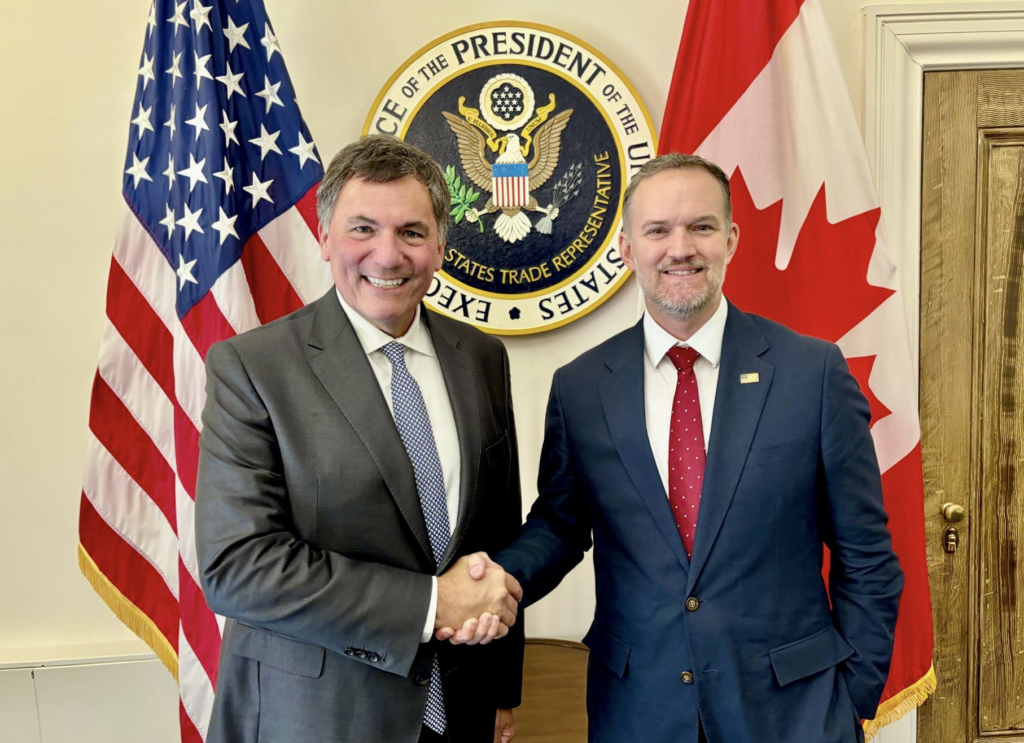 Canada-U.S. Trade Minister Dominic Leblanc and USTR Jamieson Greer on Wednesday, August 19, 2026/Leblanc X
By Colin Robertson
August 19, 2026
While the details where the devil famously resides have yet to be unveiled, Canada-U.S. Trade Minister Dominic Leblanc and United States Trade Representative Jamieson Greer have announced that a trade deal has been struck between the two countries to break the deadlock over the future of CUSMA.
“Congratulations to Minister LeBlanc and Ambassador Greer for the significant progress made in the trade negotiations between Canada and the United States,” Prime Minister Mark Carney posted following Wednesday’s announcement. The wording “significant progress” is a reminder that the agreement hasn’t been finalized.
Less than two hours before Donald Trump’s new 50-per-cent Section 338 tariffs were to take effect on August 19, Trump postponed them for three days, giving negotiators until Friday, August 21, to finish the documentation. The threatened tariffs covered about US$20 billion in Canadian goods.
While we’ve moved back from the cliff edge, the key takeaways are still unknown — are there remaining tariffs on Canadian exports to the U.S.? How did the auto industry fare? What are the triangulations and quid pro quos associated with the breakthrough? While Leblanc told reporters on Wednesday that supply management remains intact, there are still more questions unanswered than answered.
Avoiding Section 338 is not the same thing as solving Canada’s tariff problem. The test of whatever agreement emerges is not the declaration from the White House. It is the document.
For Canadians, five things matter: autos; steel and aluminum; what Canada gives up on dairy, alcohol and retaliatory tariffs; what Washington means by “economic security” and “digital trade alignment”; and whether the agreement restores enough predictability to make CUSMA credible again.
As a conceptual aid, Washington’s bewildering tariff regime is most easily understood as an unappetizing layer cake of chaos.
The bottom layer is CUSMA, under which most qualifying Canadian-American trade still receives preferential treatment. On top sit successive American tariffs: Section 232 duties on steel, aluminum, autos and other products; Section 301 measures; and now the threatened Section 338 duties, imposed under the Depression-era Smoot-Hawley statute and resurrected to punish alleged Canadian discrimination involving dairy subsidies, alcohol boycotts and retaliatory automobile tariffs.
Not every slice contains every layer. Saying simply that “Canada faces 50-per-cent tariffs” badly distorts the picture.
But Section 338 was especially serious because Washington said the duties would apply even to goods qualifying under CUSMA. That punched another hole in what has been Canada’s most important commercial shield and predictability asset — not just for Canadian business and exporters, but for foreign direct investment (FDI) relying on U.S. market access.
Before this latest threat, the Bank of Canada estimated that about 90 per cent by value of Canadian merchandise exports to the United States were entering tariff-free. CUSMA is far from dead. But its credibility is being steadily eroded by American carve-outs within a larger context of increasingly vulnerable global supply chains.
That is why autos are the most important test of the prospective deal.
Canada and the United States have discussed reducing the American auto tariff from 25 per cent to 15 per cent. But the headline number matters less than how this is calculated.
Washington wants relief based essentially on U.S.-made content. Canada wants Canadian and Mexican content recognized as part of a North American automobile.
Canada should hold that line.
CUSMA’s automobile rules were deliberately designed around a continental production platform. Its regional-value rules reward production across Canada, the United States, and Mexico rather than simply production in the United States.
Trump has a point that North America should reduce strategic dependence on China and strengthen industrial capacity. Canada should be prepared to work more closely with Washington and Mexico on critical minerals, investment screening, export controls and strategic technologies.
But North American economic security is not synonymous with American economic nationalism.
If an Ontario transmission or Mexican component is treated a little differently from one imported from Asia, CUSMA ceases to be a North American industrial strategy and becomes preferential admission to an American one.
That would undermine the very continental production system CUSMA was created to sustain.
The second test is Section 232.
If Canada avoids Section 338 while substantial tariffs remain on steel, aluminum and automobiles, Ottawa cannot present the outcome as a comprehensive victory. Section 338 was the newest threat. It was never the whole problem.
Canada’s negotiating objective should be straightforward: fewer tariffs, preservation of North American production, and restoration of a CUSMA framework businesses can once again trust.
The objective should be to strip away the tariff layer cake until businesses can again see the CUSMA foundation underneath.
Third, Canadian concessions.
Alcohol restrictions and aspects of dairy administration are bargaining chips, not sacred objects. Canada should deal where concessions produce measurable gains in market access.
But the negotiating rule should be explicit:
No unilateral appeasement. Every Canadian concession should purchase a measurable American concession.
If American wine and spirits return to Canadian shelves, Canadians should be able to point to something tangible coming off the American tariff wall.
Provincial liquor restrictions have also demonstrated that Canada has leverage. Ottawa cannot simply order Ontario, Quebec or other provinces to restock American products. That makes Team Canada essential.
Canada’s vastness means its regional economies differ markedly and tariff pain is uneven. Forest products matter disproportionately to British Columbia, autos to Ontario, aluminum and dairy to Quebec, while agriculture, potash, oil and gas dominate elsewhere.
Premiers also have relationships with American governors. Provinces control liquor boards, electricity systems, and much resource development.
Federalism makes negotiation more complicated. Properly managed, it also gives Canada more cards.
Fourth, Canadians should scrutinize U.S. Trade Representative Jamieson Greer’s references to “economic security” and “digital trade alignment.”
The emerging bargain increasingly looks like more than a tariff settlement. It could encompass critical minerals, China policy, investment screening, technology regulation, digital trade and defence supply chains.
Much of that could serve Canadian interests. Canada shares the American concern about Chinese overcapacity and strategic dependencies.
But alignment must be reciprocal, not submission by another name.
Canada has cards. We are the largest foreign supplier of crude oil to the United States and an important source of uranium, potash, aluminum and critical minerals. Geography makes Canada indispensable to NORAD and Arctic defence.
Trump has also raised Keystone XL. That is worth watching, but there is not yet enough evidence to conclude that reviving the pipeline is an agreed Canadian commitment.
Reliability is one of Canada’s advantages. These assets should not be brandished recklessly. But neither should we negotiate as though Washington holds every card.
Finally comes the long game: CUSMA itself.
The United States still absorbs about 72 per cent of Canadian merchandise exports. Geography, pipelines, railways, electricity grids and four decades of integrated production cannot be wished away.
Diversification toward Europe, Mexico and Asia is essential, but replacing the American market is fantasy.
CUSMA’s economic logic therefore remains compelling. What is increasingly doubtful is whether businesses can rely on its rules when deciding where to invest billions of dollars over decades.
That is the real damage caused by Trump’s tariff chaos, with tariffs that appear, disappear, and reappear under different sections of American trade law.
Canada’s negotiating objective should be straightforward: fewer tariffs, preservation of North American production, and restoration of a CUSMA framework businesses can once again trust.
A deal that merely cancels the Section 338 tariffs while preserving the larger tariff wall would be welcome, but insufficient.
A deal that reduces Section 232 tariffs, recognizes Canadian and Mexican content in North American automobiles, exchanges Canadian concessions for measurable American concessions and establishes reciprocal economic-security cooperation would be something more substantial.
It could begin rebuilding the North American bargain. Section 338 is a chapter, not the book. Administrations change. Geography does not.
Don’t get mad. Get results.
The tariff layer cake has grown far too tall. Canada’s objective is not simply to prevent Washington from adding another layer.
It is to restore the full faith and integrity of the North American economy.
Contributing Writer Colin Robertson, C.M., C.D, a former career diplomat, is a fellow and host of the Global Exchange podcast with the Canadian Global Affairs Institute in Ottawa.