
Flaming Steamships, Brawling Lumberjacks, and a Pig War: A Brief History of Pre-Trumpian Bilateral Hostility
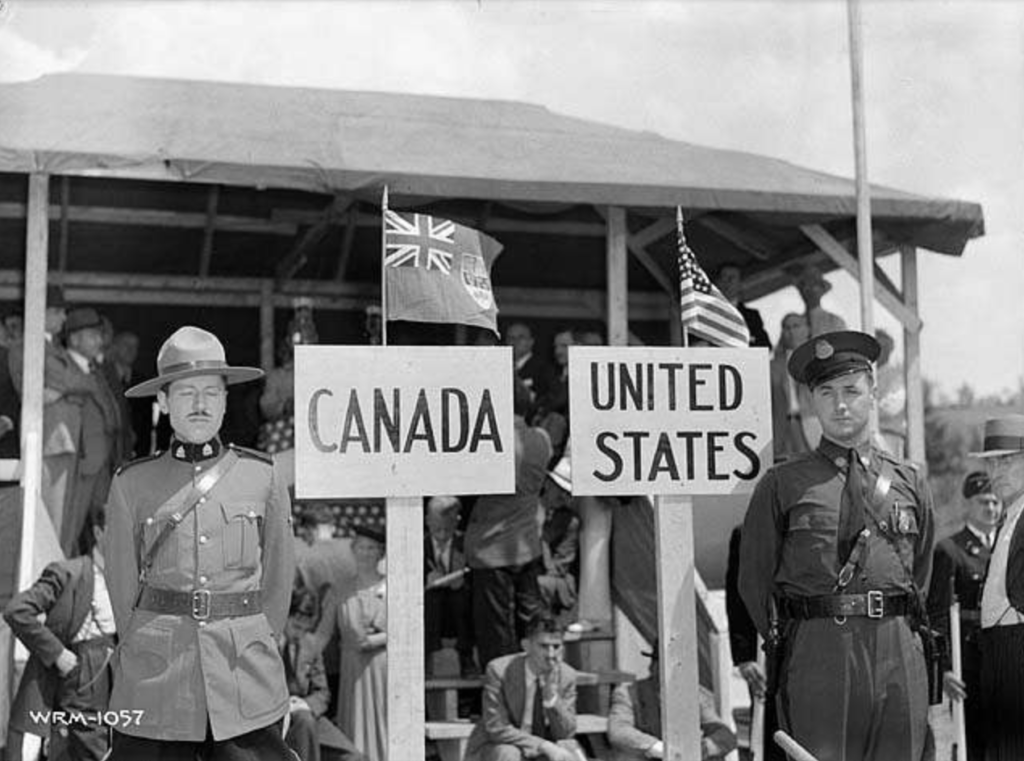
A Royal Canadian Mountie and a Maine State Trooper in Highwater, Quebec, in 1941/LAC
August 25, 2026
Even before he escalated his trade war, President Trump liked to speak of Canada as a future 51st state.
That’s about as likely to happen as the 2020 election being overturned.
Canadians are, of course, insulted, and the vast majority of Americans like things between the two neighbors the way they are.
Still, as absurd as Trump’s idea might seem, it’s not entirely new.
None other than Benjamin Franklin, who had continental ambitions even before the revolutionary war, was an early financial backer of the Montreal Gazette in the 1770s as a propaganda vehicle to convince the French-Canadian population to join the American rebellion. Franklin, too, loved French Canadians.
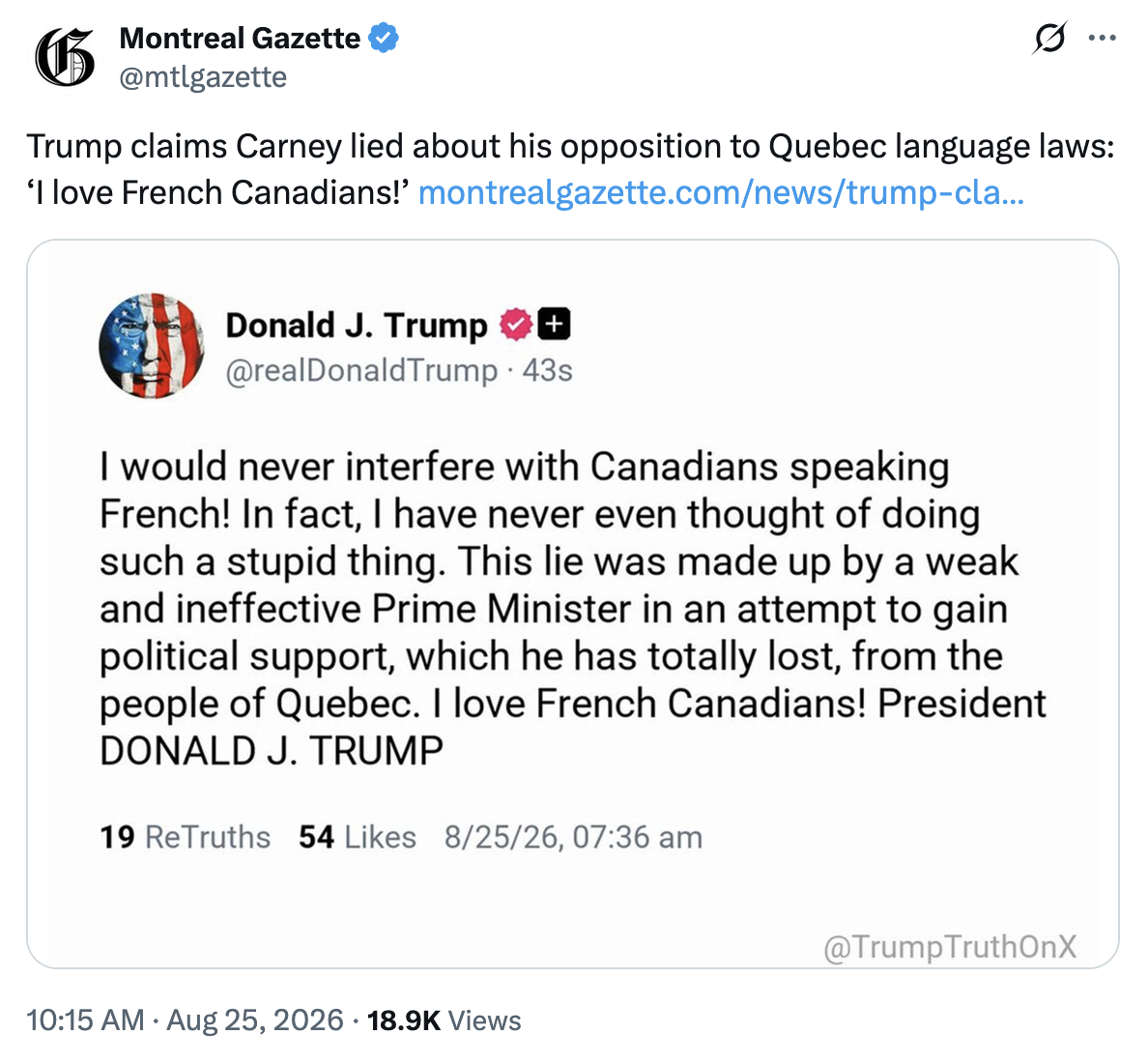
It was not an entirely far-fetched idea given that Quebec and the American colonies were not entirely happy being subjects of Great Britain.
During the American War of Independence, the Continental army (note the ambitious name) invaded Quebec with the aim of seizing the French-speaking territory. The idea was to make Quebec the 14th Colony. A December 1775 attack on Quebec City, led partly by the infamous Benedict Arnold, failed miserably. The troops lingered in the fortified city; nearly starving, they ventured back to Fort Ticonderoga the following spring.
The stubborn Americans wouldn’t give up. Article XI of the Articles of Confederation, the unsuccessful precursor of the American Constitution, openly invited Canada to join the new republic. In fact, Canada was granted automatic, unconditional entry if it so desired.
The article acknowledged Canada as unique. “No other colony shall be admitted,” the article stated, “unless such admission be agreed to by nine states.” There was no mention of Greenland. Canadians didn’t jump at the opportunity.
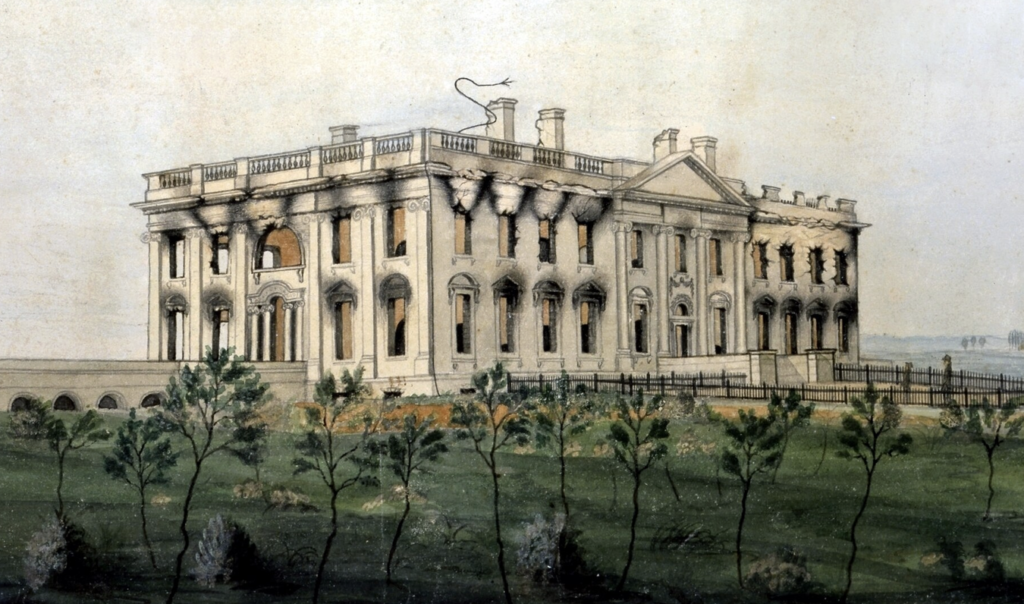
The White House following its burning by British troops on August 24, 1814/George Munger, artist
During the War of 1812, the Americans invaded Canada again. But the British and their Canadian subjects, with vital help from the Shawnee chief and public speaker Tecumseh, repelled the Americans a second time. Laura Secord, a Loyalist who overheard American military plans and warned her fellow countrymen, remains a Canadian hero to this day — complete with a chocolate and ice cream empire named in her honour.
That war ended with no territorial changes in 1815, six months after the August 1814 burning of Washington by British troops in retaliation for the burning and looting of York the previous year. A new sense of Canadian identity was born from the struggle. British settlers, French Canadians and First Nations had united in defence of Canada’s separateness against multiple American attacks, laying the groundwork for the Confederation formed in 1867.
In subsequent years, there were incidents and skirmishes.
In 1837, after the failed Upper Canada Rebellion of William Lyon Mackenzie, British militiamen and law enforcement briefly entered U.S. territory to seize the American steamboat and rebellion supply ship the Caroline, set it ablaze and sent it tumbling over Niagara Falls. The incident itself blew over but what became known as the “Caroline test” still informs the principles of international law dealing with self-defence and the pre-emptive use of force to this day.
In the winter of 1838-39, there was a border timber-rights dispute between armed Maine and New Brunswick lumberjacks known as the Pork and Beans War (named for the daily lumberjack diet) or the Aroostook War. The U.S. Congress sent troops, but not a single shot was fired. The dispute was ultimately resolved by Secretary of State Daniel Webster and Alexander Baring, the 1st Baron Ashburton, with the signing of the Webster–Ashburton Treaty in Washington in 1842.
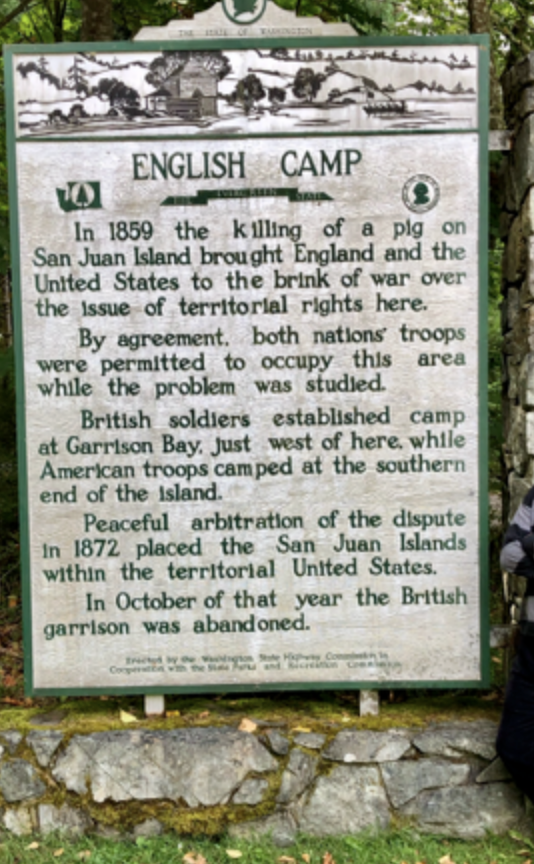
Pig War monument, San Juan Island/Wikipedia
Then came the so-called Pig War in 1859, named for an incident on San Juan Island (now part of Washington State), whose ownership was then disputed between the Americans and the British. When an American farmer shot a pig owned by an Irishman employed by the Hudson’s Bay Company, the dispute escalated, with warships and soldiers facing off. Cooler heads prevailed as both sides realized a war over a dead pig made might seem excessive.
The border became a hot zone during the American Civil War as Great Britain sent thousands of troops to the border to guard against an American incursion.
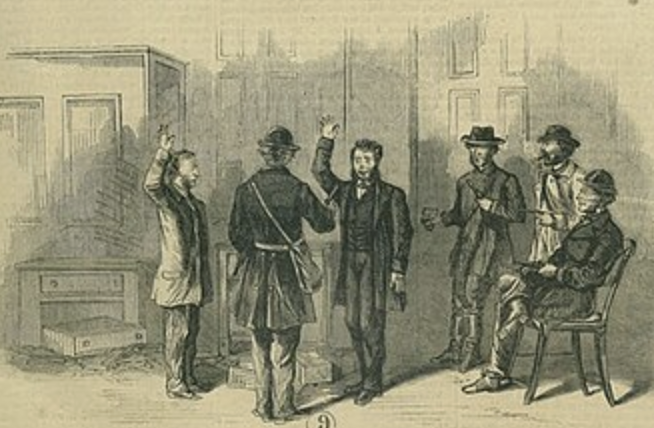
St. Albans raiders forcing bank employees to swear an oath to the Confederacy/Uknown
In the St. Albans Raid of 1864, 21 Canada-based Confederate agents crossed the border into Vermont, robbed three banks, killed a civilian and returned to safety in Canada. A Canadian court released the agents, to the outrage of Union partisans. A Union general threatened to invade Canada in hot pursuit of future invaders. Tempers cooled, and a separate war was avoided.
But in 1866, the lasting tensions convinced the United States to revoke the Reciprocity Treaty of 1854, ending free trade. (History seems to be repeating itself nearly two centuries later.)
In 1866 and again in 1870-71, the Fenian Raids saw battle-hardened Irish veterans of the Civil War stage a series of incursions on Crown targets in Canada to pressure Britain to grant Irish independence. A Canadian militia fought off the invaders. Repelling the raids was seen as a unifying factor among the provinces, and one that drove momentum toward Confederation.
Finally, the Alaska Gold Rush incited the Alaska border dispute over the Alaska-British Columbia boundary, which was resolved by arbitration in 1903.
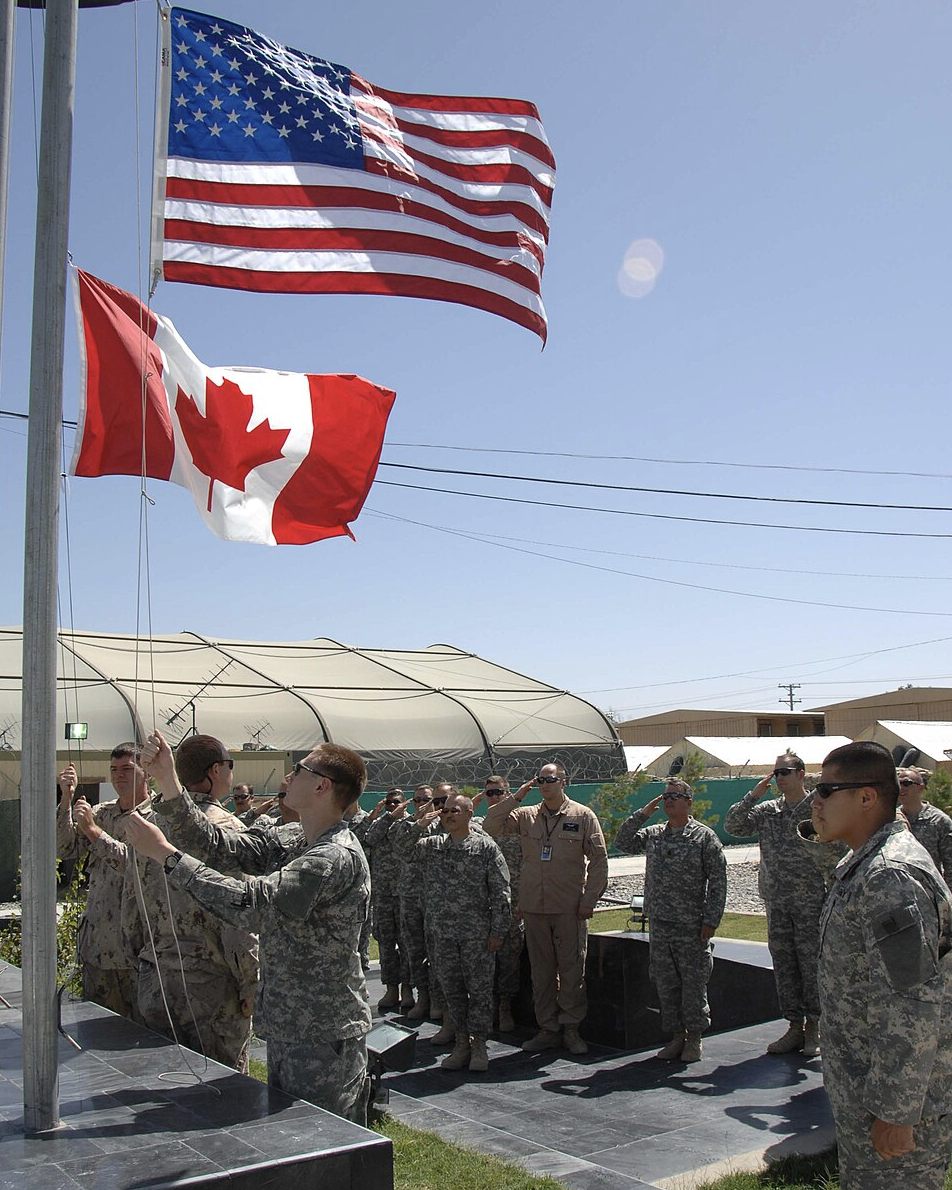
Canadian and U.S. troops in Bagram, Afghanistan, in 2007, on the
65th anniversary of the joint WWII 1st Special Service/US Army
Sparks died down in the 20th century, in part because relations between the United States and Great Britain grew closer. Americans and Canadians fought together in World War I and World War II, and more recently side by side in Korea and Afghanistan.
The relationship has also been defined by shows of solidarity — from the sheltering of U.S. diplomats by Canadian Ambassador Ken Taylor during the Iran hostage crisis to the overwhelming generosity Newfoundlanders displayed in welcoming U.S. travellers stranded by 9/11.
Despite differences over the Vietnam War and the Iraq War, the long Canadian-U.S. border has been free of tension for many decades – until recently. The George W. Bush administration was not happy with Canada’s stance on Iraq but there was none of the hostility we see today out of Washington.
Perhaps this is why Prime Minister Mark Carney appears far more confident in defying President Trump than do other Western allies. Carney has gained international prestige for his stance, and he must know that many Americans are cheering him on.
Waging a trade war against a peaceful neighbour based on a casus belli less coherent than a dead pig is an insult to people on both sides of the world’s longest undefended border.
As the New York Times Canada bureau chief in the early-to-mid aughts, I did experience some tensions during the U.S. invasion of Iraq, particularly in Toronto. There were some minor, rude episodes but I found most Canadians to be friendly and polite to me, and happy to explain their country.
From what I know of Canadians, do I think it’s possible that Trump will one day replace Montreal Gazette backer Benjamin Franklin on the $100 bill to celebrate his own conquest of Canada? Don’t bet your Bitcoin on it.
Clifford Krauss was the New York Times bureau chief in Canada between 2002 and 2006. His daughter was born in Toronto. He is the author of The Mirror of History Substack.