
Donald Trump and the Quebec Election

August 27, 2026
When asked on Thursday morning to name her “principal adversary” in the campaign she had just launched for the scheduled October 5th Quebec election, premier and Coalition Avenir Québec (CAQ) leader Christine Fréchette did not say, “The leaders of the other parties,” “Quebec independence”, or “21st-century malaise”.
“My adversary is Donald Trump; he is the real adversary,” Fréchette replied. “He is the one who truly threatens Quebec and Quebecers.”
Because Donald Trump loves tariffs even more than he loves French Canadians, he is now l’ennemi public numéro un in la belle province. How will that impact the next 39 days?
One seriously undervalued attribute of chaos actors is that chaos, by definition, doesn’t always produce the outcome its purveyors intend. In tactical terms, it is deployed to trash the status quo with previously unthinkable preposterousness and create a reality in which normal is dead and anything is possible.
In other words, if at any previous point in our bilateral history, a president of the United States had sat at the Resolute Desk and announced he was renaming by executive order Lake Ontario to Lake America, we’d have assumed we were watching a Saturday Night Live cold-open presidential cameo.
As it is, because this isn’t Trump’s first outing as a hydronymy hacker, we are less surprised than morbidly fascinated — a trolling response for which Trump is happy to settle as diversion fodder while the geopolitical gangsterism of his bilateral trade war takes on a life of its own sans (that’s French) Canada as a daily enabler.
Meanwhile, in Quebec, the Parti Québecois is leading in the polls but with a couple of asterisks. The first is that PQ Leader Paul St-Pierre Plamondon has been the beneficiary of relatively late-breaking leadership chaos in the Quebec Liberal Party that saw Pablo Rodriguez resign last December — six months after his election as leader — over an incriminating text message sent by a party apparatchik implying a vote-buying scheme in his leadership race. He was later cleared.
Charles Milliard, who succeeded Rodriguez, is relatively inexperienced and lacks the name recognition of the former federal cabinet minister he replaced, especially among the allophones on the Island of Montreal who represent a reliable chunk of the LPQ’s base.
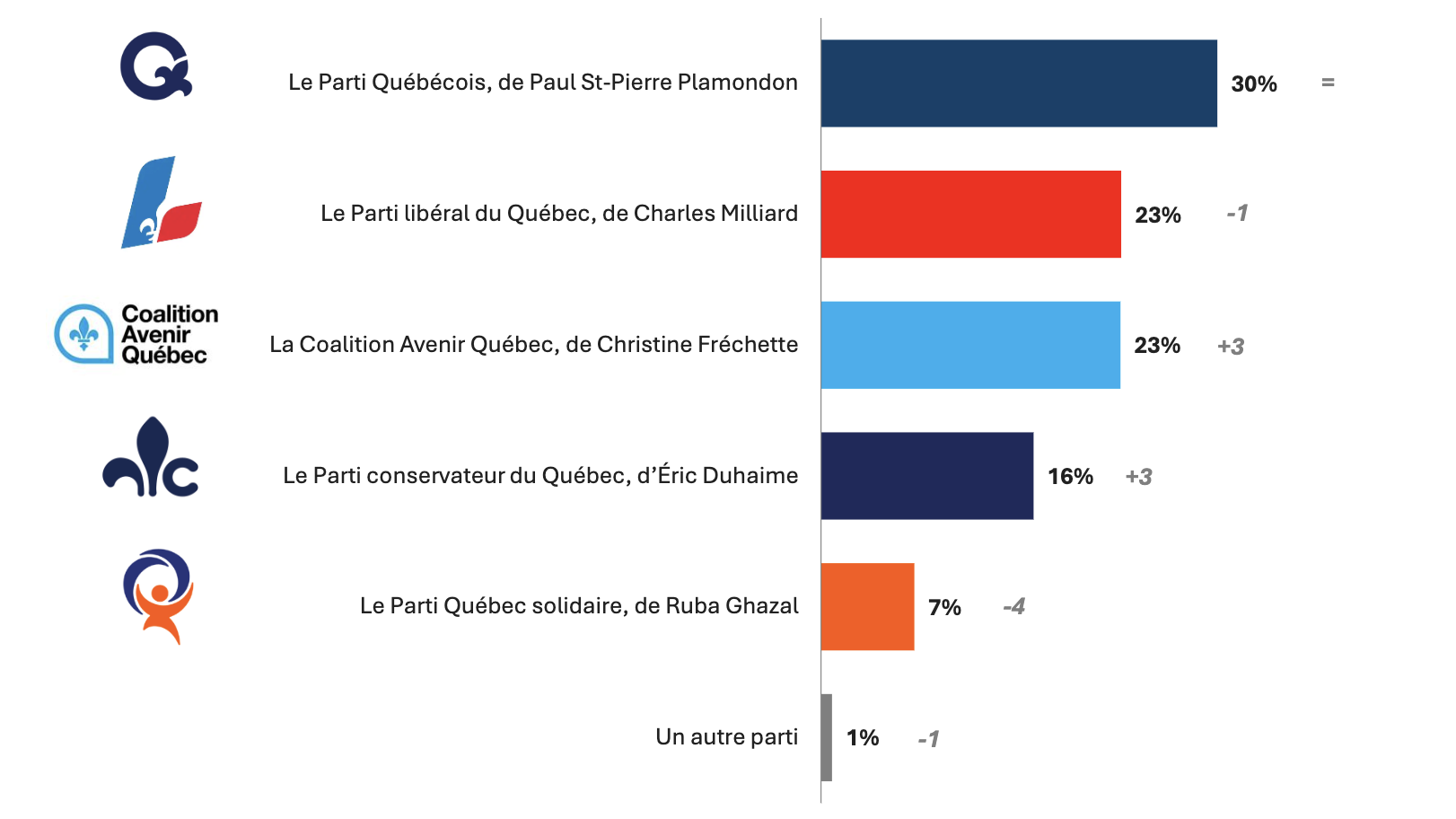 Leger poll results published August 24, 2026
Which means that the political party conventionally tasked with neutralizing the threat of an independence referendum activated by an election mandate is in a weaker position than it otherwise would be.
St-Pierre Plamondon has attempted to further defuse the longstanding binary ballot question that has dragged the PQ’s prospects when support for independence is low — it is now at just 31% — by postponing any independence referendum until after Donald Trump is out of office which, at this rate, could happen by Canadian Thanksgiving if the 25th amendment is finally, mercifully activated on insanity grounds.
This decision is meant to decouple a vote for the PQ from a vote for independence as a means of disarming St-Pierre Plamondon’s main opponent, who is not Donald Trump but Fréchette.
For her part, Fréchette is benefiting from Trump’s chaos-driven trade war against Canada in a way that is enabling her to shake the CAQ fatigue induced by 8 years of François Legault and usurp the Liberals as the safe, known-quantity alternative to the PQ in a moment of economic and existential peril.
Her appearances with Prime Minister Mark Carney last week at the announcement of the new Churchill Falls hydro project — billed as the largest clean energy investment in North American history — and this week at the Davie Shipyard in Lévis to unveil $11 billion plans for six new icebreakers, underscored Fréchette’s power as the sitting premier in this campaign.
They also associated her with Carney, ranked in some polls as the most popular political figure in the province, and one who has just burnished his credibility in the province by defending French language and culture in walking away from Trump’s tariff deal.
A lot can happen during an election campaign, especially in an era of narrative warfare in which so many consequential election and referendum campaigns become storyboards of cunning stunts, misrepresentation, arsonist dumpster fires, absurd propaganda, and un-ignorable sideshows.
Fréchette is correct to say that Trump is her main opponent in this election, but Trump is just one element of a wider war on democracy.
If Danielle Smith could only articulate with the same clarity as have Plamondon and Fréchette the connection between the socioeconomic destabilization of Donald Trump and the referendum she’s declining to postpone , the country might survive this attack — to use the prime minister’s word — in one piece.
Policy Editor and Publisher Lisa Van Dusen has served as Washington bureau chief for Sun Media, Washington Columnist for the Ottawa Citizen, international writer for Peter Jennings at ABC News, and as an editor at AP National in New York and UPI in Washington.