
Canadians Prefer Trade Peace but Support Defensive Economic Measures
September 6, 2026
Canadians are following the Canada-U.S. tariff dispute like they’ve followed few issues in the 45 years I’ve been measuring public opinion.
While the jibes aimed at Canadians from the current U.S. administration are hard to miss, if Donald Trump, Howard Lutnick, Scott Bessent, Jamieson Greer, and Pete Hoekstra think Canadians are wilting in the face of the insults and threats, they are very much mistaken.
From our latest Spark Insights polling (6345 adults, online, August 26-September) here’s where the mood of the country is:
An impressive 83% say: “I really hope we can get back to the kind of friendly and mutually beneficial relationship that we once had with the US.”
There has never been any question of what outcome people are looking for.
The Canadian mindset is: “Why did you agree to trade agreements that you said were in your interests, only to renege on them, claiming that they were one-sided and a rip off?”
The notion that selling our oil to Americans is ripping them off seems ludicrous to Canadians. The president said that if America stopped buying from Canada, they would just save the money and be better off. It’s a head-scratcher.
Canadians have hoped that a spirit of serious discussion would work to end the White House rhetorical and tariff escalation. But we knew hope wasn’t a strategy, and that the U.S. President might not be open to reason.
Trump’s tariff policy is a deadweight for the Republican Party in the run-up to the November 3rd midterm elections, but he’s busy posting memes and building monuments to himself.
Meanwhile, Canadians have been getting on with a parallel effort to expand trade and investment relationships with the rest of the world. The response has been unprecedented.
In a matter of days, investors from around the world will be in Toronto to explore the many opportunities to build with Canadians.
Public opinion polls by our company and others have made it clear that Canadians are giving Prime Minister Mark Carney and his team a good amount of latitude to make the choices they feel are best, in dealing with US tariffs. No one wants more tariffs, but pretty much everyone is willing to stay in the fight, including supporting some ideas that would have seemed out of the question a couple of years ago.
About 80% would be willing to support export restrictions or export taxes on Canadian oil and canola, export restrictions on potash and electricity, and an end to purchases of U.S. military equipment. There is virtually no difference in the level of support for each of these hypothetical measures.
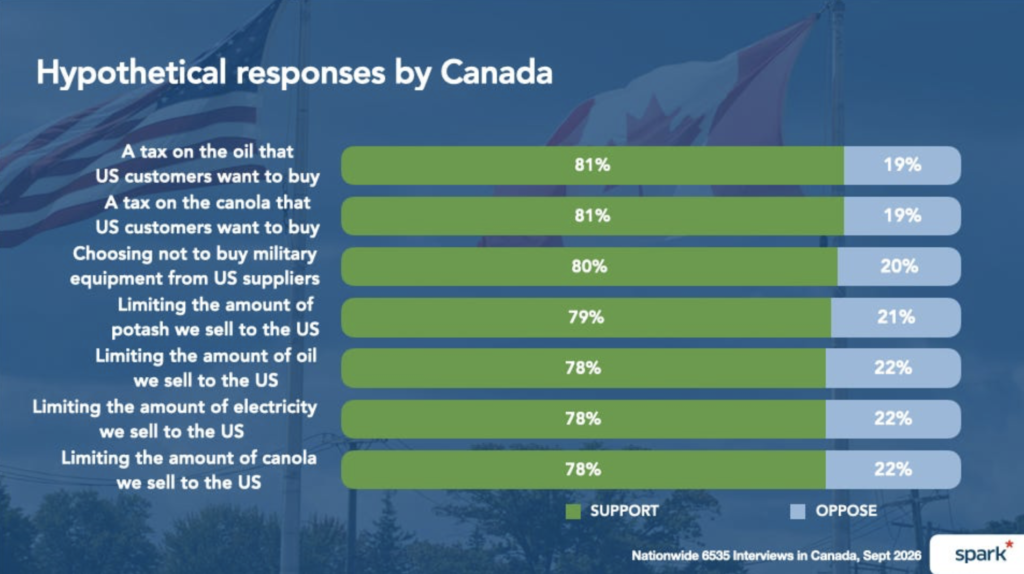
You may wonder if this is regionally divisive. The range of support for these measures is between 74% and 78% in Alberta, only a few points below the national average.
What about partisan divides? Two out of three Conservative voters would support limiting or taxing our oil exports to the U.S. This is more or less the political equivalent of unanimity.
That people would support these measures doesn’t mean that they hope to see them.
The proper analysis is that people don’t actually want these things to happen. But they are willing to stand their ground and use whatever tools might be most effective to bring the Trump administration to a place where it wants to stop trying to destroy our economy so that it can annex our country and take our resources.
Canadians do not believe that this is what most Americans want.
They do see it as unmistakably the agenda of Donald Trump and his fellow travellers. Equating us to “a little yippy dog”, as Treasury Secretary Scott Bessent just did in a Fox News interview will make us neither weep nor bend.
If President Trump imposes yet more pain and cost on Americans doing business with Canada, Canadians are very unlikely to waver.
And then it will be up to Americans to decide what kind of relationship they want with Canada.
Policy Contributor Bruce Anderson is Founding Partner and Chief Strategy Officer of Spark Advocacy. He has been a pollster, political strategist and communications advisor for more than 40 years and is a regular on The Bridge podcasts. He was an active supporter of Mark Carney during the Liberal leadership campaign and federal election.