
‘Surviving Chaos’: Thinking Like an Artisan in the New World ‘Un-Order’
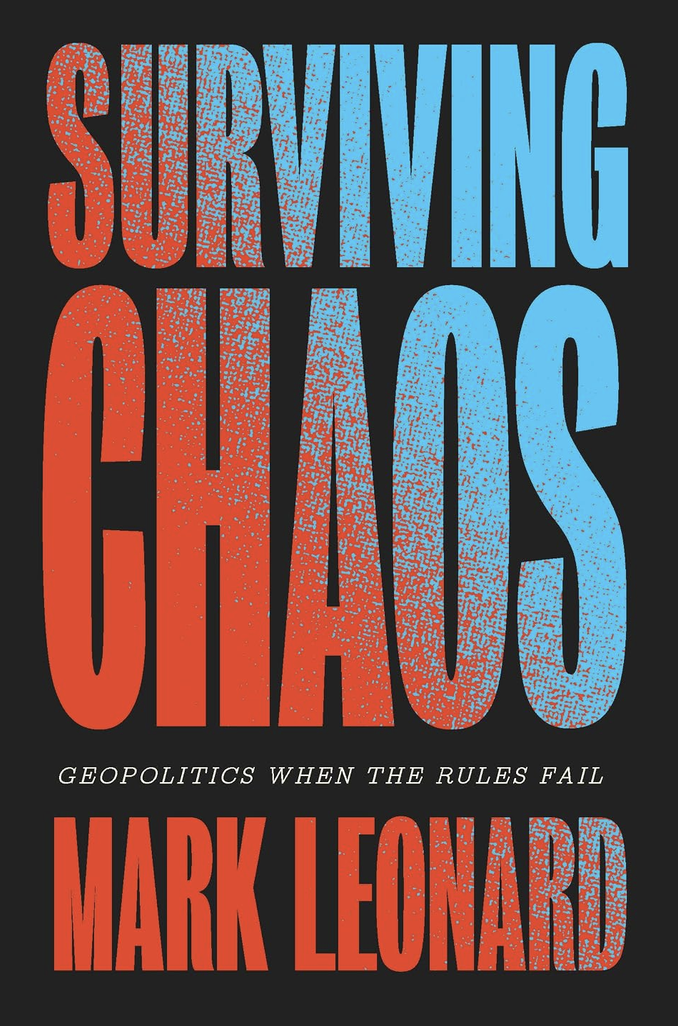
Surviving Chaos: Geopolitics When the Rules Fail
By Mark Leonard
Polity Books, June 2026/208 pages
Reviewed by Colin Robertson
September 14, 2026
Mark Leonard is co-founder and director of the European Council on Foreign Relations, and he has written an uncomfortable read for those of us who’ve spent our careers believing that rules mattered.
Leonard’s message in Surviving Chaos: Geopolitics When the Rules Fail is that the old rules-based order is not simply under stress, but that it may be giving way to what Leonard calls “Un-order”: a world in which the rules, institutions and assumptions of the postwar system no longer command enough authority or power to shape behaviour.
For Canada, this is not an academic argument. We built our prosperity and security around the United States, NATO, open trade and multilateral rules. Leonard’s question is therefore ours: what does a middle power do when the architecture remains standing but some of its foundations have shifted?
Leonard’s answer is to think less like an architect and more like an artisan.
“Architects design and build grand structures from scratch,” he writes. Artisans “repair, restore and adapt using inherited materials and practical knowledge.” In a predictable world, architects prosper. “But in a complex world of constant change, the artisans have an edge.”
While it’s a bit precious – we saw the Americans as the architects of the postwar order and Canadians as engineers — the distinction provides a useful way to assess Mark Carney’s emerging foreign policy.
Carney’s values-based realism, his talk of variable geometry, and his preference for coalitions of the willing all sound distinctly artisanal. The aim is not to abandon NATO, the UN, the G7 or the existing trade system. It is to work around institutional paralysis by assembling different partners for different purposes.
The timing could not be better as Canada and Europe are wrestling with Leonard’s central problem at exactly the same moment: how do successful architects of the old order adapt to a world they can no longer order?
Leonard sees Donald Trump as an accelerant of this global power hack rather than the underlying cause.
The deeper forces are structural. In Surviving Chaos, he groups them under the deliberately explosive label “C-4”: capital, climate, chips and civilization.
Capital describes the weaponization of economic interdependence. Sanctions, tariffs, currencies, energy, critical minerals and supply chains have become instruments of state power.
Climate is no longer simply an environmental challenge; it is an industrial and geopolitical contest.
Chips stand for AI, semiconductors, quantum computing and the other technologies increasingly determining economic and military advantage.
Civilization refers to the shift away from several centuries of Western predominance toward a more plural world.
China, in Leonard’s telling, grasped this earlier than much of the West.
Beijing pursued economic security while Europeans were still “singing the gospel of free trade.” It invested in solar power, electric vehicles, rare earths, AI and industrial automation. Its method was experimental rather than doctrinal: Deng Xiaoping’s famous practice of “crossing the river by feeling for stones.”
Leonard is not urging Canada or Europe to copy Chinese authoritarian capitalism. He is arguing that democracies need to rediscover the ability to experiment, invest, fail and adjust.
Here his argument fits Carney well.
Trade diversification is not about replacing the United States. Geography makes that impossible. It is about reducing vulnerabilities. Canada needs deeper economic ties with Europe and the Indo-Pacific, a more strategic relationship with Mexico, and practical partnerships around critical minerals, energy, technology and defence.
Canada’s growing European connection is already tangible. Ottawa has become the first non-European participant in the EU’s SAFE defence initiative, and Canadian firms are beginning to win contracts through it. Canada and the EU are also broadening cooperation in energy, climate, technology and critical minerals. The European Union is opening an antenna office in Ottawa to strengthen political dialogue.
That is variable geometry in practice. But Leonard offers an important warning to Carney.
In his recent Foreign Affairs essay, “The Abandoned Order,” Leonard argues that middle powers risk trying to preserve “the form of the old order without its substance” — especially the American power that enforced it. “The old rules-based order was never, in fact, just about rules,” he writes. Rules worked because a powerful United States was prepared to bear disproportionate costs to uphold them. Middle powers cannot simply pool their resources and recreate American hegemony.
We should hedge against American unpredictability but we should not bet on permanent American estrangement. Our strategy should be resilience, not divorce.
In his conversation with Foreign Affairs editor Dan Kurtz-Phelan, Leonard goes further. Much Western policy, he says, resembles “grief management” more than strategy. He specifically challenges Carney’s rhetoric of rupture: if the rupture is real, governments must change behaviour, not simply talk about it.
It is a fair challenge.
Coalitions of the willing sound good. But willingness without capability does not deter Russia, build a semiconductor plant or open a blocked sea lane. Networks matter only when members bring something useful.
For Canada, that means strength at home.
Carney’s Build Canada agenda is therefore not separate from foreign policy. It is its foundation.
If we want diversified trade, we need ports, railways, energy corridors and digital infrastructure that get Canadian goods to markets beyond the United States. If we preach freer trade abroad, we should finally remove needless barriers among our own provinces. If we claim Arctic sovereignty, we need ships, submarines, surveillance systems, infrastructure and people capable of exercising it.
The same applies to defence. Leonard argues that allies should not simply copy America’s enormously expensive military model. Ukraine has shown how drones, software and cheaper technologies can offset more costly platforms. Canada’s rearmament should therefore be linked to industrial policy: shipbuilding, aerospace, drones, cyber, AI, sensors and Arctic technologies.
Climate offers another Canadian opportunity. Leonard argues that China made climate policy part of national economic development and security, treating adaptation “as a competitive space.” Canada can do something similar without abandoning emissions reduction. Our hydroelectricity, uranium, critical minerals, natural gas and clean technologies can serve climate objectives while strengthening energy security and export capacity.
A climate policy that produces cleaner energy, better jobs and greater resilience stands a better chance of surviving democratic politics than one presented primarily as sacrifice.
Where I differ from Leonard is on the permanence of American decline.
Kurt Campbell and Rush Doshi make the stronger counterargument in their Foreign Affairs discussion with Leonard. Alliances have survived Suez, Vietnam, Nixon’s economic shock and earlier bouts of American unilateralism. The forces holding allies together — China and Russia, technology, markets, intelligence and defence integration — remain substantial. They warn that declaring the alliance system dead can become a self-fulfilling prophecy.
That seems particularly relevant to Canada.
We should hedge against American unpredictability but we should not bet on permanent American estrangement. Our strategy should be resilience, not divorce.
Leonard’s central insight nevertheless stands. Canada cannot wait for someone else to restore yesterday’s world. His Foreign Affairs essay compares the abandoned international order to China’s unfinished “rotten-tail” apartment buildings. The successful inhabitants do not wait for the original developer to return. They improvise, salvage what works and make the structure habitable.
Canada need not squat in the ruins just yet. But the metaphor has bite.
Europe and Canada still believe in open societies, alliances and rules. Neither should abandon them.
But both need more power behind their principles.
Carney’s values-based realism supplies the compass. Variable geometry supplies the method. Coalitions of the willing provide partners. Building strength at home supplies the leverage.
Canada should remain an architect where architecture still works. But Leonard is right that we also need the habits of the artisan: adapt quickly, build capacity, diversify risk and stop conflating yesterday’s institutions with tomorrow’s strategy.
Values without capabilities become aspirations. Alliances without resilience become dependencies. And rules without power eventually become suggestions.
Contributing Writer Colin Robertson, C.M., C.D., a former career diplomat, is a fellow and host of the Global Exchange podcast with the Canadian Global Affairs Institute in Ottawa.