
UNGA 2026: President Khalilur Rahman’s Agenda for UN Reform
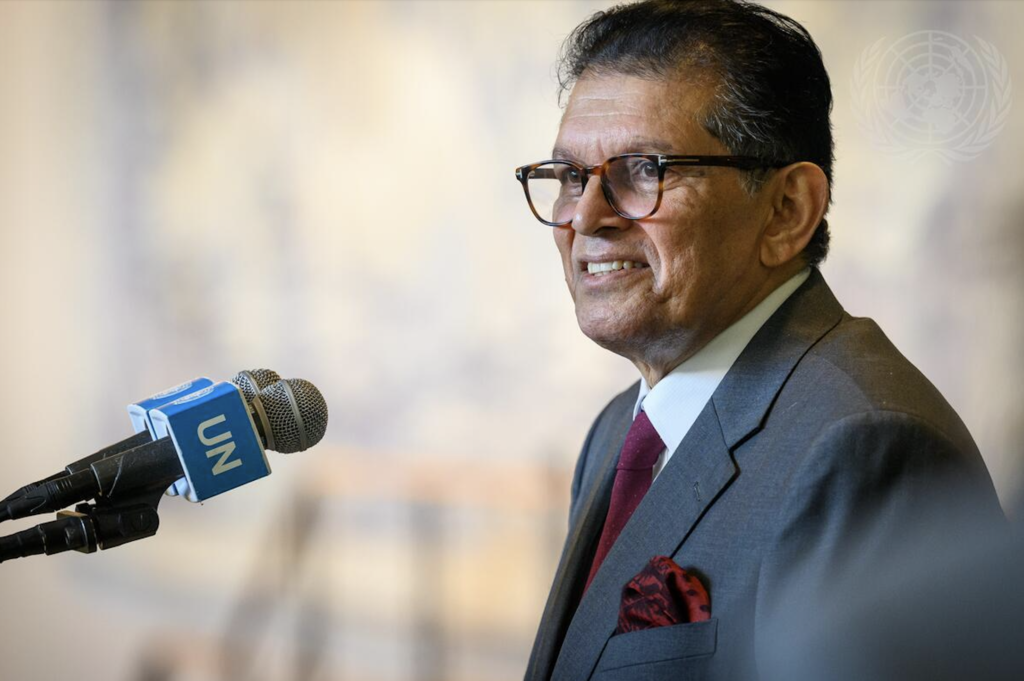 UNGA President Khalilur Rachman addressing reporters on September 8th, 2026/UN Photo
By Anil Wasif
September 20, 2026
In 1986, a young Bangladeshi diplomat named Khalilur Rahman stood in the United Nations General Assembly Hall for the first time, as staff to its new president, Humayun Rashid Choudhury, his own foreign minister and the first Bangladeshi to hold the gavel.
On September 8th, at the opening of the 81st Session of the UNGA, Rahman recalled the optimism of that year, and the awe. Forty years later, he held the same gavel, having won it in June by 99 votes to 91. Rachman’s first line to the press as UNGA president was a context delineation:
“This is not 1945. The world has moved on. The organization must move on.”
Rachman’s speech gave the year six priorities, each with a name, and one demand: that every member pay its dues “in full, on time, and without conditions.” Some of the six he can act on himself. Others belong to rooms he does not control.
1. Peace and Security: Silencing the guns comes first, and it is the one he has the least say over. Peace and security belong to the Security Council, fifteen countries, five of whom can block any decision alone. Rahman cited the 200,000 Bangladeshis who have served as UN peacekeepers, and the body he now runs cannot send a single one anywhere. But it has a lever. When the council deadlocked over Suez in 1956, because two of its permanent members were the ones invading, the assembly met in emergency session under the Uniting for Peace rule it had written six years earlier, and Canadian foreign minister Lester Pearson proposed a force to separate the armies. It passed 57 to nothing. Peacekeeping was invented in the room Rahman now chairs, and eleven times since, members have asked a president to convene it within 24 hours. Asked this week what he says to those who call the assembly toothless, he answered that if it were useless there would be no high-level week. That is true, and it is not the same as power. The question for his year is whether that lever is a relic or a tool.
2. Sustainable Development: No one left behind is where his own country is the test. The category is the UN’s invention: in November 1971 it created the least-developed country (LDC) classification and named the first 25. Bangladesh, independent that year, was among them, and is now due to graduate out of that label on November 24th, in the middle of his presidency. It has asked for three more years. The UN’s expert committee called an extension warranted, and in July the question went to the assembly. Canada has a tariff line riding on it: Bangladeshi garments enter duty-free under the LDC country tariff, and Ottawa’s legislated three-year runway after graduation would slide from 2029 to 2032. A president presiding over his own country’s reprieve should be seen to hold the gavel and nothing else.
3. Climate Action: This has a date; the sea-level rise meeting on September 24. The assembly convenes well. It brought the world to Stockholm in 1972 and built the environment program that followed. What it has never done is capitalize a fund. What a president can do is ensure small island states are in the room when funding is discussed, rather than just in the high-level meeting that will talk about their problems.
4. Human Rights: Rights and protection is the UN’s proudest invention and its least funded. It adopted the Universal Declaration of Human Rights in 1948, before there was a Human Rights Council or a High Commissioner, and built both later. Today, the pillar takes about 4 per cent of UN spending, against roughly a quarter each for peace and development, by the Dag Hammarskjöld Foundation’s count. Bangladesh shelters more than 1.2 million Rohingya, and when Secretary General Antonio Guterres visited Cox’s Bazar last year, 100,000 of them came holding placards that read “we want to go home,” he recalled. His lesson: “Violence will not solve any problem. It will only defer it.” The UN can fund the camps. Going home requires Myanmar. What Rahman can do is refuse to let that 4 per cent fall further while the reform is written.
5. Technological Transformation: Or inclusive innovation, it is the one of the changes since 1945: artificial intelligence, with guardrails, without slowing it down. The UN’s instruments are a year old, a scientific panel and a Global Dialogue created in 2025, whose outputs so far have been summaries. The tool belongs to companies, not states. The ambition worth having is not a treaty but a standing seat: making the panel’s findings something members answer to rather than receive.
6. Restoring Multilateralism: Where the priorities above get paid for, and the Assembly has been here before. In 1964, the Soviet Union and France refused to fund peacekeeping they had not authorized, their arrears crossed the line at which the UN Charter strips a member of its vote, and rather than force the question, the assembly spent a whole session taking no votes at all. It survived by not deciding. The bill is larger now. At the end of April, unpaid regular-budget assessments stood at $2.8 billion and unpaid peacekeeping assessments at $3.5 billion, against a $3.45 billion regular budget for the whole year, and one member, per the Group of 77, “continues to account for a disproportionate share.” Washington paid nothing in 2025 and in August told Congress it plans to pay $850 million, conditional on reform. The money has not moved. Canada paid its US$81.4 million in full on January 14. In his speech, Rahman’s “without conditions” and “every penny” were aimed at the White House.
Reimagination does not always need to be grand. Rahman wants to “unlock” the UN for civil society, he told reporters. BacharLorai Global (BLG), the community-led research and welfare organization for which I volunteer, is finally accredited, and on September 25th, I will accompany a few of our best and brightest at a high-level meeting of the General Assembly. The UN’s Indico registration system asked each of our delegates for a passport-style photograph, a pdf version of a signed letter of representation on our letterhead, demographic information, corporate information, identification documents, and a 300-word statement for a potential two-minute speaking slot. Any person doing this for the first time will feel the UN’s age. A shorter form takes one memo from the GA President and six months from a team of experienced customer relationship management (CRM) experts to save crucial hours for thousands of organizations.
Reimagination is tough, but it’s happening. On September 17th the Assembly voted 152 to 3 to let Palestine take part by special arrangement after the host country refused its delegation visas for a second year. The United States voted no, as it had a year earlier.
The next secretary-general will be chosen in a room in which Rahman does not sit. Five of the eight candidates are women, in a process the assembly opened last November by urging members to “strongly consider” a woman, none having yet held the post. On September 18th, the UNSC’s third straw poll put Costa Rica’s Rebeca Grynspan back ahead of Guyana’s Carolyn Rodrigues-Birkett, nine votes to eight. Rahman has promised to run his end “fair, inclusive, and transparent,” which is all of it he holds.
Pew Research reported in September 2025 that adults under 35 like the UN more than their parents almost everywhere. Asked what he would want to look back on, Rahman did not name a priority. He named a test. If members agree on reform, agree to keep the organization solvent, and agree to speed up delivery on the ground, “if I have some movement on any of these, I’ll happily hand over my gavel,” he said.
The first belongs to the members, the second to the largest contributor, the third to country teams doing more with less. In San Francisco on June 25, 1945, when the Charter was put to the vote, every delegation rose and stayed standing. Rahman recalled that day as a reminder that trust can be visible. His performance over the next year will convince us whether he can do that again, with the powers bestowed.
Policy Columnist Anil Wasif is a public servant in the Ontario government. He serves on the University of Toronto’s Governing Council and the Advisory Board of McGill’s Max Bell School. Internationally, he serves on the OECD’s Infrastructure Delivery Committee and the Board of Trustees at BacharLorai Global. The views expressed are his own.