Canada at the UNGA: Reform, Renewal, and the Courage to Act
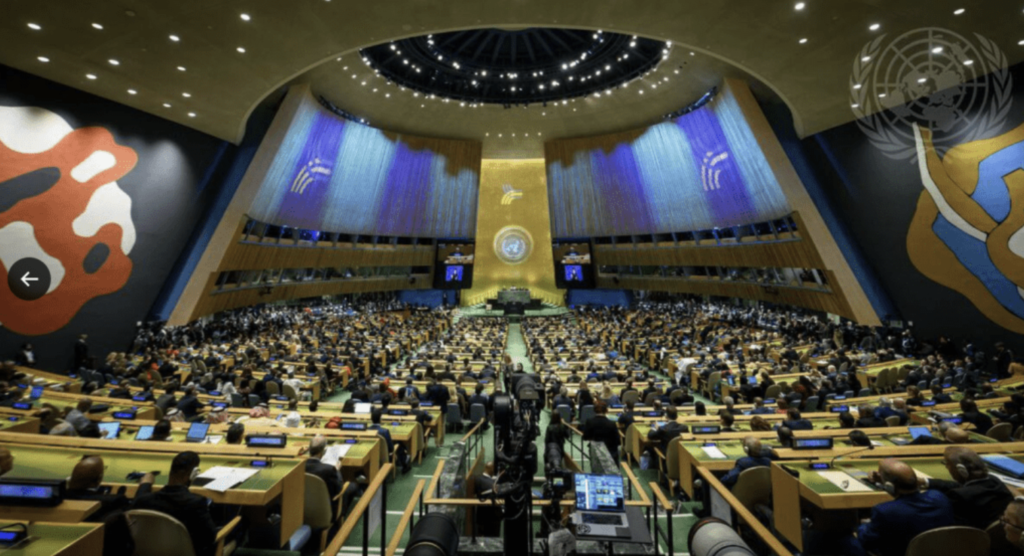 UN/X
UN/X
September 21, 2026
As the general debate of the 81st General Assembly of the United Nations gets underway this week, the UN remains indispensable, but it needs repair—and governments willing to make it work.
A divided world needs somewhere to meet — and machinery that keeps working when diplomacy fails.
For Mark Carney, this week’s visit to New York will offer a practical test of values-based realism. Can Canada and its partners protect the international system on which their security depends? Can coalitions of the willing deliver where wider agreement fails?
Canada brings substance to these conversations. Canadians should know that Canada is the UN’s sixth-largest donor, contributing over $2.2 billion in 2024. Canada pays its mandatory dues fully and on time.
The backdrop to this year’s UNGA is grim. Uppsala University researchers recorded 65 armed conflicts involving at least one state in 2025, the highest annual total since their records began in 1946. UNHCR reported 117.8 million forcibly displaced people at the end of 2025.
Democratic resilience is weakening, too. The University of Gothenburg’s Voices of Democracy Institute’s 2026 report places only 26 per cent of humanity living in liberal or electoral democracies while 74 per cent live in autocracies.
The International Rescue Committee describes the current global situation as “more shocks, fewer shock absorbers”. Its analysis finds that the share of official development assistance reaching fragile and conflict-affected states fell from 43 per cent in 2013 to 25 per cent in 2024.
The machinery is being weakened just as the demands upon it are growing.
Renewal begins with leadership. António Guterres’s successor is expected to take office on January 1, 2027. The next secretary general must re-engage in personal diplomacy, encourage fresh proposals for resolving conflicts and win public support. Keeping relief operations going cannot become an excuse to abandon peacemaking.
Long criticized as a bloated bureaucracy, in March 2025, the UN launched UN80, a reform initiative marking its 80th anniversary. The secretariat’s internal reform initiative is driving budget changes, job relocations and discussions about merging agencies.
But cutting expenditure is not a strategy. Priorities should be reliable funding, fewer overlapping mandates, stronger mediation and properly equipped field operations.
The veto-prone Security Council — long a topic of organizational criticism internal and external — also needs an overhaul.
Africa and other under-represented regions need a stronger voice. Yet UN Charter amendments require ratification by all five permanent members: the United States, China, Russia, Britain and France. They hold the keys to changing their privileges.
Canada should pursue achievable improvements without pretending that institutional redesign alone will overcome political obstruction.
The UN’s utility extends beyond the council.
Smallpox eradication and ozone protection demonstrate what sustained cooperation can accomplish. Political paralysis must not become an excuse to dismantle practical achievements.
Ottawa should concentrate on work where Canadian money, expertise, and convening power can make a demonstrable difference, and explain those choices to Canadians.
Carney has identified priorities: ocean protection, maritime security, partnerships and institutional reform. Canada should match each with expertise, resources and partners prepared to sustain the effort.
The Prime Minister’s Davos address supplies a method: principled engagement, stronger domestic capacity and cooperation among middle powers. Variable geometry means assembling different partners for different purposes. Membership should follow the task and the capacity to contribute.
Artificial intelligence offers a test. Carney’s Strasbourg proposals include closer Canada–EU cooperation on AI. Canada, Europe and Britain should develop a funded program on safety standards, testing and transparency, open to others willing to participate.
The September 25th meeting on pandemic prevention, preparedness, and response offers another opportunity. Outbreaks do not stop at passport control. Disease surveillance, laboratories and resilient health systems deserve sustained investment.
Aid allocation is equally strategic. Partners should identify essential programs at risk, decide who will sustain them and publish what was promised, paid, and delivered.
Canada’s Ambassador to the UN, David Lametti should also cultivate partners beyond familiar allies, especially in the Global South. Shared concern is insufficient: effective coalitions need budgets, responsible ministers, measurable commitments, and deadlines.
Canada cannot promise everything to everyone. Middle powers cannot replace American or Chinese capacity. They can preserve cooperation where interests overlap and demonstrate that commitments still count.
Ottawa should concentrate on work where Canadian money, expertise, and convening power can make a demonstrable difference, and explain those choices to Canadians.
Defence, domestic investment, and international assistance compete for public resources. A smaller number of sustained commitments will achieve more than an expanding catalogue of announcements.
Ministers should return from New York with named partners and agreed next steps, then report on progress. The test is what survives after leaders leave Manhattan: services maintained and promises kept.
Lametti and his team should build on the effective diplomacy of his predecessor, Bob Rae, who served as president of the UN Economic and Social Council (ECOSOC). His parting advice should guide Canada’s efforts to renew the UN:
“Courage can be difficult. It means stepping out, standing up, trying to persuade people who don’t agree with you. But the thing we know about courage is that it is infectious. If some stand up, then others will stand up.”
The UN remains indispensable, but its members must make it work. When the great powers fail to lead, Canada and its partners must have the courage to act where they can.
Canada cannot compel others to honour their commitments. But we can keep our own — and give others reason to join us.
Contributing Writer Colin Robertson, C.M., C.D., a former career diplomat, is a fellow and host of the Global Exchange podcast with the Canadian Global Affairs Institute in Ottawa.