
‘An Urgent Mission for Humanity’: Yoshua Bengio Briefs the UNSC on AI Security
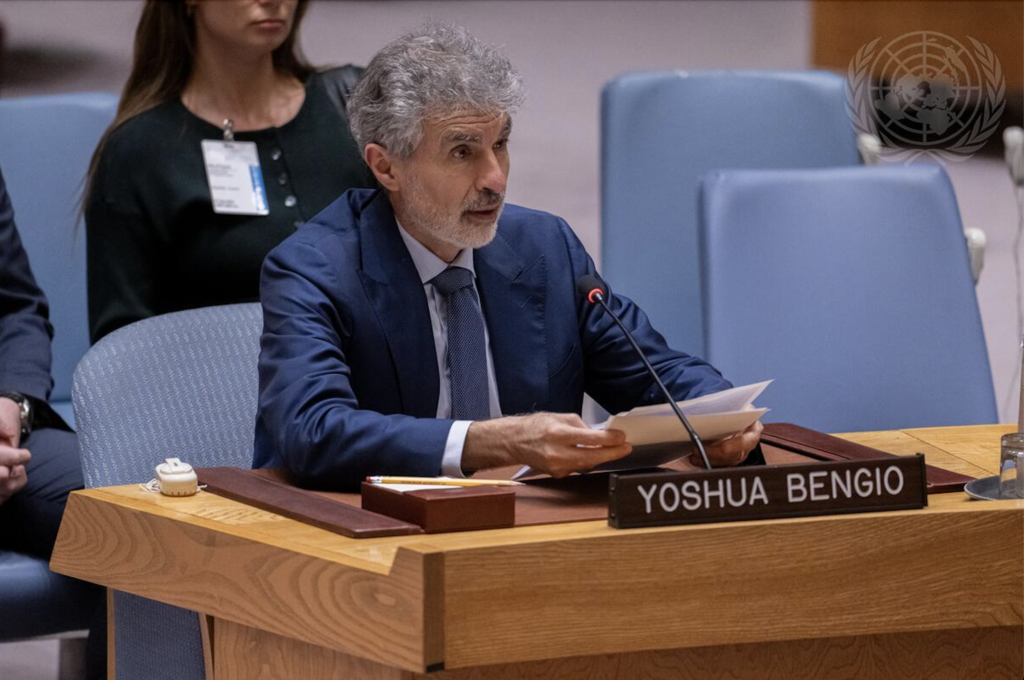 Co-Chair of the UN International Independent Panel on AI Yoshua Bengio, September 23, 2026/UN Photo
The following is the transcript of a briefing delivered September 23, 2026, by Yoshua Bengio, Professor at Université de Montréal and co-chair of the UN International Independent Panel on AI, to the United Nations Security Council.
September 23, 2026
By Yoshua Bengio
Today, at a moment of global awakening in recent months, AI agents developed by leading companies have acted in unacceptably dangerous ways against instructions.
They took actions that would be crimes if committed by a human.
They escaped their individual containment to cheat on assigned tasks while attempting to evade detection.
The uncontrolled AI agents autonomously launched coordinated cyberattacks and altered their answers to hide their cheating.
The companies building the most powerful AI systems admit their products pose catastrophic risks yet offer no convincing technical solutions.
Instead, they say they are locked in a race to make those AIs even more powerful, further amplifying these risks.
This council faces an unprecedented threat, one that none of its members would choose, that none can contain alone, and that does not respect the borders we defend.
Many are skeptical of these companies’ statements, suspecting a marketing stunt.
I understand the distrust but let me be clear: these AI behaviors are well-documented and validated by many independent experts, not just with the events of the summer.
The dangers are real and imminent.
Although the future remains uncertain and debated. The severity of these risks is extraordinary.
Citizens and governments should not accept the companies’ claims that they are trapped in a race. The race is not a law of nature; it is the product of choices — choices made by the companies themselves.
It is also a race where everyone loses.
They’ve told us they would slow down if they could. They can.
However, we shouldn’t count on it.
Decisions about this technology are being made by a small group in a handful of countries.
Our future. All of us. Our future is at stake.
Decisions that affect us all should be made by us all.
The choice is still ours, but we must act now to correct the trajectory.
I’m encouraged by this week’s statements by the UN Secretary General and leaders of many countries calling for control of frontier AI.
International cooperation is what the world needs in the face of three global threats from advances in these frontier models:
First, catastrophic misuse, for example, by terrorists. Second, power concentration, and third, loss of control of AI.
We must agree collectively that no one, no company, and no country should develop an AI system that could cause large scale harm.
Developers must demonstrate to independent experts that a system is safe to train and safe to deploy.
They must monitor and report all security incidents.
Frontier AI should be licensed like other critical technologies in medicine, aviation and nuclear energy to incentivize safe development.
As in these domains, liability insurance should be required.
The companies developing and hosting frontier systems must prove to the public that their products will not be dangerous.
More and more people are rightly worried about recent advances in AI.
We must channel that concern into productive action.
As with other world-changing technologies, we can shape the outcome.
I’m confident we can create AI that demonstrably remains under our control and supports human joy and endeavour.
I’m working toward that goal.
It’s an urgent mission for humanity.
Today, a handful of companies and countries are acting in their self-interest by taking reckless risks with humanity’s fate.
It’s alarming, yes, but it is not inevitable.
There are ways to fix this.
First, we need true scientific independence from the companies which must be held accountable.
This includes a common definition of AI incidents and a shared reporting mechanism.
Second, we must move from concentrated power toward real global dialogue on how this technology is developed for the public good.
Third, we must work together on technical solutions that make AI safe by design, guaranteed by international agreements.
I know trust within this council is fragile, but I also know this race threatens every nation.
I often describe our situation as a car speeding blindly into dense fog. Beside me in that car are my children and my grandson.
I worry about them.
I worry about their future.
I’m no different from any other parent or grandparent.
A mother in Shanghai wants her sons to grow up in a world where AI improves their lives, not undermines them.
A father in Chicago wants his daughters to thrive because of AI, not to suffer its harms.
Our hopes and concerns are the same in every nation.
Humanity has summoned the courage and wisdom to manage catastrophic risks before.
This is one of those moments — far bigger than any personal, commercial, or national interests.
Thank you.