
‘Nova Scotia’s Lost Century’: The Vanishing Contradictions of a Province Coming into Its Own
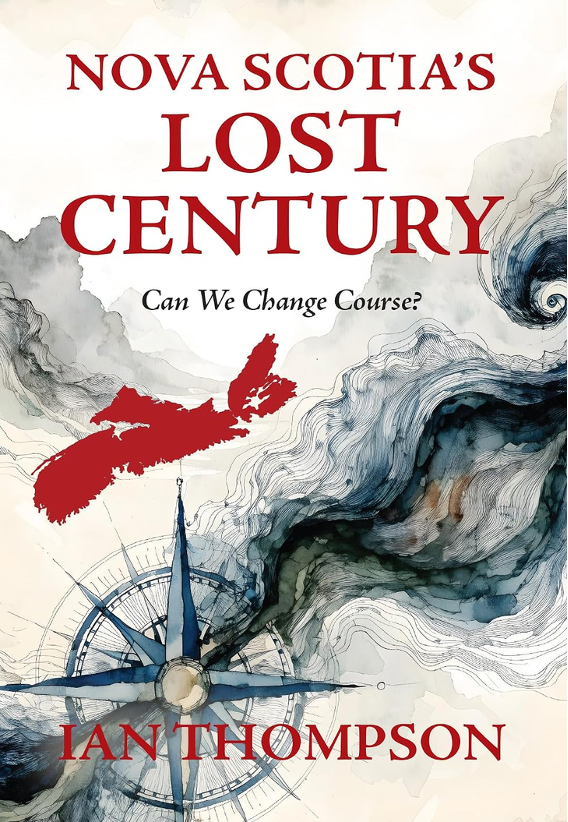
Nova Scotia’s Lost Century: Can We Change Course?
By Ian Thompson
Nimbus Publishing, September 2026/224 pages
Reviewed by Lori Turnbull
September 27, 2026
In his book Nova Scotia’s Lost Century: Can We Change Course?, Ian Thompson tells the story of his home province, its beleaguered past, and its chance for a better future.
This book is a must-read for Nova Scotians, anyone interested in Nova Scotia, in regional politics in Canada, in the role of government in economic growth and development, and in the salience of political culture to the shaping of history.
Thompson explains that, for a range of reasons — many but not all of which were beyond the province’s control — the 20th century was a period of missed and lost opportunity for Nova Scotia. A mix of economic, social, structural, and cultural factors held the province and its residents back.
But in the last decade or so, Nova Scotia has shown up differently.
A pandemic population boom of newcomers — from both inside and outside of Canada — seeking splendid isolation pushed the province’s population past the 1 million mark for the first time in December 2021.
With a fresh entrepreneurial spirit, the quality-of-life opportunities created by remote work in its picturesque towns and cities, and the government’s confidence in pitching Nova Scotia’s products to international markets, the province has undergone an unexpected, organic re-brand as a calm, cool place to live in an increasingly chaotic world.
Thompson argues convincingly that Nova Scotia should, once and for all, ditch its identity as “Canada’s Ocean Playground” (the unserious phrase unhelpfully stamped on its license plates) and take its place as, in his words, “The World’s Ocean Destiny”.
This is a book whose impact far outweighs its page count, which speaks to the strength of the author’s writing and his deep understanding of the terrain. Thompson guides the reader through the major events and themes that defined Nova Scotia’s politics, governance, and finances for over a century.
He shows how, since Confederation, the province has been consistently neglected by Canada and by Ottawa. Nova Scotia’s resources and contributions, exploited time and time again, have never been fairly recognized. Its potential has been less than fully realized because the federal government has always prioritized something or someone else.
Key sectors in Nova Scotia went unsupported throughout the 20th century, which led people (including skilled workers) to leave the province in droves, which shrunk the tax base and aged its population, leading to unsustainable pressure on social services and programs. This cycle kept the province down for decades.
While he carefully documents Ottawa’s role in Nova Scotia’s problems, Thompson does not let Nova Scotia’s governments — or Nova Scotians, for that matter — off the hook. Some of Nova Scotia’s most critical problems and challenges come from within.
Nova Scotia is small, but it’s complicated. The nuances and complexities in its culture, transmitted over decades through music, books, poetry, and plays, at workplaces and kitchen tables, have taught its people to be proud but not too proud, lest you acquire what we call ‘big feeling’.
For example, Thompson refers to the 2014 Report of the Nova Scotia Commission on Building our New Economy (more commonly referred to as the Ivany report) and its finding that Nova Scotians seemed to be “somewhat less welcoming” to immigrants than to people coming to the province from other parts of Canada.
Thompson also writes about racist provincial policies and actions, including the neglect and forceful displacement of the Africville community in the 1960s as the nadir of the province’s treatment of African Nova Scotians, a multi-generational trauma still being felt and processed.
Thompson bravely wades into the aspects of Nova Scotia’s political culture that bear some responsibility for the province’s history of economic underperformance, which he attributes in part to resistance among Nova Scotians themselves to confidently embrace their rich natural capital, diverse heritage and identity.
That the province is now experiencing a soft-power boom based on outsiders — including cultural influencers like Syrian refugee and Peace by Chocolate founder Tareq Hadhad — discovering those attributes seems to validate Thompson’s theory.
I read Mr. Thompson’s book with much personal interest.
Nova Scotia is my home province, too. Thompson was born in Halifax (aka the big city); I was born and grew up in Cape Breton. While I learned a lot from Thompson’s book in terms of Nova Scotia’s history, perhaps most particularly with respect to Halifax’s role as a strategic port city during the Second World War, I was most struck by how thoughtfully he reflects on the province’s culture. To me, this is the book’s most unique and important contribution.
Nova Scotia is small, but it’s complicated. The nuances and complexities in its culture, transmitted over decades through music, books, poetry, and plays, at workplaces and kitchen tables, have taught its people to be proud but not too proud, lest you acquire what we call “big feeling”.
Thompson talks about the province’s tall-poppy syndrome: the tendency to resent successful people and even “stigmatize success” tended to drive those tall poppies away, and the whole place suffered as a result.
In this century, that has started to change.
To be fair, growing up in Nova Scotia meant being subject to a steady diet of what felt like contradictory messaging. It went like this: Nova Scotia was the most beautiful, special, naturally rich place in the world, but if you want to succeed, you’ll have to leave.
And those who left often felt guilty about it, along with a palpable sense of being away from home no matter how long ago they lived there.
If Ian Thompson gets his wish, the notion that Nova Scotians have to leave to succeed will be a thing of the past. This book, and recent history, provide lots of reasons to be optimistic.
Dr. Lori Turnbull is a professor in the Faculty of Management at Dalhousie University.