
On Being Canadian Under the Law
 ideacity.ca/screencap
This piece is part of our Policy series On Being Canadian.
By Irwin Cotler
October 28, 2026
My earliest memory of what it means to be Canadian is from May 8, 1945; my fifth birthday. It was Victory in Europe Day (VE Day), the end of World War II, the liberation of the death camps, and the end of the horrors of the Holocaust. My father took me into the streets of Montreal for this great moment of celebration of the victory of the Allied Forces, including Canadian soldiers, in World War II.
I didn’t yet fully understand that it was VE Day, so I thought it was the most beautiful, euphoric birthday I had ever celebrated — a memory I’ve never forgotten. Sadly, as I grew up, I learned about the horrors of the Holocaust that had marked the years from my birth in May 1940 — the same month Auschwitz was operationalized — to May 8, 1945.
Part of that processing of my history is about Canadian policy — as set forth in Irving Abella and Harold Troper’s classic work, None is Too Many — and the human rights stain of state-sponsored antisemitism that remains part of our national story.
More recently still, I’ve been reminded of the warning signs of the 1930s that we ignored at our peril.
Today, as troubling signs reappear, fuelling an unprecedented explosion of antisemitism — a threat to our democracy, our security, and our shared humanity — we, too, ignore them at our peril.
The next moment of understanding and affirming the importance of being Canadian occurred when my father took me on my first-ever trip to Ottawa and to visit to Parliament Hill, in 1951. As we arrived at Centre Block, he turned and said to me, in a tone of reverence and awe that I will never forget, “Son, this is vox populi, the voice of the people.”
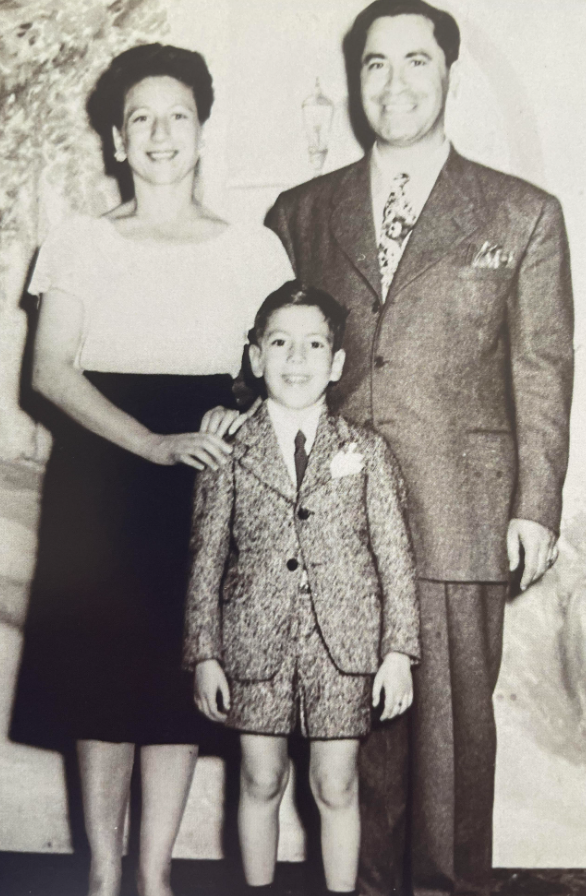
With my parents, Faye and Nathan Cotler/Courtesy
It was a teaching that has remained with me. On that same trip, we also visited the Supreme Court, which my father called a pillar of our constitution, as well as the National War Memorial, which underscored the importance of remembrance and of our Canadian military, “standing on guard” for us.
These three foundational values — respect for Parliament, the judiciary, the military — were amplified in my first public service employment in 1968, as special advisor to then-Justice Minister John Turner, who while reaffirming these values, would underscore the importance of democracy. As he put it, “Democracy does not happen by accident. You have to nurture it. You have to protect it. You have to defend it. And parliament is a central actor for that purpose.”
That message, which I internalized, served me well as a parliamentarian and as Minister of Justice thirty-five years later.
My father came to Canada as a one-year-old immigrant in 1907, and grew up in the French-speaking Montreal neighbourhood of Papineau, becoming a Francophile with a love and respect for the French language and culture, seeing Quebec as a distinct society before it became principle and policy, and was actively engaged in the Montreal and Quebec Bar Associations, with his combined love for language and the law.
As it happened, my own first publication, The Legal History of Bilingualism and Biculturalism in Quebec and Canada resulted from an assignment by my then-professor, the legendary F.R. Scott, at McGill University in 1963. Scott had taught my father, and they had become close colleagues and friends, with their shared commitment to la primauté du droit – the rule of law – yet another foundational principle of what it means to be Canadian.
Along with F.R. Scott, who was both lawyer and poet, my father was also close friends with poets A.M. Klein and Louis Dudek, sharing a passion for another important dimension of being Canadian — a love of Canadian literature — something I shared, as well, as a student of Canadian poet Irving Layton, who would speak of Leonard Cohen and myself as his “two spiritual children,” which spawned a lifelong friendship between myself and Leonard, an icon of Canadian culture.
My father was also a quintessential social democrat, anchored not only in his friendship with Scott, but also with NDP Leader David Lewis, both of whom were architects of social democracy, as yet another foundational Canadian norm, and not simply a partisan slogan.
 With my wife, Ariela, on the night of my 2000 re-election as Liberal MP for Mount-Royal/Courtesy
He was also a great sports fan, with season tickets to the Montreal Royals, when they played at Delorimier Stadium — where he introduced me to the legendary Jackie Robinson, an encounter that had an enduring impact on my subsequent involvement in the Civil Rights struggle — and also season tickets for the Montreal Alouettes and Montreal Canadiens. For my father, sports were a part of being Canadian and the Stanley Cup and Grey Cup were national inspiration symbols, another love he passed onto me.
But perhaps my father’s most important teaching — something that I saw as a foundational Jewish, Canadian and universal value – was that the pursuit of justice is “equal to all the other commandments combined.” This, as he put it, “must be your guiding mission, and that which you must teach unto your children.”
And here is where my mother’s values and teaching came into the picture. As she would say to me, “If you want to pursue justice, you have to understand, you have to feel the injustice about you. You have to go into the community and beyond and feel the injustice and combat the injustice, otherwise the pursuit of justice will be a theoretical abstraction.”
Both these related lessons were equally important: my father’s intellectual personification of teaching what justice was all about, and the example of my mother — the most compassionate soul that I’ve ever encountered — who lived it in her daily life.
Also, my father was what you might call a free-speech theorist. He would read to me from all the great judges — from Brandeis to Cardozo to Rand — and was very much a First Amendment exponent; but it was my mother, who would always say, “Words can hurt and words can wound and words can even kill,” and therefore, I should understand the dangers of hate speech when appreciating the importance of freedom of expression.
When I went to law school, my two major law teachers were Scott — a true exponent of free speech in all its dimensions, the Oliver Wendell Holmes of Canada — and Maxwell Cohen, who chaired the Special Committee on Hate Propaganda in Canada when I was a law student, and while he valued free speech, he also talked about the dangers of hate propaganda.
These two law professors, respectively, brought together the two teachings of my parents. Frank Scott was like my father, and Maxwell Cohen was like my mother. So, I ended up being an exponent of the importance of freedom of expression, but also of the dangers of hate speech — both of which have informed my scholarship and advocacy to this day and are unique and foundational Canadian values.
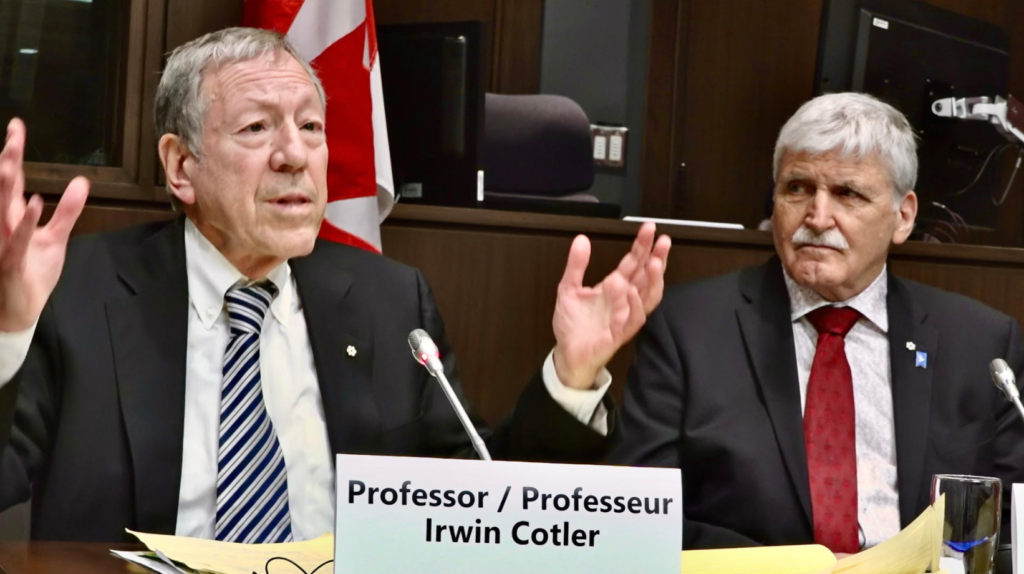 With Lt. Gen (ret) Roméo Dallaire at a news conference on Mass Atrocity Crimes/Abbey Neidik
My mother was also the exponent of two other foundational Canadian values. First, her passion for the environment found expression through her frequent references to Rachel Carson’s 1962 book, “Silent Spring.” Second, she taught me that the test of a just society is how it treats its most vulnerable — its refugees, its immigrants, its elderly, its sick, its poor, its violated women, its battered children — emphasizing the need for compassionate policy over idle talk.
My parents saw education as a foundational value anchored both in Jewish values and Canadian values, in keeping with the Jewish tradition “learning is the highest call”. The Ethics of the Fathers– a treatise on ethical values – was imparted to me at a young age and underpinned my own respect for values-based education. My parents saw education, as I began to see it, as the pathway to identify.
A final foundational value that incorporates much of the above can be summed up in one phrase: rights-based constitutionalism. As a Canadian value, it inspired Canada’s “Constitutional Revolution,” whose centerpiece is the Canadian Charter of Rights and Freedoms — what I used to refer to, and still refer to, as “The People’s Charter in the Age of the Charter for the Children of the Charter” — and which I have written about in A Revolution in Five Acts.
The adoption of the Charter of Rights, where Canada moved from being a parliamentary democracy to being a constitutional democracy; from the sovereignty of Parliament to the sovereignty of the Constitution; judges moved from being the arbiters of legal federalism — the “powers process” — to being the guarantors of our rights, not because they sought that power, but because Parliament bequeathed them that power.
Individuals and groups moved from being passive bystanders to the “powers process” to being rights holders and rights claimants, with a panoply of previously nonexistent rights and remedies, with standing to bring justiciable claims, and with the capacity to come to the courts and petition for the redress of grievances.
In summary, fidelity to the Constitution — to the rule of law, to the Canadian Charter of Rights and Freedoms — is the canon and commitment which must inform the actions of government, parliament and citizenry.
The Charter promotes and protects what the pursuit of justice is all about — not only the inherent dignity and worth of every human being, but their equal dignity and worth. It allows us to aspire to a society that celebrates both equality and human dignity, a society that defines us, not only in terms of who we are but in terms of what we can aspire to be.
Realizing that aspiration is the last revolutionary act in this constitutional drama. It is the transformative act that is now being written. We are all its scriptwriters, as well as its beneficiaries.
That is what it means to be Canadian.
Prof. Irwin Cotler is International Chair of the Raoul Wallenberg Centre for Human Rights, a constitutional scholar, a former Member of Parliament and Canada’s former Minister of Justice and Attorney General.