
Satisfaction with Carney Hits 70%: Is ‘Bridge’ Politics Beating ‘Wedge’ Politics?
October 27, 2026
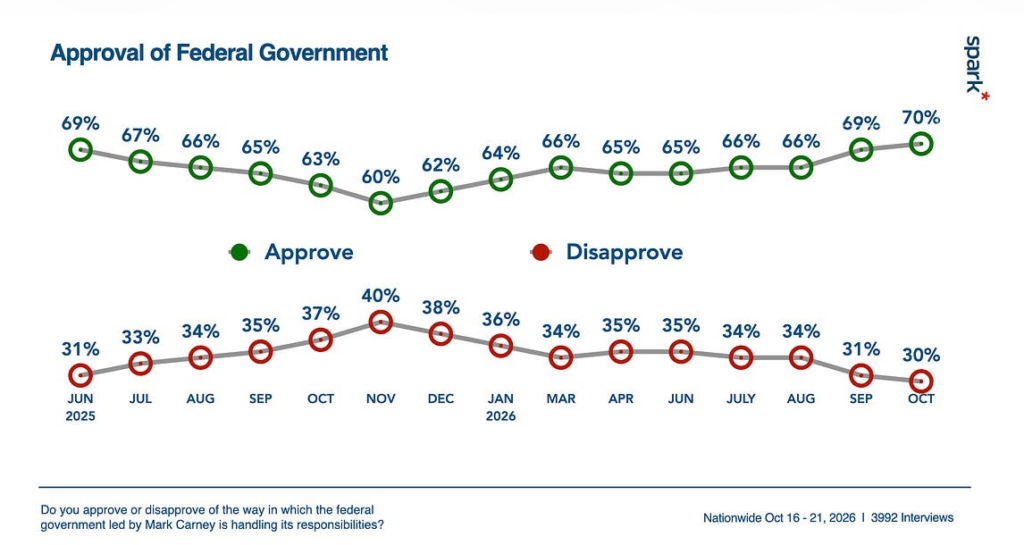
Our latest Spark Advocacy survey wrapped up 3992 (yes, we like big samples) interviews on October 21st. Confidence in the Carney government remains at quite elevated levels by historical standards. With a voting intention advantage over the Conservatives of 49%-28%, the Liberals have built strong support across the country, including across the political spectrum.
Approval of the government touched 70% in this wave of surveying, including above 60% in Saskatchewan and Alberta. Over a third of current Conservative voters approve of the Carney government’s performance, as do 57% of NDP and 61% of BQ supporters.
If there were to be an election soon, two thirds would prefer to see Carney win rather than Pierre Poilievre, including 59% in Alberta, 63% in Saskatchewan and 19% of those who cast a ballot for Poilievre in 2025.
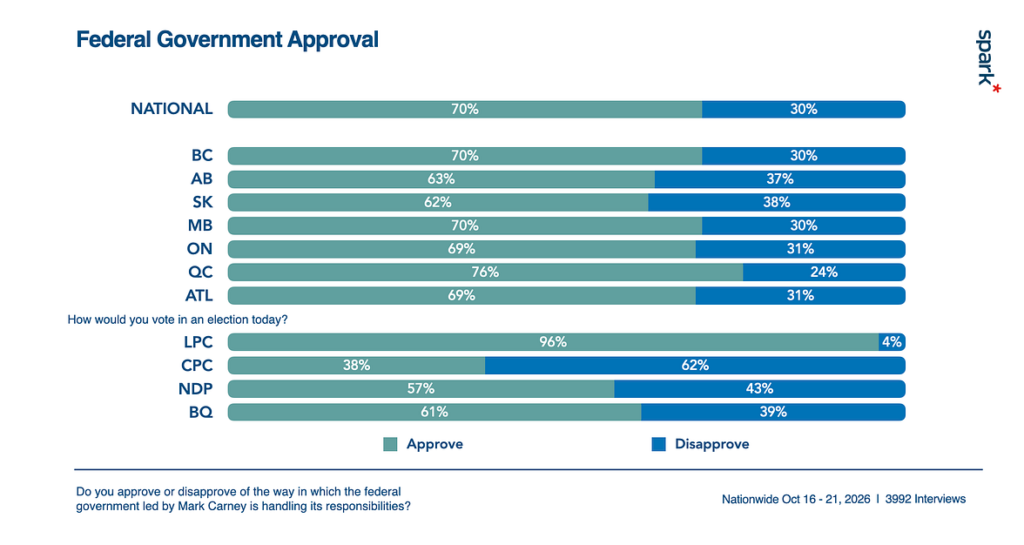
These patterns stand in contrast with what had seemed to be the norms of modern politics — especially that it would be impossible to increase support from the left and the right, or the West and the East, at the same time.
Or that Conservative Party supporters would be anything but 90% plus rock-solid opponents of a Liberal leader.
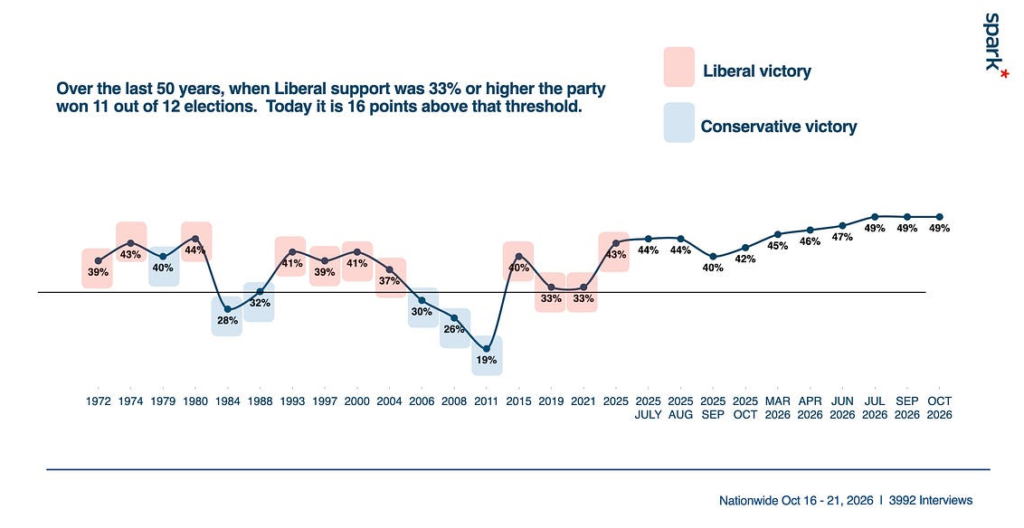
Over the last 50-plus years, when Liberal support was 33% or higher, the party won 11 of 12 elections — 49% suggests an unusually wide advantage for Carney.
I’ll write a couple more pieces based on this latest data set.
However, the biggest story for me is that a mood of ‘work it out’ seems to be prevailing over the reflexive division that politics has been so good at manufacturing.
Canadians witnessed this in the Alberta referendum result and also in the tepid support for the PQ and the broad opposition of Quebecers to a referendum on separation. To some degree, the Conservative victory in BC was predicated on that party taking a radical step with its leadership, to reassure voters that the party wouldn’t divide and create endless friction.
Overall, this realignment is not only a reaction to a commonly felt Trump/trade threat. It is also a reaction to the fact that Carney is visibly trying to ease regional and cultural tensions as a central part of his approach to governing. Wedge politics is out, replaced by a deliberate “bridge politics” approach.
During the last election, it became clear that people wanted, more than anything, serious leadership taking the work of politics seriously — the results so far suggest this is what many people believe they are getting.
Policy Contributor Bruce Anderson is Founding Partner and Chief Strategy Officer of Spark Advocacy. He has been a pollster, political strategist and communications advisor for more than 40 years and is a regular on The Bridge podcasts.