
What Canada’s Associate Membership in the EU Is and Is Not

By Maria Popova
November 1, 2026
The Montreal Canada-EU Summit that produced an enhanced commitment between the two transatlantic parties is easy to read as a story about Donald Trump.
The U.S. president has waged a tariff war, talked about making Canada a 51st state, and called Canada’s closer ties with Europe a “hostile act”. All of this invites an intuitive narrative that Canada is simply lashing out at an unreliable neighbour and running to Europe for reassurance. This is the wrong interpretation of events.
While the Trump administration has accelerated these events, the deepening of ties between Canada and the EU is a broader trend, and it is going to define Canadian foreign policy for the foreseeable future, whoever sits in the White House.
We learned three things from the Montreal Summit.
Associate Membership is About to Become a Category
Until European Commission President Ursula von der Leyen used it in September, “associate member” did not exist in the EU’s vocabulary. The details will be worked out, but we now know the spirit and meaning of the term.
Associate membership is multifaceted close cooperation in the realms of economy, defence, critical minerals, research cooperation, and people-to-people ties.
The crucial difference between full-fledged EU membership and associate membership is that while the former means ever-deepening economic and political integration that European states sign up for, the latter will be driven primarily by geostrategic goals and will be open to non-European countries such as Canada.
EU members pool sovereignty. Canada and the EU will not pool their sovereignty but will work together to protect each other’s sovereignty from challenges by others: be they from Russia in Ukraine, wider Europe or the Arctic; or be it from U.S. threats to Canada or Greenland.
The EU and Canada will not become one unit. They will keep their political and economic goals, and their domestic domains, separate. Both Canadian and EU officials have been clear that full Canadian EU membership is not the aim, even if geography and the articles of the Treaty of European Union did not preclude it.
At the summit, Carney and von der Leyen unveiled this arrangement as “An Alliance for the Future”. In addition to protecting sovereignty, the alliance’s goal is to show the world that two big democracies are still committed to a rules-based international order and willing to spearhead its renewal.
The emphasis on not simply standing with Ukraine but bringing Russia to accountability for its aggression is an expression of the continued and shared belief that the rules of territorial integrity and international legal order need to be upheld.
As hard as this may be given America’s alarming drift towards banding with autocratic transgressors and committing its own violations, Canada and the EU are signing up to do it together.
The Process is Moving Faster than Expected
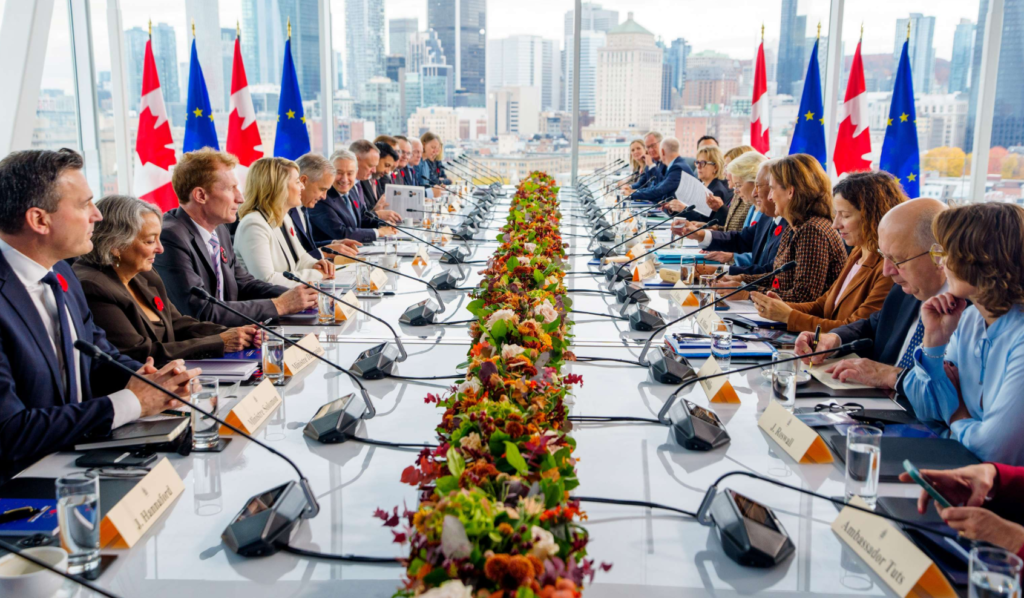 The Canadian and EU delegations at the Canada-EU Summit in Montreal, October 30, 2026/PMO X
The timeline is already set. In March, the Canadian cabinet will hold negotiations with the EU’s College of Commissioners. In June, Prime Minister Carney will join the European Council meeting to formalize the framework agreement. Carney has also said the outcome will go to the Canadian Parliament for debate and a vote. Given that polls show an overwhelming majority of Canadians support this rapprochement with the EU, the issue isn’t likely to become divisive.
That is remarkable. EU enlargement normally takes between five and twenty years and sometimes it stalls altogether. Here, the process could be complete within a year.
The usual delays come from two places.
The first is values. In Europe, EU enlargement has been driven by the desire to unite the entire continent in the peace project that the EU started out as. The process often hinges on whether the joiner and the EU genuinely agree on democracy, human rights and the rule of law. Where that meeting of minds is missing, as in Turkey, Serbia, Bosnia and Georgia, the process stalls or becomes altogether frozen.
The second source of delay is institutional capacity. Taking part in the economic, legal and political integration that pooling sovereignty requires means a state able to implement it. Where that capacity has to be built first, as in the Western Balkans, Eastern Europe, and now Ukraine and Moldova, the road is often long and involves the adoption of difficult domestic institutional reforms that the EU and local civil society have to push forward, sometimes against pushback by entrenched political interests.
Canada and the EU face neither problem in forging their new relationship. Both have a longstanding commitment to the same values. It is the close alignment of values that is the main driver of this process. And the institutional capacity needs no building: Canada is one of the few established democracies that has not suffered any democratic backsliding, and it has the state capacity to carry out its policies.
Take away the customary obstacles to EU enlargement and what is left is political will, and there is plenty of that on both sides.
A Turning Point in Canadian Foreign Policy
This is where the change is biggest. For a long time, Canadian foreign policy put a lot of weight on international development and on helping countries that wanted to adopt our values. In practice, that often meant trying to cajole and convince, especially smaller developing states, to come around to our way of doing things.
That is changing. Canada will now focus on defending its values and its national interests, purposefully, alongside the EU as its closest ally, and perhaps alongside the U.S. too, if a future administration returns to like-mindedness.
To do that, the long-term focus is on building up our security and economic sovereignty through diversification and investment. It also means holding those who violate the rules-based order, such as Russia, accountable for their actions, and building the capacity to deter others from violating and threatening the values and interests we hold dear. The job is no longer to persuade smaller states to adopt our values. It is to protect those values from the predatory behaviour of bigger, rogue states.
The Future is Already Here
It is a mistake to treat all this as a reaction to one administration, and to assume it would easily be reversed. A fixed timeline, a new category of association built from scratch, and a foreign policy reoriented around economic security, defence and sovereignty are not the impulsive actions of a country either in a snit or hedging its bets. They are the makings of a long-term commitment, shared by Canada and the EU.
This is more than an adaptation for the future; that future is here.
Policy Columnist Maria Popova is the Hiram Mills Associate Professor of Political Science at McGill University and Co-Director of the Jean Monnet Centre Montreal.