
Mark Carney, the Commonwealth and Variable Geometry
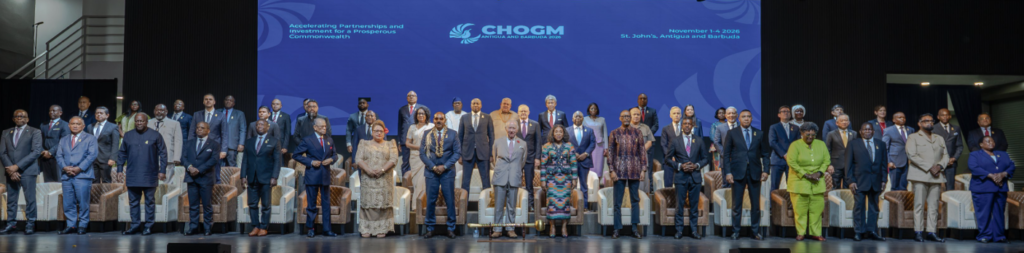
The 2026 CHOGM in St. John’s, Antigua and Barbuda, November 3, 2026/Commonwealth X
November 3, 2026
At this writing, Prime Minister Mark Carney is preparing to head home from the Commonwealth Heads of Government Meeting (CHOGM) in St. John’s, Antigua and Barbuda, where his participation continued a long tradition in which Canada has helped shape the organization’s evolution.
“As Canada charts its path forward in this new world, we look to our fellow Commonwealth members as partners,” Carney said in a statement from the CHOGM. “In an increasingly fragmented world, we are acting together to create greater security, opportunity, and prosperity for our peoples.”
That wording provides a small window on how the 77-year-old Commonwealth of Nations squares with Carney’s vision of a post-American rules-based global order. But how will Canada’s history with the organization inform that evolution in the relationship?
In February, in the wake of the global impact of Prime Minister Mark Carney’s Davos speech the month before, I argued in this magazine that two of the most significant speeches in Canadian foreign policy history were Louis St. Laurent’s 1947 Gray Lecture, which established the framework for Canada’s postwar foreign policy, and Carney’s Davos speech, which proclaimed that the international order Canada had helped build was undergoing a fundamental rupture.
“Over the past two decades, a series of crises in finance, health, energy, and geopolitics laid bare the risks of extreme global integration,” Carney told the World Economic Forum’s annual gathering. “More recently, great powers began using economic integration as weapons.”
Carney argued that our turbulent world required a reset, including a new focus on flexible alliances among middle powers and priorities shifting according to the issues at hand.
In St. Laurent’s Gray Lecture, the Commonwealth had figured prominently. Commonwealth relations, he declared, were “a basic consideration in the external policy of this country.” He went further: “We Canadians, perhaps more than any other of its members, have contributed to its development.”
If the Commonwealth occupied such a principal place in St. Laurent’s vision of Canadian foreign policy in 1947, could it play a similarly significant role in Mark Carney’s vision of a recalibrated world order in 2026?
We may find out soon.
A Record of Leadership
Canada’s contribution to the evolution of the modern Commonwealth began with St. Laurent as Prime Minister and Lester Pearson as Minister of External Affairs, who helped negotiate the constitutional compromise that allowed Jawaharlal Nehru’s India to remain a Commonwealth member when it became a republic in 1950.
St. Laurent strongly supported retaining India in the Commonwealth. The solution was to recognize the monarch as the symbolic “Head of the Commonwealth”. The relationship worked both ways. Nehru helped broaden Canadian understanding of the aspirations of a newly independent Asia, and the leaders developed a close working relationship. Addressing Canada’s Parliament in October 1949, Nehru said their positions were “identical or very near to each other” on every issue they had discussed.
The Commonwealth had become a bridge between East and West.
John Diefenbaker helped establish the Commonwealth as a multiracial association. At the 1961 London conference, he joined African and Asian leaders in opposing South Africa’s apartheid policies. “Apartheid has become the world’s symbol of discrimination,” he declared. Faced with opposition to continued membership, South Africa withdrew its application, despite British efforts to keep it in the Commonwealth. Racial equality had become an essential principle of membership.
Pierre Trudeau hosted the 1973 Commonwealth summit in Ottawa and introduced informal retreats where leaders could discuss international problems without ministers or officials. Writing afterward, Trudeau observed: “There is little headline material in this kind of gathering.” But the opportunity for communication and understanding was immense. Within the Commonwealth, he argued, “each Commonwealth member is equal. None is senior; none is superior.”
Relationships developed with leaders from Asia, Africa and the Caribbean subsequently complemented his North-South diplomacy and efforts to advance international development.
Brian Mulroney continued Canada’s opposition to apartheid, using the 1987 Vancouver summit to strengthen international pressure on South Africa in the face of resistance from both Ronald Reagan and Margaret Thatcher. Recalling his confrontation with Thatcher over sanctions and the need to liberate Nelson Mandela, Mulroney told her: “Margaret, you are on the wrong side of history.”
The Commonwealth’s commitment to democracy was tested again in 1995, when it suspended Nigeria following the military regime’s execution of activists and its imprisonment of leading political figures. As it had done with South Africa, the Commonwealth threatened expulsion.
Among those prisoners was Olusegun Obasanjo, who was eventually released and elected president in 1999. Later, he became co-chair of the InterAction Council with Jean Chrétien, whose government had strongly supported the Commonwealth pressure for democratic reform in Nigeria.
Hugh Segal, senator and later head of Massey College, was Canada’s representative on the Commonwealth Eminent Persons Group, where he helped advance another major achievement: the 2013 Commonwealth Charter, which emphasized the values of civility, democracy, human rights and the rule of law.
A strong advocate of the Commonwealth, Hugh wrote in Policy Options in 2012: “As an international and intergovernmental organization of sovereign states in voluntary association, this remit is unique and compelling.”
This historical record justified my assessment in the 2000s that the Commonwealth was “one of the least known but most important of our foreign policy assets.”
The Commonwealth Today
The Commonwealth today comprises 56 countries with 2.7 billion people, nearly one-third of the world’s population. Its membership stretches across Africa, Asia, Europe, the Caribbean, and the Pacific, bringing together some of the world’s largest economies and many of its smallest and most vulnerable states with intra-Commonwealth trade projected to reach$1.2 trillion in 2027.
At this week’s summit in Antigua and Barbuda, Carney has emphasized the possibilities for expanded trade and investment, particularly with the Caribbean. At a breakfast with Caribbean leaders on November 3rd, he pointed to more than one million Canadians with roots in the region and approximately $4 billion in annual trade. That relationship, he declared, “scratches the surface of what’s possible.”
The State of the Commonwealth Report 2026, released as leaders gathered in Antigua, identifies three priorities: economic, environmental, and democratic resilience. Like Carney’s Davos speech, it urges the Commonwealth to “Bridge divides to build coalitions for international reform.”
Canada is already its second-largest financial contributor, providing almost $13 million to Commonwealth institutions in 2025–26. Could we do more? Additional support for climate adaptation, education and democratic development could give practical substance to the Commonwealth’s ambitions but the question is not simply how much Canada contributes, but where Canadian experience and resources could make a distinctive difference
Variable Geometry: Beneficiary or Casualty?
Carney’s Davos doctrine poses a paradox for the Commonwealth. If middle powers increasingly pursue temporary coalitions around issues, will established multilateral organizations become less relevant, or will they provide the diplomatic infrastructure from which these new coalitions emerge?
Andrew Cooper, in a recent Global Policy analysis of Carney’s Davos address, argues that middle powers have different interests and cannot be assumed to form a cohesive bloc. Their cooperation is more likely to be “loose, time-specific and increasingly targeted at informal institutions.”
Commonwealth experience suggests that such arrangements can work. Trudeau used the organization to strengthen North-South relationships, while Mulroney joined Australia and India in pressing for sanctions against South Africa despite British opposition. Neither achievement required unanimity among all Commonwealth members.
In 2012, Hugh Segal emphasized a frequently overlooked strength of the Commonwealth: its members also belonged to most of the world’s major regional and international organizations. “This broad reach can be put to use for the benefit of the membership,” he wrote. That insight is even more relevant today.
The Commonwealth’s 56 members include 21 countries of the African Union, 12 of CARICOM, 11 of the Pacific Islands Forum, seven of APEC, seven of La Francophonie, and two NATO allies. The network also extends into the European Union with Cyprus and Malta. This overlapping membership gives Canada potential partners across every region, providing a foundation for the flexible coalitions of middle powers that Carney advocated at Davos.
One especially promising area is democratic development. The Commonwealth Secretariat’s new report specifically recommends fostering international coalitions for democracy at a time when it is under threat around the world; strengthening electoral institutions, and developing shared expertise to counter cyberattacks, artificial intelligence-enabled disinformation and threats to democratic participation.
Canada could respond by reviving an idea first proposed by Stephen Harper. In 2008, the Conservative government promised to establish an independent, non-partisan Canadian democracy-promotion agency. I chaired the advisory panel that produced a detailed blueprint in 2009, recommending a stand-alone institution devoted to strengthening political parties, electoral systems, and democratic institutions through long-term partnerships. Significantly, we identified the Commonwealth, the Francophonie, and the Americas as priority regions.
The Commonwealth’s renewed emphasis on democratic resilience offers an opportunity to reconsider that unfinished Canadian initiative. A revived “Democracy Canada” institution could work with Commonwealth election observers, parliamentarians, judges, and civil society organizations to help countries strengthen their democratic systems. Such assistance should be developed with local partners, not imposed from abroad.
There are, of course, competing demands on Canadian resources. The European Union is central to our economic and security strategy, and NATO remains indispensable to collective defence.
But the Commonwealth offers something different: relationships with countries across the Global South, access to smaller states whose concerns are often overlooked, and a diplomatic network spanning multiple regional organizations.
The United States is not a Commonwealth member. Donald Trump has no seat at its table nor a veto over its decisions: to its advantage, it is one international association that he cannot disrupt.
The Commonwealth’s relevance relies on its ability to bring different countries together for different purposes. In other words, the Commonwealth has always practised variable geometry. As he returns from the Caribbean, I am sure Mark Carney is reflecting on this fact.
Thomas S Axworthy is Public Policy Chair at Massey College.