
From Borrowing to Growth: IFSD Tests Budget 2026
Bottom Line:
Budget 2026 answers the call for a more explicit investment strategy, but it does not settle the harder questions about additional private investment, execution, cash borrowing and measurable results.
The strategy is clearer. The transmission from public support to durable growth still has to be proven.
What the budget does
- Builds the economic strategy around an “investment supercycle,” with $403.9 billion in federal capital investment on an accrual basis over 2025–26 to 2030–31.
- Introduces a permanent Productivity Mega Deduction with an estimated five-year fiscal cost of $36 billion. The government estimates it will cut the marginal effective tax rate on new business investment from 13% to 6.4%.
- Concentrates the growth agenda on major projects, electricity, nuclear energy, critical minerals, trade diversification, research commercialisation and access to capital.
- Projects a $62.3 billion deficit in 2026–27, with the deficit-to-GDP ratio declining from 1.8% to 1.3% by 2030–31. Federal debt remains close to 40% of GDP through the forecast.
- Promises an operating balance by 2027–28 and limits average direct program expense growth to 1.5% from 2026–27 to 2030–31. Excluding capital investment, direct program expense growth averages 0.2%.
- Uses an improving revenue outlook, supported in part by higher oil prices, stronger corporate profits and wage growth, while adding substantial new measures that are largely time-limited.
IFSD test 1 | Does borrowing translate into growth?
- The budget is close to the investment-led strategy IFSD expected. The Productivity Mega Deduction is broad, permanent and potentially material. The budget also identifies major-project machinery, a one-project/one-decision/one-year objective and significant energy infrastructure. These are stronger links than a conventional list of programs.
- But the key test is additionality. The budget cites nearly $500 billion in investment commitments and large pools of institutional capital, while warning that the figures span different activities and timeframes and should not be treated as directly comparable or additive. Public incentives can improve returns, but the podcast should press for evidence that projects and business investment accelerate beyond what would otherwise have occurred.
IFSD test 2 | Is there real fiscal room?
- The headline deficit path improves gradually and the debt ratio is broadly stable. That provides a defensible fiscal narrative, especially in a still-uncertain economy. The operating balance and expenditure-review savings also show an effort to distinguish day-to-day spending from investment.
- However, the preview warning remains central: capital treatment does not make borrowing costless. The government’s financial requirement is $149.5 billion in 2026–27 and rises to $169.0 billion in 2027–28, far above the budgetary deficits, because non-budgetary transactions and asset purchases also require cash. Public debt charges rise from $60.2 billion to $85.5 billion by 2030–31, or from 1.8% to 2.2% of GDP. Treasury-bill issuance is being increased by $16 billion relative to the spring update.
IFSD test 3 | Is restraint credible and appropriately timed?
- The budget avoids blunt near-term austerity and relies instead on slower operating growth, expenditure review and a shift toward capital. That broadly matches IFSD’s pre-budget position: protect a weak economy while reallocating toward priorities.
- The open question is implementation. Holding non-capital direct program growth near zero while funding defence, affordability and public-service demands will require visible choices. The claimed savings need departmental plans, milestones and reporting. “Slower growth” is not automatically the same as better performance or genuine reallocation.
IFSD test 4 | Can government execute?
- Budget 2026 contains more delivery machinery than rhetoric alone: 28 major initiatives, 18 projects representing more than $194 billion, an approvals standard, and targeted delivery entities. It also makes large commitments to grid expansion and resource projects that depend on provinces, Indigenous partners, regulators and private investors.
- That makes execution the decisive risk. A project list is not a delivery plan. The next test is whether each major initiative has a responsible authority, completed approvals, financing, procurement milestones, construction dates and public measures of progress. The credible unit of analysis is not dollars announced, but projects advancing and private capital committed.
IFSD test 5 | Is the plan resilient to a shock?
- The budget includes scenario and sensitivity analysis and a declining deficit ratio. But part of the stronger revenue outlook comes from higher oil prices and stronger nominal incomes. That creates a useful distinction between a durable improvement and a windfall that may reverse. The government is spending much of the improvement rather than banking it.
- The debt ratio is stable rather than falling materially, debt charges continue to rise, and cash requirements are large. Canada retains capacity, but the margin for another trade, energy, security or interest-rate shock is not unlimited.
Overall assessment
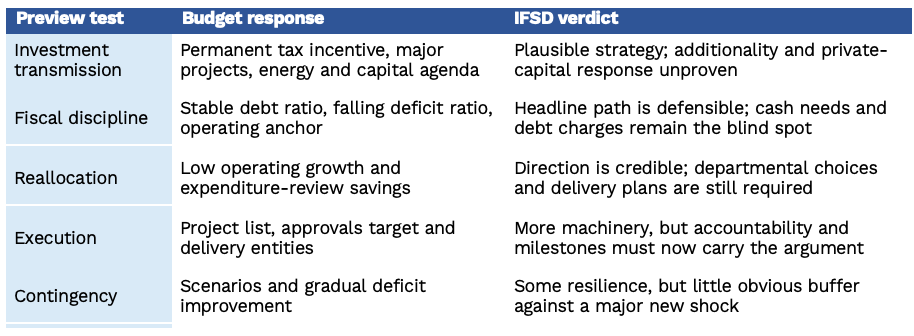 IFSD conclusion:
Budget 2026 has a clearer theory of growth than many recent budgets. It identifies investment, productive capacity and diversification as the route to stronger performance. Its credibility now depends on three things the budget cannot announce into existence: additional private investment, accountable execution and economic returns large enough to justify the borrowing and rising debt-service costs.
Founded in 2016 by Kevin Page, Canada’s first Parliamentary Budget Officer, IFSD is a non-profit Canadian think-tank and a global advisory practice. IFSD employs a disciplined research-based consulting approach that leverages decades of team experience in public financial management, macroeconomics, and public administration. Situated at the University of Ottawa, IFSD works in Canada and worldwide to support better decision-making by governments, and their stakeholders in the broader public and private sectors.