
‘Canada Rising’: A Convincing Case for Trade Diversification, Come What May
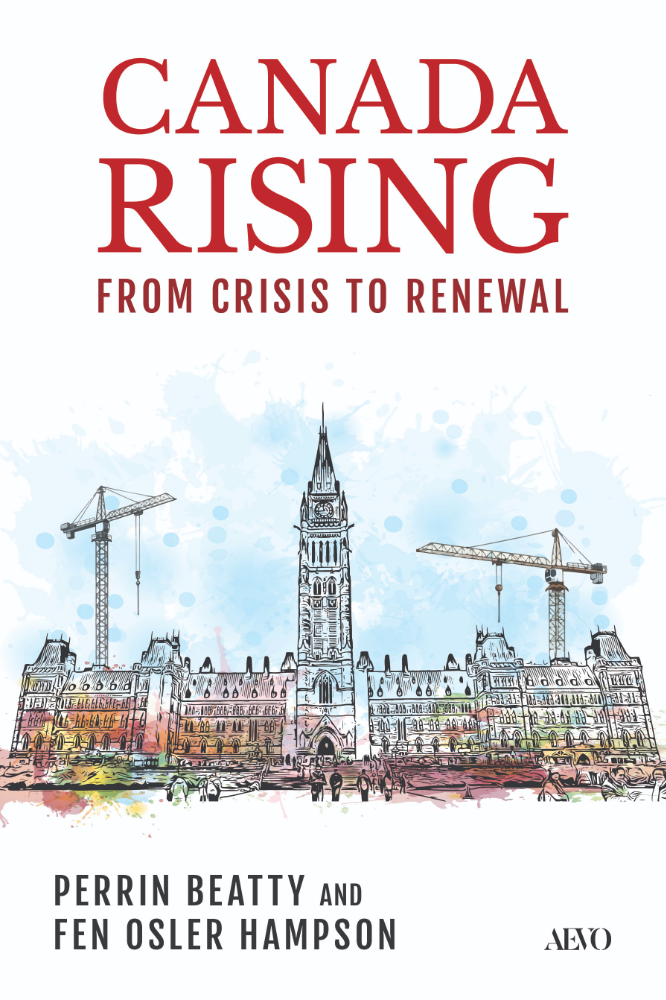
Canada Rising: From Crisis to Renewal
By Perrin Beatty and Fen Osler Hampson
University of Toronto Press, November, 2026/248 pages.
Reviewed by Colin Robertson
November 11, 2026
The most telling sentence in Canada Rising comes after Perrin Beatty and Fen Osler Hampson have described the gains Canadians made from free trade with the United States: “Yet with these benefits came new dependencies”.
Those of us who helped negotiate the Canada–US Free Trade Agreement and NAFTA have reason to linger over that sentence. We wanted Canadian firms to have the confidence to invest for a continental market. They did. What we did not anticipate was an American president prepared to use the resulting integration to extract concessions from America’s closest neighbour.
Beatty and Hampson make a persuasive case that Canada can recover some freedom of action.
A disclosure. Perrin and Fen are friends. They co-chair the Expert Group on Canada–US Relations, of which I am a member.
Both have made distinguished contributions to Canadian public policy. Beatty held seven federal ministerial portfolios, including National Defence and External Affairs, and later ran the Canadian Chamber of Commerce. Hampson is a prolific author and esteemed scholar of international affairs at Carleton University. Both are longtime fellow contributors to Policy Magazine.
Their starting point is Mark Carney’s Davos speech. They argue that it ranks with External Affairs Minister Louis St. Laurent’s 1947 Gray Lecture that set the direction for our post-war foreign policy. They accept Carney’s diagnosis of a rupture in the international order and turn to what challenges and options this presents to a prime minister, a premier, or a business leader.
Donald Trump figures prominently but, if he retired to play golf tomorrow, Canadians would still have an investment problem, a productivity problem, and a defence problem. Beatty and Hampson remind us that solving those problems, including rebuilding economic partnerships, requires time.
The Carney ‘Build Canada Strong’ program will take at least a decade and require holding course through changes of government.
That modest observation carries much of the book’s weight. Canada needs to preserve access to its largest customer during the years it will take to acquire others.
Hampson has been making a version of this argument for a dozen years.
In Brave New Canada: Meeting the Challenge of a Changing World (2014), he and Derek Burney, who served as Brian Mulroney’s chief of staff where he helped negotiate the original Canada-US Free Trade Agreement (FTA) and later our ambassador in Washington where he helped negotiate the North American Free Trade Agreement (NAFTA), urged Canadian firms to look beyond a comfortable continental market to the growth of an emerging Asia.
In Braver Canada: Shaping Our Destiny in a Precarious World (2020), Burney and Hampson returned to the question under Trump’s first administration. China’s rise still mattered, but so did American protectionism and the appeal of authoritarian politics.
Read together, the three books record the increasing price of Canadian inaction. In 2014 the cost was largely a missed sale. By 2020, it included exposure to great-power rivalry. In Canada Rising, it reaches into the factory dependent on American orders and the armed forces dependent on American technology.
The authors understand the gravity of trade: a large, rich market next door has attractions that survive even an obnoxiously disagreeable president.
The authors are fair to both protagonists in the great free-trade election of 1988. John Turner understood what East-West infrastructure had done to hold the country together. Brian Mulroney understood what access to a much larger market could do for Canadian living standards.
Beatty and Hampson move from the 1988 election debates to subsequent trade figures and anecdotal evidence, from the testimony of business leaders to comparisons with other countries.
On continental integration, the evidence is substantial. At the end of 2024, Canadians held nearly $1.3 trillion in direct investment in the United States, or 52.1 per cent of their total direct investment abroad.
That stock represents enterprises built and customers won. It also explains why a change in American policy reaches so far into Canadian boardrooms and supply chains.
The authors understand the gravity of trade: a large, rich market next door has attractions that survive even an obnoxiously disagreeable president. They envisage three futures for CUSMA: renewal with modest changes; a harder bargain with substantial new American demands; or American withdrawal.
The strongest argument for building other markets is that it gives a Canadian negotiator more room to decline a bad bargain. How do we acquire that room?
They cite BlackBerry founder Jim Balsillie, who argues that Canada needs to better protect its intellectual property and bring it to scale. Balsillie criticizes a Canada that exports commodities and buys back more lucrative technology and intellectual property.
Beatty and Hampson acknowledge the criticism but counter with the remarkable story of canola, a reminder of how much science can go into a crop. They are right to defend both the farm and the laboratory. Balsillie’s harder question is who owns the seed technology, the industrial process, or the software, and who collects the income over its working life?
The same question applies to the mining and refining of critical minerals. Refining ore in Canada makes sense where power, skills, buyers, and costs support long-term jobs and give Canada geopolitical leverage.
Beatty and Hampson also call out the premiers as laggards in addressing internal trade barriers. The 2025 Canadian Mutual Recognition Agreement on the Sale of Goods allows a product lawfully sold in one participating jurisdiction to be sold in another, subject to specified exceptions. Food and alcoholic beverages sit outside it. The exclusions tell us where local interests trump the public good.
On defence, the authors are admirably plain: “Alliances are not charities”. In other words, our allies expect us to carry our weight in defending our territory.
The Auditor General supplied an uncomfortable illustration in 2022. Federal agencies could neither track vessels continuously in Arctic waters nor reliably identify those that did not transmit their position. Replacing aging equipment threatened to open further gaps. A Canadian capacity to see what is approaching, share the information through NORAD and act on it serves national, continental and collective NATO security.
Abroad, the authors imagine “multilateralism without the mammoths”. Their historical analogy is the medieval Hanseatic League, whose trading cities gained bargaining power by acting together. Its modern relevance is that each member brought something the others needed. That is recognizably Pearsonian functionalism. Countries earn influence where they can contribute to the outcome.
Canada Rising left me pondering two questions: How much social protection, defence and infrastructure are Canadians prepared to pay for, and what gives when the sums do not add up; and, will Canadian businesses keep diversifying if they regain preferred access to the American market?
In Canada Rising, Beatty and Hampson make a convincing case for diversification while building a strong, resilient Canada.
Contributing Writer Colin Robertson, C.M., C.D, a former career diplomat, is a fellow and host of the Global Exchange podcast with the Canadian Global Affairs Institute in Ottawa.