
On Harper’s ‘Here for Canada’: Notes from a Recovered Opponent
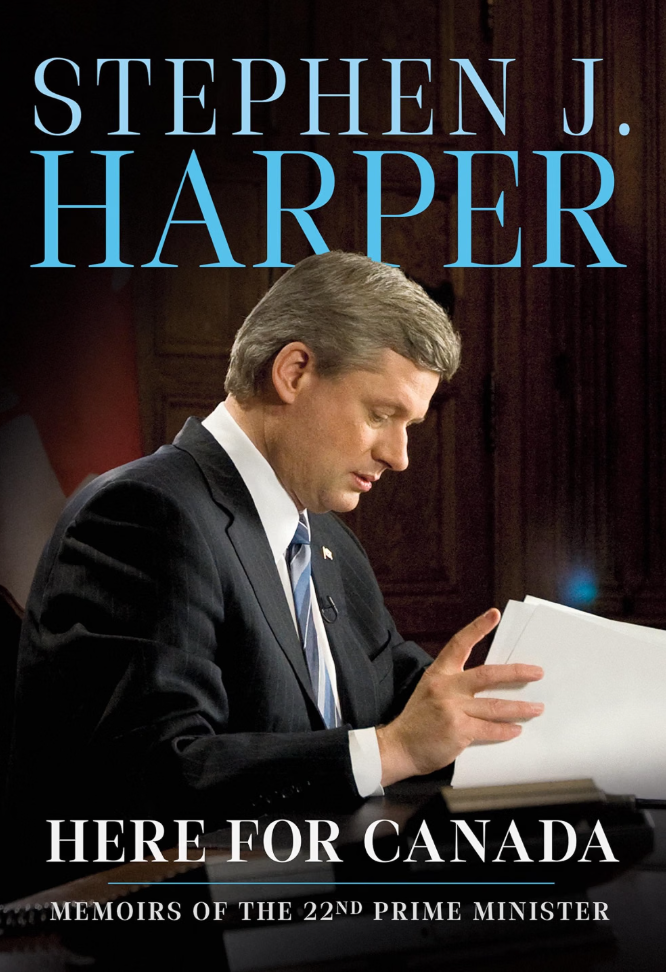
Here for Canada: Memoirs of the 22nd Prime Minister
By Stephen Harper
Penguin Random House Canada, November, 2026/656 pages
Reviewed by Michael Ignatieff
November 16, 2026
If you’ve clicked on this review of Stephen Harper’s new memoir expecting a vindictive screed filled with snark and freshly triggered political PTSD based on my status as one of the author’s more notable casualties, you’ve come to the wrong place.
After many years and a memoir — Fire and Ashes — therapeutically dissecting my career in politics as Stephen Harper’s opponent and quarry, I’m over it.
With that disclaimer, let me just get one retort off my chest: I was here for Canada, too.
Harper was a tough, relentless, disciplined partisan and politician. He radiated a kind of charm-free obliviousness to criticism which, whatever the truth, left him seemingly unperturbed by tough reviews from Press Gallery wags and the liberal intelligentsia.
In the end, like a bulldozer, he had his way. He won three elections, governed for nine years, and thanks to the alchemy of time and Ottawa amnesia, was fêted upon his return last spring for the unveiling of his official portrait on Parliament Hill.
This massive memoir, 650 pages long, is as relentless and disciplined as its author. He rarely lets his guard down. He does not dish the dirt. Scores are not settled, feathers are not ruffled.
He has pleasant words for some of his opponents, including yours truly. He’s warm about his family, candid when he confesses to exhaustion, and even admits a mistake here or there. The mistakes he will own up to are tactical. As for strategy, he is convinced that he was right all along.
Memoirs are a performance art, as I should know, and Harper’s is no exception. He is careful throughout to temper the ferocity of his old enmities.
In the 2011 election campaign, we Liberals had gone after him with our attack ads, and he relished his revenge, though you would never know it from this memoir.
The ads he authorized against me exploiting my years living in London and heading the Carr Center for Human Rights at Harvard — “Just Visiting”, “He Didn’t Come Back for You”, etc. — were so effective that strangers still ask occasionally whether I’m Canadian. I’ve never been anything else.
In politics, Harper was a lifer, a staffer on the Hill in his 20s and an MP in his early 30s. What set him apart—and made him Prime Minister—was the trajectory that led him to leave Eastern Canada and stake his political future on the Reform conservatism sinking root under Preston Manning’s leadership in the West.
When the Progressive Conservatives crashed to defeat and oblivion in 1993, he began a decade-long slog to take the leadership away from Manning and forge a new kind of coalition of Western Canadians, central Canadian Tories and bleus from Quebec.
Harper was one of the rare Reformers who had passable French, who understood you couldn’t be a national party without reaching out to Quebec. He was one of the rare central Canadians who took to heart Western alienation and also understood Westerners’ desire to exercise real power in Ottawa.
Memoirs are a performance art, as I should know, and Harper’s is no exception. He is careful throughout to temper the ferocity of his old enmities.
While he talks repeatedly about conservative ideology and values, these seem less sources of passion than his relentlessly clear-eyed focus on winning power. To do so, he forced the party into the centre, jettisoning anti-abortion, anti-Quebec, anti-immigrant strands of Reform and reaching out to francophone voters, new Canadians and women.
To this centrist orientation, Harper added fiscal responsibility, debt reduction and lowered taxes. He appropriated what he plausibly could of the moderate middle from the Liberals, while managing to hold on to the right-of-centre Conservative base of his party.
This is the historic achievement for which Harper will be remembered: making the Conservative Party of Canada electable and proving, in government, that it could govern, all without the people skills or natural extroversion of a Brian Mulroney.
In government, he burned the midnight oil in his office, mastered the briefs and showed that a policy wonk could not only run an administration but manage a party through five long years of minority government.
If you want to know what he thinks about managing the public service, choosing a governor general, or trimming old age security, you’ll find plenty of pages in this memoir to satisfy your policy passions.
Much of it is dull stuff to most people but he clearly loves it, which softens the slog. There is a surprising amount of space devoted to meetings with foreign leaders and he has some scathing remarks about the futility of many of the international summits that require a prime minister’s time.
Overall, the portrait Harper paints of the office he held is of a job that is simply too much for one man. By the time he was defeated by Justin Trudeau in 2015, he confessed to relief at regaining his freedom.
The critical moment in Harper’s tenure, when he could have lost office, came in late November 2008, when Jack Layton, Gilles Duceppe and Stéphane Dion made a secret agreement to bring the minority government down and install a coalition. Harper prorogued Parliament to forestall the confidence vote.
People like me in the Liberal Caucus, who had not been told about the agreement, were appalled that our party would sacrifice its federalist credentials for a coalition agreement that depended for its survival on the support of Gilles Duceppe, a committed separatist. Resistance to the deal grew in the caucus and Dion was compelled to stand down.
When I became leader, we made it clear to Harper we could only support a budget if it contained a plan to reflate the Canadian economy and if the government gave Parliament a quarterly report on its expenditures.
Up to that point, including their autumn economic statement, Harper and his minister of finance, Jim Flaherty, were trying to muddle through the crisis with the tax cut strategy on which they had been elected.
As Harper says in the memoir, he was only too happy to accept the deal and give Parliament its quarterly report since it would allow the government to take public credit.
He got the credit for saving the Canadian economy, survived to fight another day, and to this day, people ask me why we didn’t bring the government down. I reply that no Liberal party should ever seek the support of separatists.
To which I would add, no Liberal party should try to topple a government in the middle of a devastating economic crisis. Harper gambled that this was what we would think, and he was right.
So, in more ways than he might be prepared to admit, he owed some of his success to his rivals.
Stephen Harper was a fearsome opponent, a ferocious partisan and a serious Prime Minister. He is now enjoying the globe-trotting pleasures of high-level consulting with Harper Associates. I wish him well from the safe distance of Vienna, where I’m just as Canadian as ever.
Michael Ignatieff is Distinguished Affiliated Scholar at the Institute for Human Sciences in Vienna.