
Three Recommendations for Strengthening Budget 2026 Reporting
 Shutterstock
By Kevin Page and Abigail Sampson
November 18, 2026
The Carney government’s Budget 2026 is in the parliamentary approval stage, with the House of Commons debating the government’s budgetary policy and the legislative implementation process beginning.
Canadians broadly accept that the country faces a hinge moment requiring greater economic independence, investment and diversification, but they remain divided over the government’s borrow-to-invest fiscal strategy and unconvinced that it will improve their living standards (Abacus Data, Liaison Strategies, IPSOS).
The government’s main political challenge is demonstrating that higher borrowing will generate measurable investment, productivity and income gains rather than simply larger ongoing expenditures. Execution is fast becoming the central test because the anticipated growth benefits are uncertain and largely longer-term.
Trust and confidence are economic functions of a budget. Trust depends on the ability of legislatures, citizens and markets to see the whole fiscal picture — current position, future trajectory, policy costs and fiscal risks. A credible budget connects promises to implementation. Credibility matters, particularly when the cost of borrowing is rising.
In the current environment, the government must manage a credibility gap – public acceptance of the hinge moment diagnosis exceeds confidence in the fiscal strategy to address it. Better budget reporting should be part of the economic strategy to manage the gap.
Three recommendations are provided for strengthening Budget 2026 (and future budgets) implementation and fiscal reporting:
- Strengthen reporting on financial requirements and balance-sheet measures;
- Provide a clearer reconciliation of spending with the fiscal plan;
- Introduce a major-projects fiscal statement and implementation tracker.
Strengthen Reporting on Financial Requirements and Balance-Sheet Measures
Canada should modernize its presentation of borrowing requirements because the deficit alone no longer provides a complete picture of an increasingly investment-oriented fiscal strategy. Clearly linking the deficit, financial transactions, borrowing and resulting assets would give Parliament and Canadians a better basis for assessing what the government is borrowing for and what it receives in return.
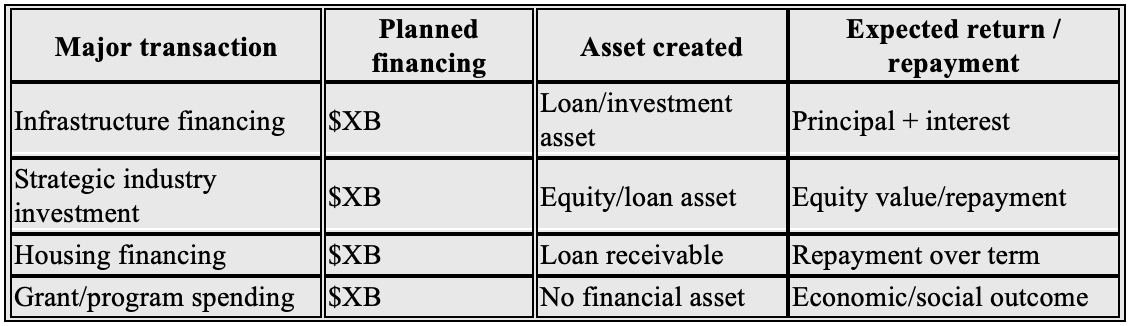
Budgets 2025 and 2026 put greater weight on investment. But if the fiscal strategy asks Canadians to accept more borrowing because it will create productive assets and future growth, the budget should make that proposition visible: How much is borrowed? Where does it go? What asset is acquired? What risk does government assume?
At present, the budget presentation largely focuses on budgetary transactions – revenues, expenditures and balances. It has been this way for many decades. Information on non-budgetary transactions, like loans, investments and advances or changes in non-financial assets are relegated to a separate table with little supporting information. Information on refinancing needs from maturing debt are relegated to an annex on the debt management strategy.
Canada already produces much of the underlying information. The issue is less about creating an entirely new accounting system and more about bringing the relevant information together prospectively in the budget, where fiscal choices are explained and scrutinized.
We are not recommending replacing the budgetary or operating balance as headline fiscal indicators. We are recommended building a more integrated bridge.
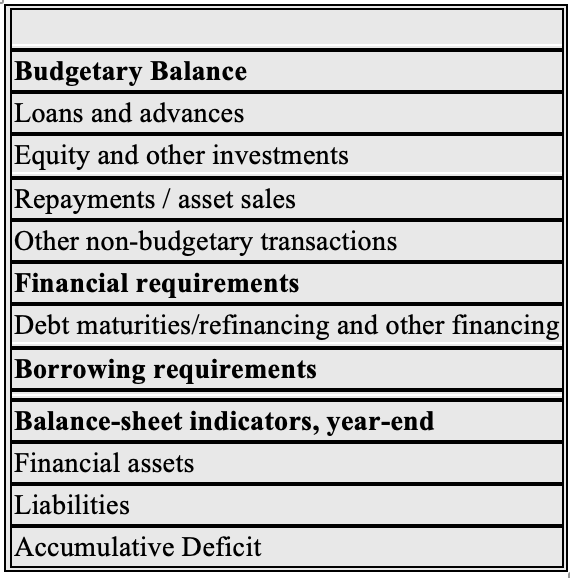
In Budget 2026, the planned budgetary deficit is $62 billion; net financial requirements are $150 billion; and borrowing requirements (reflecting refinancing needs) are $611 billion.
To reinforce the credibility of the government’s borrow-to-invest narrative, we need the legislature, citizens and markets to distinguish between borrowing that finances an asset on the federal balance sheet and borrowing that finances expenditure without creating a financial asset.
Finance Canada needs to develop a budget presentation that does not currently exist.
Provide a Clearer Reconciliation of Spending with the Fiscal Plan
Parliament and Canadians need a consolidated departmental spending plan with the Budget, tabled on budget day, showing planned spending by department over the fiscal forecast horizon and reconciling those amounts with the government’s aggregate expenditure forecast.
Many Canadians might be surprised that this does not exist for Parliament, whose job it is to authorize spending and hold the government to account.
This critical information exists for legislators in other countries on budget day – the United Kingdom, Australia, New Zealand, Norway, Sweden, the US, and more.
The weakness in Canada’s current model is not that departmental spending information doesn’t exist. It is the separation of the fiscal plan from detailed departmental expenditure planning. Instead, we ask Parliamentarians to wade through the Budget, Main and Supplementary Estimates and Departmental Plans.
This fragmentation makes a deceptively simple question difficult to answer – after Budget 2026, how much is each department expected to spend over the fiscal planning horizon?
Two large transparency gaps face parliamentarians as they approve Budget 2026. More than $70 billion of direct program spending (government operations and other transfers) was reduced over five years to help finance more than $140 billion in new budgetary measures. There was no departmental breakdown.
While a budget policy chapter provided a much-needed national security spending line for Canada’s commitment to NATO, planned spending for National Defence (the Department) was not included in the budget tables.
In the summer of 2025, Prime Minister Carney announced that Canada would start tabling budgets in the fall, months in advance of the start of the fiscal year. A great move.
The International Monetary Fund Fiscal Transparency Framework says comprehensive fiscal reporting strengthens the credibility of fiscal plans and can underpin market confidence and perceptions of fiscal solvency. We need a similar (Prime Minister-Finance Minister) commitment on the provision of departmental spending plans with the budget.
Introduce a Major Projects Fiscal Statement and Implementation Tracker
Budget 2026 makes the major-project strategy visible, but not yet fiscally transparent.
The budget identifies major projects, significant federal capital investment and the government’s broader investment strategy. What is missing is a consolidated accounting of how individual projects affect the medium-term fiscal plan.
Parliamentarians and Canadians cannot readily determine how much support takes the form of spending, loans, equity, tax incentives or guarantees; how these commitments affect cash requirements and borrowing; or what fiscal risks the government is assuming.
Greater transparency would mean publishing a project-level statement linking federal commitments to annual costs, financing requirements, private capital mobilized, key delivery milestones and expected economic returns.
A total of 18 major projects were identified in Budget 2026. The government should consider a consolidated major projects fiscal statement or tracker:
Project X (e.g., Mackenzie Valley Highway)
Total project value
Federal commitment
Instrument
- Contribution/direct capital;
- Loan/equity/guarantee;
- Tax credit/loan/contribution
Annual accrual/cash commitment
Maximum federal exposure
Private capital expected
Approval/construction status
This tracker should be an annex to the fiscal plan, not simply a Major Projects Office website dashboard. That would force the totals to reconcile with the budgetary balance, non-budgetary transactions and overall financial requirements, which is where the real transparency gain would come from.
The Case for Reform
Canada’s fiscal reporting must catch up with its investment strategy.
Budgets should show how major projects and balance-sheet measures affect borrowing and fiscal risk, and whether they deliver the promised economic returns.
Parliamentarians need timely budget information on departmental spending. Connecting investment, financing, delivery, and results is essential to fiscal credibility.
Kevin Page is the President of the Institute of Fiscal Studies and Democracy at the University of Ottawa, former Parliamentary Budget Officer and a Contributing Writer for Policy Magazine.
Abigail Sampson is a fourth-year undergraduate economics and political science student at the University of Ottawa. She plans to attend graduate school next year.