
‘A Noble Profession’: A Love Letter to the Teachers who Shape Us
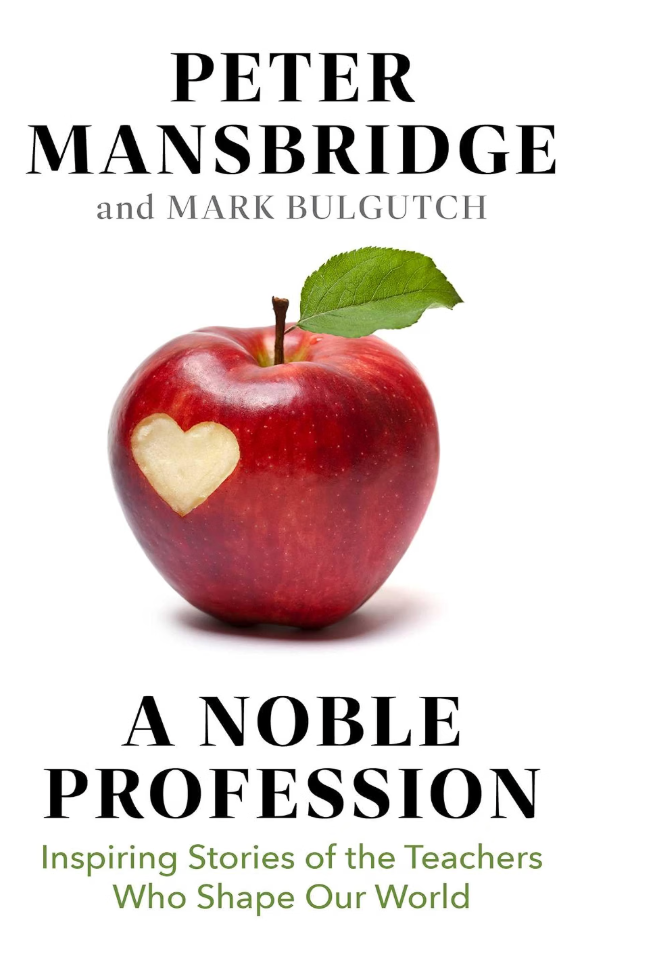
A Noble Profession: Inspiring Stories of the Teachers Who Shape our World
By Peter Mansbridge and Mark Bulgutch
Simon and Schuster, November 2026/336 pages
Reviewed by Anthony Wilson-Smith
November 25, 2026
Everyone has a favourite teacher. The one who saw something in them that not only nobody else saw, but maybe they didn’t see in themselves. The teacher who recognized a talent or brought a subject to life in a way that gave them a passion, a vocation or an avocation. That teacher whose commitment to the role went above and beyond the requirements of the job between bells.
In Canada, there are currently more than 400,000 teachers in public, elementary and high schools coast to coast to coast. Another 30,000 or so teach in private schools.
On top of that, there are more than 50,000 professors currently teaching in Canadian post-secondary institutions — not to mention countless others in such places as prisons, daycare, evening adult education classes, auto shops and more.
Not to forget the vast legion of retired teachers who’ve spent much of their adult working lives instructing others.
That’s a lot of Canadians spending their lives enriching the lives of others. As Peter Mansbridge and Mark Bulgutch remind us, we should be grateful to and for them.
The newest book from the longtime journalism colleagues, A Noble Profession, is a love letter to teachers. Its goal, along with paying tribute, is for readers to learn more about teachers rather than from them.
Happily, it succeeds in a way that should please every teacher: the book is, effectively, a fact-based platform on which teachers talk about their personal and often vastly different experiences.
Other than short introductory essays and their role in choosing their subjects and editing their stories, Mansbridge and Bulgutch give the floor over to their subjects.
The teachers’ stories, coupled with occasional, very welcome interruptions from some of the students whose lives they have changed, remind us of the many different skills, challenges, joys and sometimes heartbreak that come with the territory.
The overarching lesson: choose a profession in which you can touch many lives, and you will, in turn, be rewarded for doing so.
But as with other people in other professions, teachers get into their chosen career at different times for different reasons and often find themselves in vastly different environments.
Paige Driscoll went off to England to teach school, got married there — and when she returned to Canada, decided to accept a job teaching in a small Inuvialuit community on the shores of the Arctic Ocean.
Driscoll teaches traditional courses to mostly Innu students in the classroom and then, alongside them, absorbs lessons from their frequent trips outside to commune with nature in traditional activities ranging from animal trapping for food to ice fishing.
The recipient of a 2023 Prime Minister’s Award for Teaching Excellence, she says one of the things she has learned is that “Instead of focusing on what kids can’t do, we try to focus on what they can do well.”
For example, a young girl who was painfully shy in the classroom was completely transformed when she got outdoors and engaged in familiar land-based activities.
Sometimes, teachers come to their profession having already lived lives and challenges far beyond the realm of understanding for many people. Rebecca Okemow, who teaches classes ranging from kindergarten to Grade 8 at the Waywayseecappo School at God’s Lake First Nation in northern Manitoba, was sent away from her reserve when it came time to attend high school.
Mansbridge, for his part, knows Canada as well as anyone: there are very few of its constituent parts where he has not been, and despite all his years in an anchor’s chair, he retains a reporter’s passion for learning about life at ground level.
Okemow got pregnant at 16, left school to work at a meat-packing plant, and had three more children by the time she was 29. She then enrolled as a mature student in college, and within three years received her teacher’s certificate.
Of Cree heritage herself, she teaches the Ojibwe language to her students to reflect their own background and has also learned fluent Spanish from her husband.
She says her most important advice came from the late Indigenous elder Murray Sinclair, who said: “I want you to remember this one thing; if you want to be an excellent teacher, you must remember what it feels like to be a student.”
Sometimes, in turn, teachers impart their greatest gift through a willingness not only to teach, but also to listen and, especially, with a sympathetic ear. Josh Winters, who grew up in an intensely religious family in a very socially conservative Ontario town, realized early in life that he was gay.
But his parents refused to acknowledge that, and when his father became ill with cancer, he became angry at Josh and pushed him repeatedly to promise that he would marry traditionally and have children.
In his high school years, Josh was despondent and often considered suicide, reckoning that even though that was a sin within his family’s religion, it seemed a lesser sin than being gay.
But his English teacher, Candice Fung, had an open-door policy with her students and instinctively understood his dilemma. She quietly encouraged him to gain the strength and confidence to accept himself as he was.
Many years later, Winters credits Fung with literally saving his life and giving him the confidence to move forward, true to himself.
These are just some of the wide variety of stories, told with compassion, enthusiasm and a clear-eyed awareness of the many challenges that life at all stages brings.
Many of the stories Mansbridge, Bulgutch, and their subjects tell involve experiences in environments that will be familiar to readers, such as big-city classrooms and the small towns where, by necessity, many students share the same teacher and class space.
Bulgutch — Mansbridge’s producer at CBC’s The National for so many years when Mansbridge was anchor — has always had a keen eye for the small details that add so much texture to the larger picture.
Even though these stories are told in first person, that attention to detail is evident in the completeness of each chapter.
Mansbridge, for his part, knows Canada as well as anyone: there are very few of its constituent parts where he has not been, and despite all his years in an anchor’s chair, he retains a reporter’s passion for learning about life at ground level.
In his introductory chapter, Mansbridge relates how the idea for the book grew from an episode of his popular podcast The Bridge, when he threw out the question one day: “Who was your favourite teacher and why?”
As he tells it: “Almost immediately, my computer and mobile started dinging, and emails from coast to coast to coast began pouring in and didn’t stop”, with listeners relating anecdotes.
That led to the idea of a book of appreciation for teachers, what they do, and how they do it. Give them an ‘A’ not only for a well-intentioned effort, but for succeeding in their goal.
Policy Contributing Writer Anthony Wilson-Smith is President and CEO of Historica Canada.