
A Very British Coup, or He Who Dares, Wins
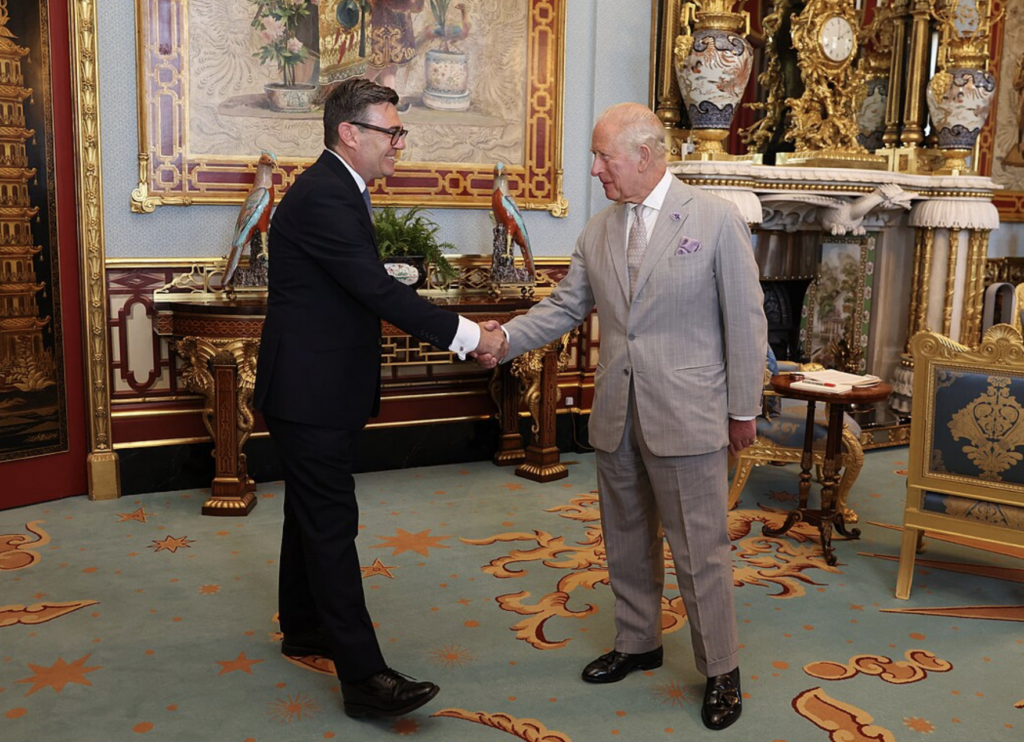
Incoming UK Prime Minister Andy Burnham and King Charles on Monday, July 20th/No. 10 Downing Street
By Jeremy Kinsman
July 21, 2026
On July 20, The United Kingdom underwent a peaceful transfer of power, with a twist.
Andy Burnham, acclaimed July 17th as leader of the Parliamentary Labour Party (in Canadian terms, the party caucus), became prime minister over the political carcass of Sir Keir Starmer after months of unprecedented but colourful public transitioning from one leader to the other.
On Monday, Starmer’s exit meeting with King Charles was followed by Burnham’s entry meeting with the King, for what as once the “kissing of hands” that constitutes the formal appointment of the prime minister. Of course, lips and hand no longer connect today. Not even an air-kiss swoop is attempted; only a partial bow, before the King asks his guest if he will form a government to present to Parliament. When hearing the affirmative, the King offers, “Congratulations, Prime Minister.”
Burnham next went the short distance down the Mall to No. 10 Downing Street, where supporters, staff, family and guests waited expectantly, some of whom had been present earlier in the day when Starmer bade farewell.
In British politics, change at the top happens with brutal and swift finality. Vans had already carried out the Starmers’ belongings, making way for the incoming family’s clothes, books, and personal treasures.
Burnham is the seventh prime ministerial occupant of 10 Downing in a decade, a disruptive rate of churn, even for permanent household resident Larry the Cat, whom David Cameron plucked in 2011 from the Battersea Animal Shelter.
The public lost faith in successive Conservative leaders, lurching from one to the next hoping for one sufficiently competent and principled to believe in.
Cameron resigned after the fateful 2016 referendum on Brexit, succeeded by pragmatic conciliator Theresa May, in turn overthrown in 2019 by hard-line Conservative sovereigntists, who backed mercurial but chronically untruthful Boris Johnson, who promised to “get Brexit done.”
He governed through Covid like an entitled clown. After evidence that Johnson had misled parliament, the Conservatives turned to the unexamined Liz Truss, whose loony libertarian instincts triggered revolt by the markets and a run on the pound. She was gone in 44 days, validating the bet by the London Star that an iceberg lettuce would last longer. Conservatives chose as leader and Prime Minister a calm, moderate, unpolitical, figure, Rishi Sunak, who called a snap 2024 election.
In 2020, Labour had changed leaders from very leftist Jeremy Corbyn, choosing the safe, moderate human rights barrister and former Director of Public Prosecutions Sir Keir Starmer, hoping his no-drama competence would end 14 years of topsy-turvy Conservative reign.
Labour won a whopping parliamentary majority, though with only 33.7% of the popular vote. Devastated Conservatives plunged to a historic low of seats and vote share – 23.7%.
Starmer’s huge majority was to give Labour the time until the next election in 2029 to develop an ambitious plan to redress the sluggish economy, staunch deterioration in public services, and to get a grip on asylum-seeking irregular immigration.
However, Starmer’s tenure swiftly fell flat. Hyper-cautious and fairly pedestrian, he seemed to lack political judgement, committing several blunders. The sullen public needed positive energy, but Starmer failed to communicate an inspirational narrative.
Burnham’s style has been refreshingly straight-talking, fact-based, eloquent, and informal. He obviously has the gift essential to successful retail politicians — he likes people and they him.
As Donald Trump unleashed tariffs on friend and foe alike, Starmer’s efforts to ingratiate himself with the volatile president fell flat with the Trump-averse UK public, and his approval rating sank to the low 20s.
Meanwhile, Nigel Farage’s extremist Reform Party was charging ahead in the polls.
By the autumn of 2025, worry within Labour about Starmer’s leadership persuaded popular Manchester Mayor Burnham at the annual party conference to test interest in a leadership review. Party authorities swiftly stifled the effort, but it had the effect of establishing Burnham — a former MP, junior minister under Tony Blair and Gorden Brown, and failed leadership hopeful in the race won by Ed Milibandin 2010 — as the logical alternative.
Party rules stipulated only sitting Westminster MPs could mount a leadership challenge, and after party HQ blocked his candidacy for an upcoming by-election, making Starmer appear weak, a different Manchester-area riding was freed-up for Burnham. He won in Makerfield, and from there it was a matter of but a month to Buckingham Palace.
Burnham’s style has been refreshingly straight-talking, fact-based, eloquent, and informal. He obviously has the gift essential to successful retail politicians — he likes people and they him.
It turns out that the Labour Party does want an experienced politician as leader, one with brio and a bit of swagger, but with solid core values out front. Burnham’s natural transparency conveys authenticity. His ambitious self-confidence resonates amid the post-Brexit slump in the disgruntled country.
Returning from Buckingham Palace on Monday, Burnham spoke to the country against the globally familiar front door of 10 Downing with no podium, no notes, but with a coherent recipe for hope. He intends to distribute more political/administrative power away from London, to Manchester and elsewhere, in the interests of people, whom he places at the centre of his policy ambitions.
That evening, Burnham unveiled a cabinet with a mix of tendencies, from progressive to pragmatically moderate, with the principal qualification appearing to be proven strength in execution. Starmer, to whom Burnham has paid tribute, had cautioned him that events will force him to immerse himself in unfolding international affairs more than he expects.
His foreign affairs and security team is compelling, with progressive internationalist and former party leader Ed Miliband in the Foreign Office, Wes Streeting — whose resignation from the Starmer cabinet was one of the 1000 defenestration blows — at Defence, and veteran policy strategist and former Blair and Starmer senior adviser Jonathan Powell staying on as Burnham’s national security adviser.
Burnham immediately assured president Volodymyr Zelensky that the UK will not diminish its commitment and actions in support of Ukraine.
As to the U.S., media there are wondering how such a “liberal” will get along with President Trump. Burnham will be frank, cordial and very much himself, but will not make the “special relationship” the be-all and end-all of UK foreign policy preoccupations, in the same way that Canada’s priorities have shifted.
Some ask whether Burnham’s sudden rise to No. 10 is democratic, in that he wasn’t even a candidate in the 2024 national election, wasn’t a member of Starmer’s cabinet, hasn’t been elected in a national vote and, so far, doesn’t seem keen to call one.
Constitutionally, the British elect a Parliament, not national leaders directly. Nonetheless, after the Tory parliamentary caucus voted to replace Margaret Thatcher with John Major, he whimsically confessed privately to have worried that until he won a national election as leader, which he did in 1992, that he’d be “living in sin.”
Time will tell whether Burnham’s poll numbers will rise the way Mark Carney’s did when he replaced an unpopular leader and re-directed Canada’s Liberal Party. If so, and as Farage’s star fades because of scandals, Burnham may go for it before long.
Either way, Britain today is upgraded and more stable, and Europe, Canada, Australia, and other partners are cheered by the new vibe.
Policy Columnist Jeremy Kinsman served as Canada’s ambassador to Russia, high commissioner to the UK, ambassador to Italy and ambassador to the European Union. He is a Distinguished Fellow of the Canadian International Council.