
Adventures in Banking: Rick Waugh’s Canadian Horatio Alger Story
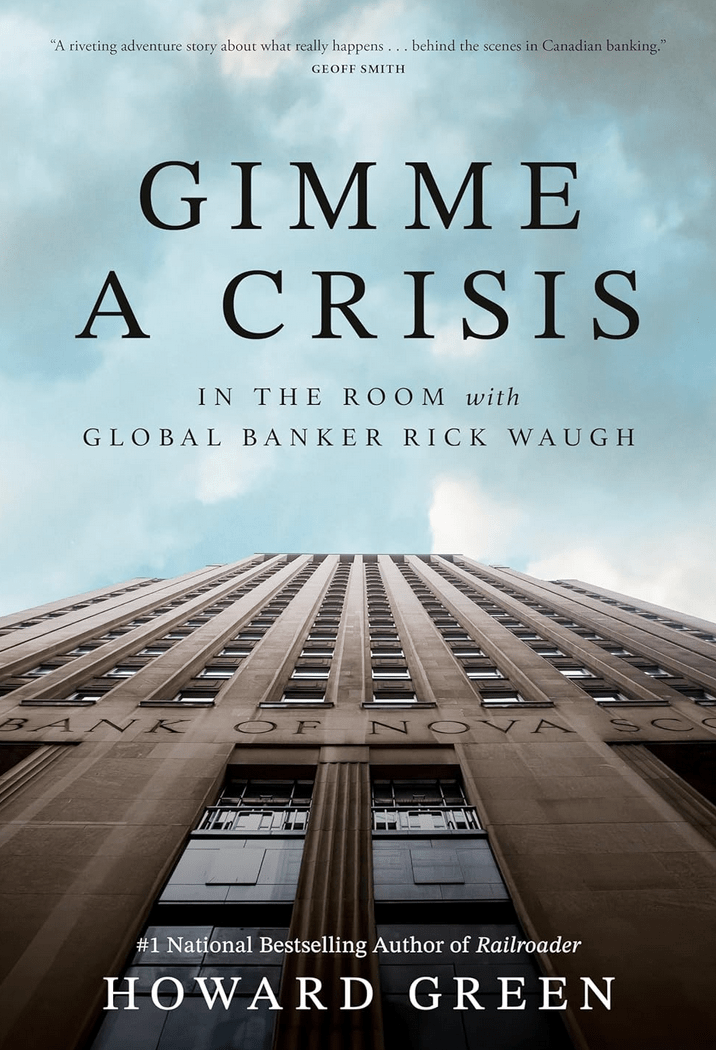
Gimme a Crisis: In the Room with Global Banker Rick Waugh
By Howard Green
Penguin Random House-Viking Canada/October 2025
Reviewed by Anthony Wilson-Smith
October 3, 2025
Of the enduring descriptions of bankers and banks, more than a few focus on two qualities that seem antithetical: the skill of those institutions at finding new ways to shake more money loose from their clients, and the supposedly dull nature of the people within.
Consumer advocate and Democratic Senator Elizabeth Warren has frequently argued that bankers should be boring. Her point: when they get too interesting or creative, bad things happen, like the 2008 banking meltdown that threatened the entire global economy based on the securitization of subprime mortgages via “exotic financial instruments”. As Warren wrote on Twitter (now X) in 2023: “Anyone who wants to take on a lot of risk to make a lot of money should not be in banking.”
To counter that argument — for which Warren makes some compelling points — consider Rick Waugh, now-retired CEO of Scotiabank. Consider, also, the history of Scotia and other major Canadian banks. Exhibit A is Gimme a Crisis: In the Room with Global Banker Rick Waugh, the at-times almost breathlessly entertaining new book by veteran Canadian business journalist Howard Green.
In it, Green traces the career of one of the most compelling figures in our country’s financial sector of the last half century against the backdrop of a bank that has grown enormously by almost every measure, while weathering some major storms — some of its own making.
Waugh’s rise from a tiny Winnipeg bungalow housing seven people to the top of the country’s financial circles reads like Canadian Horatio Alger.
His dad, a firefighter, died of heart disease caused by his job at age 54; Rick was 12 years old before he got a retail haircut because of the cost; the big meal of the day was, more often than not, Kraft Dinner (which he can no longer bear to eat); in public school, he contracted tuberculosis (then often fatal) and missed a year of school. He became renowned among friends — and eventually among colleagues and customers — for his malaprops or ‘Rick-isms’, which served as charming cover for his toughness and keen intellectual and emotional intelligence.
As Green recounts, on one occasion, Waugh unwittingly pulled off a ‘triple play’: in short order, he referred to something taking place by ‘happenchance’ rather than ‘happenstance’: described a coin as having no ‘pneumatic’ value when he meant ‘numismatic’; then said someone’s initials had been ‘embezzled’ on something when he meant ‘emblazoned.’
But as is clear from numerous anecdotes in this deeply researched book, Waugh was comfortable with himself (even with his sometimes-distressing choice of tie) and that put everyone at ease. As one longtime colleague said: “Rick was one of the most deceptively intelligent people I’ve ever known.”
In fact, Green argues, Waugh’s most striking qualities made him entirely suited for banking: “He was an instant pal who could authentically put his arm around you and close a lending deal at the same time, he had the requisite ice water coursing through his veins.” He also grew up in remarkably talented company: childhood friends with whom he remains in warm contact include Gary Doer, the former Manitoba premier and ambassador, and Arni Thorsteinson, the commercial real estate magnate and philanthropist.
From an early age, Waugh had the gift of being liked and respected by those to whom he reported, those reporting to him, and sometimes those in competition.
From an early age, Waugh had the gift of being liked and respected by those to whom he reported, those reporting to him, and sometimes those in competition. His engaging personality, Green writes, is coupled with his genuine interest in those around him. (As CEO, he became a strong advocate for promoting women in a bank with a longtime culture – like most Canadian financial institutions – of male dominance.) That said, his blunt, hard-charging manner in a culture that has demonstrably prioritized conventionality, inevitably ruffled some feathers – but not enough to ever knock him off track.
Perhaps Waugh’s greatest gift as a banker, as Green demonstrates, was an almost uncanny ability to quickly synthesize complex information and recommend clear outcomes that, far more often than not, were the right ones. With deceptive ease, he rose rapidly through the ranks, first in increasingly important jobs in Toronto, then as a major rainmaker of deals in New York City, then back to Toronto to very senior positions that finally led to the top job in 2004. He stayed until 2013 (consistent with the unwritten tradition at all major banks that CEOs usually stay for roughly a decade), then retired.
Waugh’s career was also marked at times by engagement in events as outsized in their impact as the force of his personality – but less positively. Green devotes several chapters to Scotia’s long, sometimes fraught history in Latin America and the Caribbean. While engagement in both has been successful overall, there have been challenges that sometimes transcended even the high financial stakes involved.
Chapters on the bank’s adventures in the Dominican Republic, Argentina during its millennial economic crisis, and Haiti amid its struggles with poverty and criminal gangs detail episodes downright terrifying at times. Waugh was deeply involved in efforts to rescue the bank and its executives in 2002, when the Argentine government turned hostile, refused to allow some of them to leave the country, and threatened imprisonment.
In Haiti, conditions were routinely so fraught that senior executives were protected by armed guards around the clock at home and in their vehicles. Bank executives from outside the country were discouraged from visiting because of the dangers. Waugh ignored that, flying in to conduct his own ground-level assessments. He also played a role in colourful but less hazardous bank engagements. His time in New York City allowed him to build relationships with top American financial figures, such as JP Morgan CEO Jamie Dimon and Donald Trump, with whom he was not impressed.
If Waugh is something of a dream protagonist around whom to build a book, the other key figure is Green himself. The author of three well-received previous books – Banking on America, on TD Bank; Distilled, on mega-philanthropist Charles Bronfman (co-authored with the subject); and Railroader, on the late railway executive Hunter Harrison, Green has a deep understanding of how business works and the people who make that happen. In his long career as lead anchor at BNN Bloomberg business television network, he was the go-to interviewer for the country’s leading executives.
Many CEOs (I learned in my time in corporate communications) insisted their interviews be conducted by Green. That was because he was invariably well-informed, courteous, and more interested in giving his subjects a chance to air their thoughts than in dominating the space himself (not always essential requirements in 21st century media.)
The same qualities shine through in this deeply informed, engaging book. Those familiar with the world of high finance will appreciate the finely drawn portraits of how deals come together, and the myriad qualities, good and less so, of the people involved. Those who are less aware will likely be surprised by how human the process is. Alongside the many complex calculations, many deals are done – or undone – because of the chemistry that exists or is absent between key players on the two sides or even sometimes, ostensibly on the same team.
The book’s title — ‘Gimme a Crisis’ — is a direct quote from Waugh that reflects his enthusiasm for trying times that test people’s qualities to the maximum.
In his closing paragraph, Green calls on a description from the great tennis player Billie Jean King about her dad, a firefighter just like Rick Waugh’s. He was, she wrote, “one of the coolest heads in the fire department under duress…as a rule, the bigger the problem, the better he was.”
The same, Green writes, was true of his subject. Contrary to the cliché about bankers, life around Waugh was, and still is, never dull.
Anthony Wilson-Smith is President of Historica Canada and former Editor-in-Chief of Maclean’s magazine.