
All the G7s Kananaskis Will Not Be Like
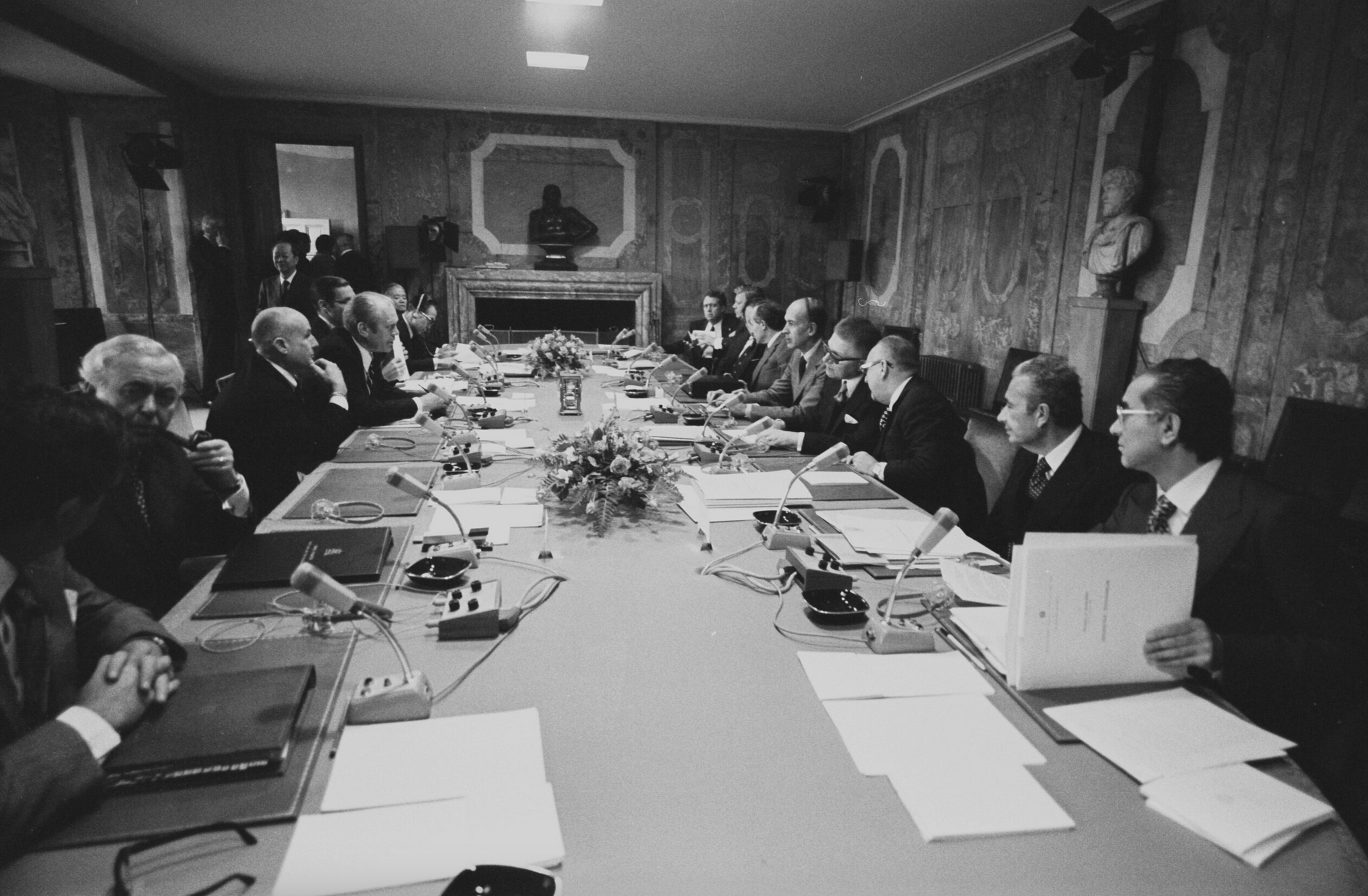 The Rambouillet G6, in 1975, the year before Canada joined and made it the G7/White House
By Lisa Van Dusen
June 5, 2025
The upcoming Kananaskis G7 has been pre-emptively framed as many things — the most important G7, the most impactful G7, the most Canadian G7. What is certain is that it is already the most unpredictable G7 based on the source of — and unprecedented factors feeding the anticipatory anxiety around — that unpredictability.
For instance, there has never been a G7 at which one of the leaders has publicly declared his intention to unilaterally annex the host country and — check against day-of — declined to retract that threat before the class photo.
There has never been a G7 at which one of the members was waging an unprovoked economic war against other members. Indeed, there has never been a G7 at which one of the leaders was an American president in the process of transforming the democratic superpower into a political, geopolitical and economic basket case.
All of which, understandably, has led to no small degree of stress surrounding the vastly expanded melodramatic and headline probabilities around this summit, which are somehow both baked into expectations and seen as the responsibility of the stable actors at the table rather than the volatile one.
So, it may help defuse that stress to conceptualize the upcoming Kananaskis G7 based on a process of definition-by-negation that isolates its essence from all the things it will not be.
First of all, it will not be the 2002 Kananaskis G7 (G8), which was the first G7 held after 9/11, amid heightened site security but with an agenda that largely telegraphed multilateral business as usual with a new partnership for African development dominating as planned. It was hosted by Jean Chrétien, Vladimir Putin was there per the expanded G8, and there was no final communiqué but instead a Summit Chair’s Summary — something to keep in mind if and when the lack of a communiqué on June 17th is portrayed as exceptional or unprecedented.
This Kananaskis G7 will not be like that Kananaskis G7, in part because the greatest threat to global security at the table this time will be the president of the United States, including as the principal security threat to his own country.
Second, it will not be the 2009 G7 (G8) at L’Aquila, Italy, which was the first post-2008 financial cataclysm G7, with all the renewed emphasis on the global economy warranted by that crisis, somewhat pre-empted by the crucial role of the second G20 Leaders’ Summit in London two months earlier as the major multilateral first responder.
This G7 will not be like that G7 because this time, the greatest economic threat of the day is not a contagion of collateralized debt obligations littering the financial markets like complexity camouflaged IEDs, but a president of the Unites States waging unprecedented economic war on the world — including against America’s traditional allies, the host country of Canada among them — via unprovoked, irrational tariffs.
Third, it will not be the 1997 Denver G7, which was actually the first G8, attended by Boris Yeltsin representing the burgeoning-but-doomed promise of post-glasnost Russia. As it turned out, including Russia among the world’s largest economies would not solve its shock therapy problem, and including it among the world’s wealthiest democracies would not make it a democracy.
For instance, there has never been a G7 at which one of the leaders has publicly declared his intention to unilaterally annex the host country and — check against day-of — declined to retract that threat before the class photo.
This G7 will not be like that G7 because the biggest threat to democracy at the table this time will not be an economically destabilized Russia led by an unpredictable, mercurial, unreliable populist. The biggest threat to democracy at this G7 will be an economically destabilized America led by an unpredictable, mercurial, unreliable populist.
Fourth, this G7 will not be the 2018 Charlevoix G7 because the greatest disruptive threat to the diplomacy of this G7 will not be a populist, black-swan president of the United States who careened to power on celebrity name recognition and a weak opponent. The greatest disruptive threat to the diplomacy of this G7 will be an emboldened, twice-impeached, coup plotting, autocratic president of the United States whose very presence betrays something seriously amiss with American democracy.
This G7 will not be like that G7 because, at that G7, the president of the United States waited until he was just out of Canadian airspace before tweet-bombing the summit from Air Force One which, in retrospect, seems like decorum. Everything Donald Trump has done in his eventful second term indicates that he is unlikely to display such restraint this time.
Fifth, this G7 will not be the 2014 Brussels G7, transplanted from Sochi after Vladimir Putin’s illegal invasion of Crimea prompted not so much Russia’s suspension from the G8 but the seven other countries’ self-suspension from the G8 via the Hague Declaration of March 24, 2014, reverting the group by default to the G7 and relocating that June’s summit from the Black Sea resort to Brussels.
This G7 will not be like that G7 because the greatest threat to the integrity of sovereign countries this time will not be a suspended Vladimir Putin. The greatest threat to the integrity of sovereign countries this time will be at the table: a president of the United States who has repeatedly threatened to invade, annex, and economically subjugate a selection of sovereign countries in violation of Article 1 of the United Nations Charter, including the G7 host passing the salt.
The group born in 1975 as the G6, which became the G7 with Canada’s admission in 1976, was the brainchild of then US Treasury Secretary George Shultz. It was anchored for decades in the diplomatic domination of America’s heft as first the ascending superpower, then the unipolar superpower. So, suspending the United States is nowhere near as simple a matter as suspending Russia.
Which leaves both Canada and the G7 as a multilateral entity that has survived all previous political, geopolitical and economic dramas over a half-century either crossing their fingers and watching the clock, or failing to adapt quickly enough to the reality of an American president who may prove to have been the most unserious, serious threat ever to the group’s existence.
Amid a global power realignment in which that president seems to have taken a side in a way that includes the obliteration of status-quo institutions multilateral and otherwise, what we do know about this G7 is that it is unlikely to be like any previous G7.
Policy Editor and Publisher Lisa Van Dusen has served as Washington bureau chief for Sun Media, international writer for Peter Jennings at ABC News, senior writer for Maclean’s and as an editor at AP National in New York and UPI in Washington.