
‘All the President’s Wars’: Peter Bergen’s Iraq-Afghanistan Postmortem
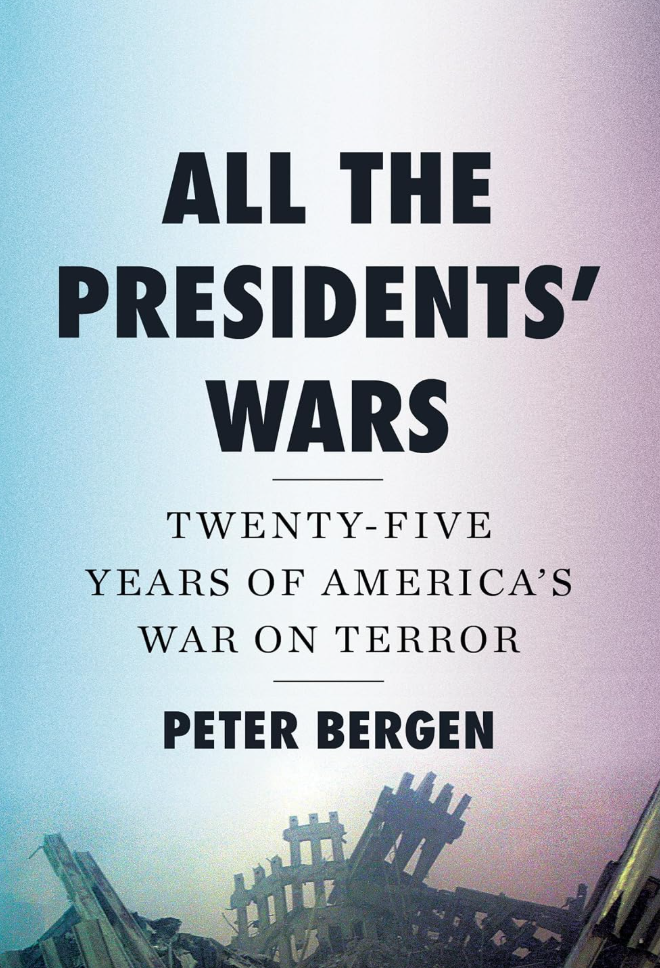
All the Presidents’ Wars: Twenty-Five Years of America’s War on Terror
By Peter Bergen
Penguin Random House Canada, September 2026/384 pages
Reviewed by Colin Robertson
September 27, 2026
All the Presidents’ Wars: Twenty-Five Years of America’s War on Terror is veteran journalist, commentator and New America Foundation Vice President for Global Affairs Peter Bergen’s verdict on America’s war on terror. Bergen is severe but fair.
Since 2001, the United States has prevented another foreign-directed attack on the scale of 9/11, dismantled al-Qaeda’s original sanctuary, killed Osama bin Laden and destroyed the Islamic State’s territorial caliphate.
Yet, as Bergen writes, it also invaded the wrong country, practised torture, spent trillions of dollars, enlarged presidential war-making power and left the Taliban governing Afghanistan.
Putting this mixed record in perspective is the strength of All the Presidents’ Wars. Bergen neither claims that everything failed nor mistakes tactical achievement for strategic success.
Washington became highly proficient at finding and killing enemies but repeatedly failed to define the political result military power should produce. As Bergen told NPR, governments must “plan for the day after”, or win the war and lose the peace.
George W. Bush made the largest error. The post-9/11 war in Afghanistan had a clear enemy, allied backing and NATO’s first invocation of Article 5. The Taliban fell and al-Qaeda lost its sanctuary.
But Washington let bin Laden escape at Tora Bora, diverted resources to Iraq and turned justified counterterrorism into open-ended political transformation.
Iraq was not merely a sound policy badly executed. Saddam Hussein had no operational alliance with al-Qaeda; intelligence was bent around a decision already made. The invasion removed a dictator but shattered the state. Disbanding the army and de-Baathification created trained, aggrieved recruits for al-Qaeda in Iraq and later for ISIS.
As Bergen writes, “The pool of potential terrorists expanded quite dramatically because of the Iraq War“. The surge and Sunni Awakening later reduced violence, but they treated a disease the invasion had helped create.
Barack Obama was more disciplined but strategically ambiguous. He ended the CIA’s “enhanced interrogation” program, authorized the bin Laden raid, and built the coalition that rolled back ISIS. Yet, he escalated in Afghanistan, expanded drone warfare and intervened in Libya without a viable postwar plan.
Donald Trump’s first administration accelerated the anti-ISIS campaign and killed Abu Bakr al-Baghdadi.
Bergen approves of supporting local partners with intelligence, advisers, special forces and air power — “go light and go long”. But Trump’s 2020 Doha agreement excluded the Afghan government and gave the Taliban a withdrawal date, removing its incentive to compromise.
Joe Biden inherited that bad bargain, but he owned the chaotic withdrawal and the failure to protect many partners. Bergen’s preferred alternative — roughly 2,500 troops sustaining the Afghan government — is plausible, not proven; it might only have postponed collapse.
Trump’s second-term war with Iran is an unsettling postscript. Its combination of dubious casus belli, absent exit strategy, and nonexistent endgame again illustrates Bergen’s warning: destruction is an activity, not a strategy.
Bergen’s final lesson is austere: terrorism can be contained but not conquered. Force can disrupt plots, defend populations and buy time; it cannot substitute for politics.
Yet, the presidential focus obscures shared responsibility. Especially in the case of Iraq and Afghanistan, these were also Congress’s, the Pentagon’s and, in the case of the first two, the public’s wars.
The war on terror, argues Bergen, could not be “won”, it could only be managed, because terrorism is a tactic, not a state. Intelligence sharing, aviation security, financial controls, and policing only made foreign plots easier to disrupt.
Brown University’s broader Costs of War estimate reached about US$8 trillion through fiscal 2022, while vast civilian death and displacement multiplied the harm.
There were also constitutional and moral costs. Guantánamo, extraordinary rendition, Abu Ghraib, and broader torture policy contradicted the values America claimed to defend; the Senate Intelligence Committee found the CIA’s coercive techniques ineffective. Congress’s broad post-9/11 authorization became an enduring licence for presidential war.
Bergen’s “day after” test is necessary but insufficient: Iraq had plans, only they were fanciful. Military victory cannot manufacture local legitimacy or institutions faster than politics allows. The deeper failure, as Philip Gordon’s Foreign Affairs assessment suggests, was allowing “legitimate fears and a quest for absolute security” to turn bounded self-defence into overreach.
Canada paid heavily in Afghanistan: more than 40,000 Canadian Armed Forces members served there and 158 died there. The political outcome does not diminish their service; it does oblige Canadian governments to adopt certain lessons from that outcome:
First, preserve independent judgement. Jean Chrétien was right to join the legitimate campaign against al-Qaeda in Afghanistan and right to keep Canada out of the Iraq invasion without Security Council authorization. Alliance solidarity is not automatic assent. Ottawa should ask whether the threat, legal basis, political objective, and proposed remedy fit together.
Second, require a written strategy before major deployments: identify the enemy, political goal, authority, civilian protections, cost, measures of progress, exit conditions and post-conflict plan. Cabinet should publish as much as security allows and seek a parliamentary vote for major combat. Bergen suggests parliamentary systems provide stronger checks, but Canadian deployments remain an executive prerogative. Scrutiny must be designed, not assumed.
Third, use NATO, the UN, the Five Eyes and other coalitions to test intelligence, distribute burdens and constrain mission creep — not merely to decorate decisions already taken. Multilateral approval cannot rescue a vague objective: Libya had allies and a UN mandate but no workable day after.
Fourth, invest in capabilities that prevent violence without war: human intelligence, languages, regional expertise, financial investigation, cyber capacity, police cooperation, digital literacy and community resilience. Public Safety Canada’s prevent, detect, deny and respond framework is sound if programs are continually tested for effectiveness and respect for rights.
Finally, distinguish bounded counterterrorism from nation-building. A modest, sustained mission with capable local partners may suppress a dangerous organization; the anti-ISIS coalition shows that.
But “go light” must not mean shifting unlimited risk to civilians and proxies or evading democratic consent. The test is not how few Canadians deploy, but whether force can produce a defensible political result without creating a larger grievance, dependency, or war.
Bergen’s final lesson is austere: terrorism can be contained but not conquered. Force can disrupt plots, defend populations and buy time; it cannot substitute for politics.
Before Canada follows an ally into another war, ministers should answer three questions: What precise danger are we stopping? What settlement can endure after combat? What evidence would make us change course? If those answers are vague, the strategy is vague. The damage will not be.
Contributing Writer Colin Robertson, C.M., C.D., a former career diplomat, is a fellow and host of the Global Exchange podcast with the Canadian Global Affairs Institute in Ottawa.