Amid the Multilateral Chaos, is it Time to Resurrect the ‘Functional Principle’?
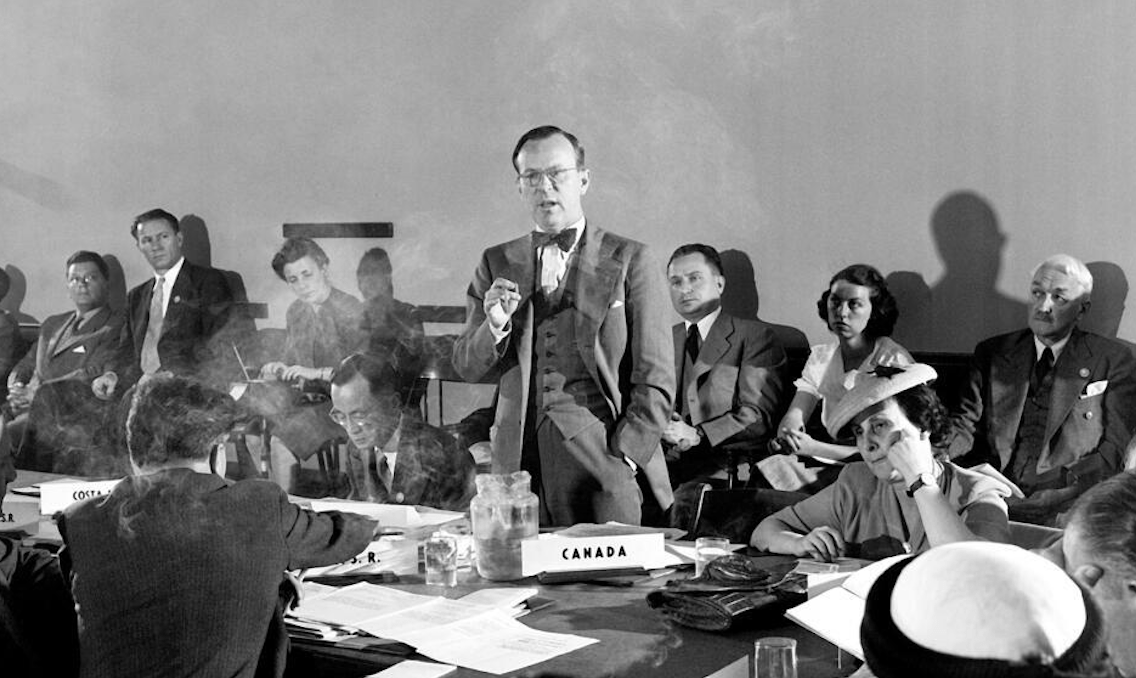 Lester Pearson at the United Nations founding conference in San Francisco on June 15, 1945/UN Photo
September 21, 2025
On this 80th anniversary of the United Nations, one major consideration — possibly an existential one — has lent an air of crisis to the occasion.
Eight months into his second presidency, Donald Trump and his administration seem determined to undermine or even destroy the very international institutions the United States had been so instrumental in creating, including the UN. We saw this coming at the 2018 G7 Charlevoix Summit, when Trump and his officials refused to agree to language calling for the preservation of the rules-based international order. There was nothing subtle or open-to-interpretation about it.
Among the other avenues by which this repurposing of America’s power may play out at the UN; the Trump administration may increasingly wield its Security Council veto power against the interests and policies of its long-standing allies, including fellow permanent council members the United Kingdom and France, as well as close partners like Canada.
In reflecting on recent events, the UN’s 80th anniversary, and where the evolving status quo leaves Canada, I went back to my University of Edinburgh PhD thesis, titled Towards principled influence: an overview of Canadian foreign policy, 1943-1948.
We were still a young country then; the Statute of Westminster having granted us 12 years earlier the complete power to handle our own foreign relations. The Department of External Affairs was staffed by a small cadre of diplomats housed on the third floor of the East Block (where, ironically, I now have my office). Our representation abroad was minuscule and the cautious liberalism of “no commitments” of Prime Minister William Lyon Mackenzie King had been the mantra guiding our foreign policy thought throughout the two decades before the war.
Amid another major upheaval, our becoming a belligerent in World War II changed all that.
In June of 1945, during a radio broadcast from the United Nations Conference on International Organization in San Francisco, leading Canadian delegate Lester B. Pearson, then Canada’s ambassador to the United States, framed the emerging guiding philosophy this way: Canadian foreign policy could not develop out “of any delusions of grandeur or overweening ambition, but out of an intelligent understanding of her own self-interest.” The modesty may have been false, as Canada played a significant role in the establishment of the UN and its specialized agencies. But the direction was clear and has served as our guide ever since.
In helping to define and develop postwar multilateralism, Canadian policy planners, particularly the senior triumvirate of Lester Pearson, Norman Robertson and Hume Wrong, embraced “the functional principle” as their leitmotif. Not originally a Canadian idea, it featured the notion that the “Great Powers” could dominate international affairs, but that control should also be shared with other (middle) powers who were willing and able to make a definite contribution to the goals at hand.
If allies can assemble a ‘coalition of the willing’ to deal with the war in Ukraine, why not a similar one to rescue and repurpose our most venerable global institution, the United Nations?
As adopted by Canada, this meant that leading representation on international councils and committees should be given to those states who, through their resources and international experience, found themselves closely associated with economic and social concerns. The functional principle drove Canadian participation and leadership in the early years of the UN and the formation of its specialized agencies. We still engage multilaterally based on the functional principle, but with mixed results.
The monikers have changed over the years: Canada as the “helpful fixer,” to this day the purveyor of ideas, the pursuer of “enlightened self-interest,” the epitome of “responsible conviction” and now apparently the proponent of “pragmatic internationalism.” (I had thought all multilateralism had pragmatism and an acceptance of giving up a small amount of sovereignty at its core).
All of these postwar formulations of Canada’s relationship to the rest of the world hinged on two elements long presumed to be fixed: America’s status as the world’s democratic superpower — since the end of the Cold War, its unipolar superpower — and how it both circumscribed Canada’s role in the world and freed us to be more philosophical than strategic. Barring an unexpected counter-disruption to America’s current trajectory, those defining elements have now been consigned to history, with potentially seismic implications.
If we were to adapt the functional principle to address new realities that have both global and domestic impact, it could be in the context of Arctic policy. The threats to our sovereignty from three permanent members of the UN Security Council, national security, economic development, climate change and the welfare of the peoples of the North all combine to present an unprecedented challenge for Canada.
Multilaterally, the Arctic Council, moribund since the Russian invasion of Ukraine, could serve an important policy function, particularly since both Sweden and Finland have become members of NATO. It could serve as a functional offset to NORAD modernization by backstopping US volatility in Arctic policy. Canada could push to expand its mandate, including on the vexing question of Russian engagement. If we are to be serious about our multilateral voice, we will need to be both bold and creative.
If allies can assemble a “coalition of the willing” to deal with the war in Ukraine, why not a similar one to rescue and repurpose our most venerable global institution, the United Nations? Would not an approach of function leading to form, form to initiatives and their execution, serve as a way forward? Canadian policy makers might do well to dust off our old functional principle, and with others bring energy and purpose to chart this path.
Policy Contributing Writer Senator Peter M Boehm is a former ambassador and deputy minister. He holds a PhD in history from the University of Edinburgh.