
Another G7, Another Annual Bout of Anticipatory Anxiety
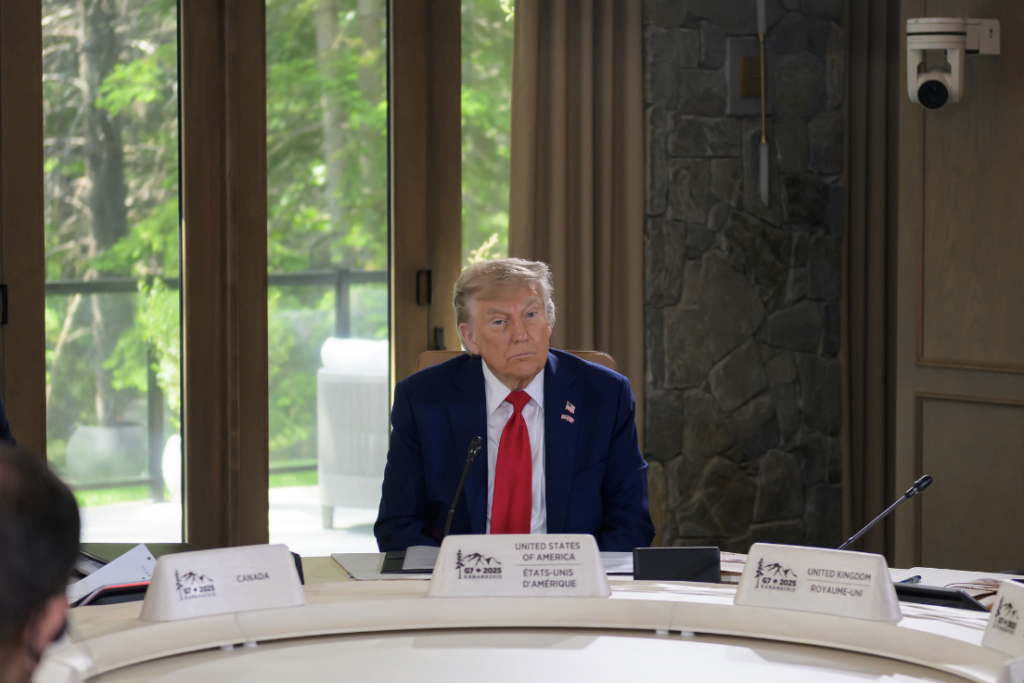 Donald Trump during the 2025 Kananaskis G7/PMO
June 11, 2026
Next Monday in Evian, G7 leaders will gather again at their annual Summit, unsure of what to expect from President Donald Trump.
While that apprehension could be either spectacularly validated by another G7 outburst, a premature exit or some other stunt to be named later, the question of continued U.S. participation in the forum of wealthy democracies haunts this G7 as it has every G7 during Trump’s two tenures.
But the context this time is different, with the Republicans already leery of their volatile president’s drag on the November midterms, and the United States scheduled to host the 2027 G7. Will Trump risk that showcase — with speculation already rife that he’ll hold it at one of his own resorts, possibly Mar-a-Lago — by sabotaging the traditional passing of the host-country baton with a sideshow?
France’s turn to host and to chair marks Emmanuel Macron’s last major turn on the world stage before French elections next April choose his successor — quite possibly Jordan Bardella, president of the right-wing Rassemblement National, who will stand as the party’s leader if Marine Le Pen’s election ban is upheld by a French court next month.
It is the second time the G7 summit takes place in Evian-les-Bains, on Lake Geneva. In 2003, Jacques Chirac presided over what was then the G8 (Russia having been a member from 1998 until its suspension in 2014 after Vladimir Putin annexed Ukrainian Crimea).
The U.S. and the U.K, had created a trans-Atlantic cleavage by invading Iraq that March, despite having been refused authorization by the UN Security Council. France, Germany, Canada prominently opposed the invasion. The White House and Congressional canteens renamed French fries “freedom fries,” and the ultimately catastrophic war proceeded.
Chirac tried at least to keep the wheels on the main task of the G8 Summit, to safeguard macroeconomic cooperation among the participants.
Economic co-operation and solidarity had been the purpose of the G7 from its inception in 1975 as the G6 following the OPEC oil embargo (its response to the 1974 Arab-Israel war) that threw developed economies into crisis. U.S. Secretary of State George Shultz, French President Valery Giscard-d’Estaing and German Chancellor Helmut Schmidt created the forum of the six most economically consequential democracies to co-ordinate a response. Canada joined the G6 in 1976.
For several years, macroeconomic solidarity and cooperation remained the G7’s purpose. Geopolitics barely intruded on the agenda of what was long labelled an “economic summit” prepared by the host country in informal consultation with partners. The preparatory process was intended to be administration-lite, with consultation essentially limited to leaders and central bankers.
The first meeting of non-economic officials occurred with Canada’s inaugural hosting at Montebello in 1981, when UK Cabinet Secretary Robert Armstrong chaired a seminar-like discussion of G7 foreign ministry and other policy planners on problems, priorities, and techniques of democratic and international governance.
It didn’t stay so narrowly limited. Within a decade, G7 summits became a huge show. Their ever-expanding agendas came to include late and post-Cold War geopolitical issues, carefully curated over the course of the year by successive meetings of Sherpas, sous-Sherpas, “Political Directors,” and other officials in an elaborate negotiated preparatory process, even scripting the eventual summit communiques.
The undeclared assumption during these years after 1985 or so was that the G7 had become an informal “steering committee” of the West. In the brief and illusory harmony of the post-Cold War moment, Russia joined in 1998 under the hopeful pretense we were by then all like-minded. It wasn’t entirely delusional: during the 2008-09 global financial crisis, the G8 did serve effectively as a crisis management forum ahead of the crucial London G20 in April of 2009.
As a sort of universalist G8 eco-system evolved, ministers typically met throughout the year, on foreign, trade, and financial affairs, to be sure, but also on energy, anti-terrorism, health, climate, etc., and culture. Divergences of trade/economic interests were typically papered over.
Perhaps what Trump really wants is to establish a G2 with China as a formalization of the post-democracy world order he’s done so much to advance. In which case, all bets are off for Evian.
On entry as a new president in 2017, Donald Trump prioritized none of those issues of multilateral cooperation. He ripped the U.S. out of various undertakings that had been vividly G7/G8 inspired — notably the Paris Accord on climate, the JCPOA agreement to limit Iran’s nuclear capabilities — while taking stands in the UN, the WTO and elsewhere that implied that the U.S. would henceforth be going increasingly its own unilateral way.
In 2018, he walked out of the Canada-hosted Charlevoix Summit that Justin Trudeau had hoped would showcase global challenges for women and girls, when the glaringly obvious topic du jour was whether the G7 members were still in solidarity at all on geopolitics, trade, and the need of an effective international institutional framework to address common global challenges, including climate change.
In 2019 in Biarritz, Macron led an effort to downplay differences while diminishing expectations of noteworthy agreement. It was inconsequential but without controversy.
Trump hasn’t chaired a G7 summit. The COVID pandemic struck in the U.S. host year of 2020 and the annual in-person summit gave way to various virtual meetings, mostly on the global health crisis, that were generally indecisive.
The Biden years saw a return to shared aspirations in an atmosphere of revived superficial solidarity, notably over the need to support Ukraine’s repulsion of Putin’s 2022 invasion.
Trump’s appearance at the first G7 Summit of his second term last June 16-17 was brief, if more or less amicable, leaving newly-elected host Mark Carney to ponder with remaining G7 members and guests the new ground rules of a changed world where the U.S. was a self-declared unilateralist, nationalist, and seemingly hegemonic power.
At Kananaskis, G7 partners had already been destabilized by Trump’s unilateral tariffs on all trading partners, foe or friend. The typical reactive strategy was to traipse to the Oval Office in sequential homage in hope of reducing their bill. This year, most have reclaimed their self-respect enough to have presented a more or less common front of outrage at Trump’s leveraged coercion tactics.
Minds of habitually aligned NATO partners were certainly re-focused by Trump’s vow to “have” Greenland, the “easy way or the hard way.” G7 leaders concluded they were all now in uncharted territory of having the U.S. as a quasi-adversary. The declarations by the administration and by Trump himself that the EU had been designed from the start “to screw us” consolidated their growing apprehension.
Trump’s performance — uneven, self-contradictory, impulsive, predatory — has forced G7 partners into a different posture. They mostly retain a cautionary damage-limitation constraint on challenging Trump personally in public, but meanwhile, Europe’s G7 leaders are looking to partners for solidarity in firm objection to U.S. actions and words that deride Europe. The U.S. desertion of the Ukrainian cause still appalls Europeans who are determined to stay the course of standing behind freedom.
The Greenland threat stiffened their spines enough to stall Trump’s lunge. But the reckless attack on Iran has made real to G7 partners the dangers of Trump’s unilateralism. The surprise attack, on the basis of a manufactured casus belli and with no apparent attention to wider global consequences, has depleted confidence in the U.S. Partners especially abhor the immense and foreseeable problems the mishandled closure of the Strait of Hormuz has created for the world economy, and for the Gulf region, that most economic authorities judge will be sorely felt, if not by the U.S. itself.
Europe’s leaders are already weakened politically at home, unpopular for shared reasons of economic sluggishness and a public crisis of unaffordability.
Keir Starmer will attend the G7 as an apparent dead politician walking, while Friedrich Merz is himself unsteady in power. Giorgia Meloni has been burned by Trump. EU Commission President Ursula von der Leyen isn’t facing election but has to deal with Trump’s hostility to the whole European project. He and his minions openly court anti-EU extremists in Germany, France, Britain, and elsewhere.
The language used by VP Vance, and Secretary of War Hegseth to depict Europe as a failing civilization allegedly being crushed by the onslaught of non-white immigration has no precedent in trans-Atlantic discourse. It is extremely disruptive politically.
The impact on European opinion is demonstrable: a survey from the European Council on Foreign Relations published June 10 indicates that an average of just 11% of Europeans see the U.S. today as an ally. Majorities in every country are no longer confident the U.S. would come to their aid in an attack on them.
Macron will no doubt try to steer the Evian Summit, for as long as Trump stays, as courteously as possible. The French-authored agenda covers the gamut of 18 issues, within a generalized conference framework of “security, economic resilience, social cohesion, in a more fragmented world” — all global features that Trump undermines every day.
A silverish lining is that the ECFR poll indicates 60% of Europeans believe that trans-Atlantic improvement will be possible once Trump is gone.
Perhaps what Trump really wants is to establish a G2 with China as a formalization of the post-democracy world order he’s done so much to advance. In which case, all bets are off for Evian.
Policy Columnist Jeremy Kinsman served as Canada’s ambassador to Russia, high commissioner to the UK, ambassador to Italy and ambassador to the European Union. He is a Distinguished Fellow of the Canadian International Council.