
Autocratic Lives Matter? Saudi Arabia and the Sovereignty Card
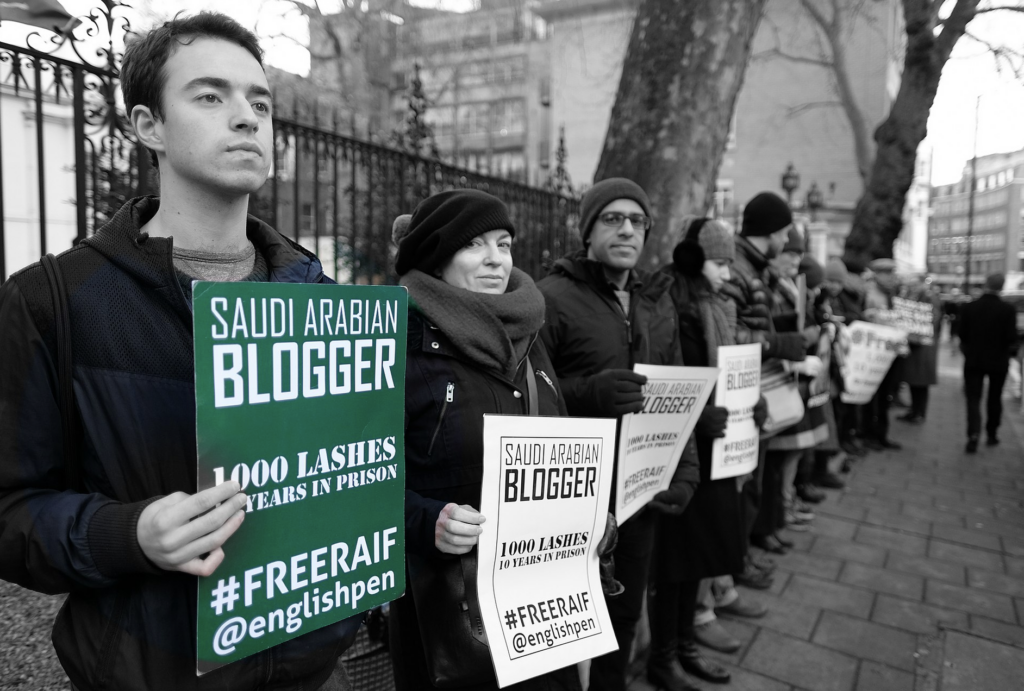 Protesters outside the Saudi Arabian embassy in London, January 13, 2027/Wikimedia
By Lisa Van Dusen/For The Hill Times
August 15, 2018
One of the many ironies of our current political moment is that while, for the first time since 1970, sovereignty isn’t on the ballot in the upcoming Quebec election, it seems to be catching on in the rest of the world.
But the sovereignty that has become an incantation among autocrats seeking refuge from condemnation isn’t your Péquiste grandfather’s sovereignty; it has less to with freedom from external control than with freedom from internal dissent.
In its statement of complaint against Canada’s entirely normal response to the arrest of activist Samar Badawi, the sister of persecuted blogger Raif Badawi, whose wife was granted asylum by Canada, Saudi Arabia used the word “sovereignty” twice and “sovereign” once.
In an interview with NBC’s Megyn Kelly in June 2017, Russian President Vladimir Putin wielded the word “sovereignty” defensively at least eight times. China has invoked sovereignty on everything from its expansionism in the South China Sea to its bullying of multinational companies. In his maiden address to the United Nations General Assembly last year, United States President Donald Trump used the words “sovereign” or “sovereignty” 21 times. Trump oddly framed sovereignty as key to protecting the rights of citizens, which is not at all how the concept has been spun by the crew of autocrats—including Putin, Chinese leader Xi Jinping, and Turkish President Recep Tayyip Erdogan—he has enthusiastically embraced and whose interests he served until lately, three months short of the midterm elections, distancing himself from each of them.
The old rules of international relations are obsolete in a world where ubiquitous surveillance and hacking among major powers has made kinetic war both unnecessary and impractical between actors with equal technological capabilities. China and Russia have proven that political, economic, and
As Trump has shown, we live in the age of strange bedfellows, the most powerful of whom are more worried about internal uprisings, as the socioeconomic impacts of the Fourth Industrial Revolution become clearer, than they are about invasive threats from each other.
It’s not that America has left a vacuum of leadership and China—and to a lesser, more-tactical-than-strategic degree, Russia—is opportunistically filling it. It’s that America seems to be systematically stepping aside to let a non-democracy replace it as the sole superpower in a new unipolar system, a process being accompanied by an attempt to shift international norms of state conduct.
Saudi Arabia’s wildly disproportionate overreaction on an issue of human rights is not unprecedented. It is entirely of a piece with China’s playbook on human rights, notably in Tibet, and on the status of Taiwan. China employs the shock-and-awe school of intimidation and deterrence, whereby hyperbole is deployed, economic clout wielded, and consequences threatened not in the name of punishing wrongs but of enabling them. Not post-truth, fake-news, you-say-tomayto wrongs; but objectively discernible, morally reprehensible wrongs.
Saudi Arabia’s pivot to China over the past year hasn’t been a reaction to Trump; his abdication of leadership just makes it more plausible. It has been an embrace of a country that will protect Riyadh’s non-democratic status quo while serving its economic interests. It’s an embrace undertaken in the apparent confidence that no countervailing American leverage will be forthcoming and which echoes a calculation being taken in capitals in the Middle East and across the globe.
Canada now finds itself both the more energetic champion of the traditional American values of democracy and human rights and the target of a country exploiting the current American president’s retreat from those values. And it is being precisely what it should be: as Canadian as possible under the circumstances.
Lisa Van Dusen is associate editor of Policy Magazine and was a Washington and New York-based editor at UPI, AP, and ABC.