
Beyond the Headlines: Wayne Eyre’s ‘Into the Breach’ is a Timely Warning for Political Leaders
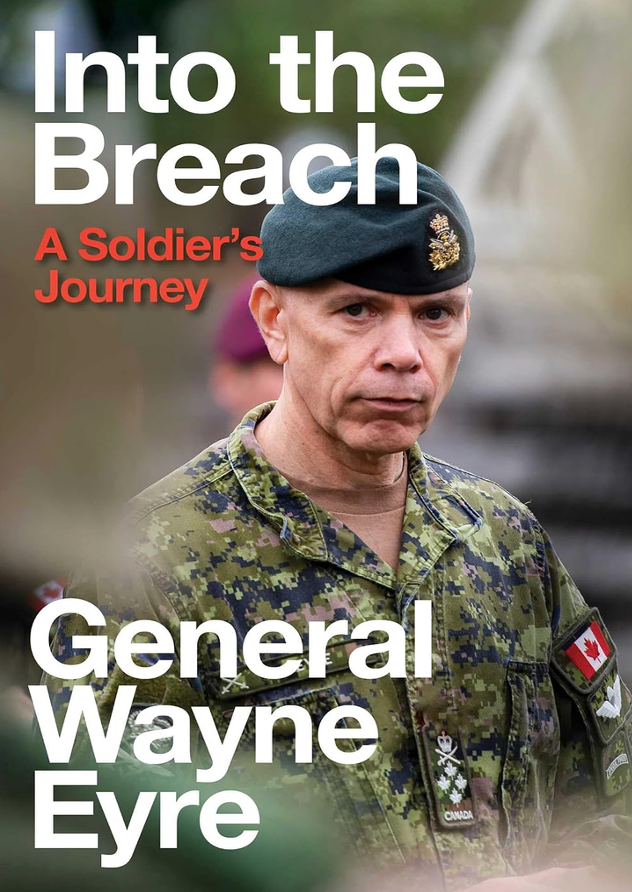
Into the Breach: A Soldier’s Journey
Simon & Schuster, October 2026/432 pages
By Gen. Wayne Eyre
Reviewed by Colin Robertson
September 28, 2026
Former Chief of Defence Staff Wayne Eyre has written a memoir as a warning.
Most of the pre-publication heat around the book focuses on Eyre’s relations with the government of Justin Trudeau, including his sense that he was “thrown under the bus” in 2021 during the sexual misconduct scandal involving senior military leaders, and the many times he contemplated resigning but didn’t.
But the headlines obscure the book’s deeper value as an invaluable warning from a voice of vast experience.
Into the Breach — the title a tweak of “Once more unto the breach” from Shakespeare’s Henry V — is an absorbing soldier’s story that contains a powerful argument against the Canadian habit of waiting for danger before preparing for it.
I met Wayne Eyre when he was deputy commander of United Nations Command in Korea. He spoke Korean and had the confidence and affection of Koreans and Americans alike. Some generals fill a room by asserting rank. Eyre held it by knowing his subject and listening. He is also, as I would experience after his return to Canada, a ‘thinking general’ and a first-class briefer on Canada and global security.
Eyre’s central judgment is blunt: “Canadian military history is a history of unpreparedness.”
In 1914, 1939, 1950 and 2001, he writes, events pulled Canada “out of our inward-looking complacency.” Our troops improvised brilliantly. Their success then disguised the neglect that made the improvisation necessary.
Eyre’s story begins on the Prairies. “I come from a family of Saskatchewan farmers,” he writes. Books, shortwave radio and Army Cadets opened a wider world. When he first put on a uniform, he recalls, “Little did I know I would continue to wear one for the next forty-five years.” The farm boy’s curiosity never left the general.
His career took him from platoon command to Cyprus, Croatia, Bosnia, Afghanistan and Korea; then to command of the Army and the Chief of Defence Staff (CDS) appointment. In his 2026 CDS oral history, he chose “change” as its watchword: the Cold War ended, September 11 redirected operations, and great-power confrontation returned.
People remain his first concern. Eyre encountered “586 policy instruments” – the bureaucratic regulations that governed service members. Families moved. Spouses lost work. Grievances multiplied. “Cookie-cutter solutions offered by prescriptive policies were not working.”
The Auditor General later found that almost 192,000 people applied to join the forces between April 2022 and March 2025, but only about 15,000 were recruited. Successful applications typically took 245 to 271 days. Canada does not lack volunteers so much as a system capable of enrolling and training them.
Culture demands accountability. Eyre acknowledges that he and other leaders were “naively oblivious to what some of our members were experiencing.” His operational focus caused him to miss signs of harassment. When he declared in 2021 that the military’s “crisis of culture is also a crisis of leadership,” he included himself.
Then the crises converged.
Eyre calls his term as CDS “the polycrisis in overdrive”: COVID-19, misconduct, Afghanistan’s collapse, floods and fires, Ukraine, Arctic threats, ageing equipment and shrinking ranks. He struggled to convince government and country “that we needed to rapidly build our military capability and readiness.”
His prescription starts with a crucial distinction. “Defence spending is but a measurement of input. What is truly important is the output.” Announcements are not readiness. Readiness means people, equipment, training and sustainment—the four elements he stressed in parliamentary testimony. A submarine without a crew, a vehicle without parts, or a gun without ammunition is an expensive press release.
Eyre loves his country enough to disturb its complacency. ‘Weakness invites aggression,’ he warns. His deeper message is more constructive: preparedness prevents wars, saves lives and gives governments choices.
Eyre sets three military priorities: First, defend Canadian sovereignty; second, contribute credible forces to allied combat operations; and third, respond to domestic disasters as the force of last resort.
The order matters. Provinces must build emergency capacity rather than routinely borrow soldiers needed to train for war.
In the Arctic, awareness comes before garrisons.
Canada needs layered sensors and surveillance “from space to the seabed and in cyberspace,” backed by forces able to deploy north.
But Eyre warns: “We should not sink funds into basing large, permanent forces in the Arctic.” That is a useful rebuke to politicians who mistake a base on a map for a strategy. Investments should be judged by what they can detect, deter and sustain, while supporting northern communities and Indigenous partnerships.
Abroad, constancy creates influence. In Korea, Eyre learned that Canada would “talk up a big game,” attend regional events and then disappear. Allies notice episodic commitment. So do adversaries.
Canada must remain present in Europe and the Indo-Pacific, maintain its indispensable defence relationship with the United States, and cultivate other reliable partners. Strategic autonomy does not mean strategic solitude.
Modern war also demands mass and speed. Canada needs ships, aircraft and sensors, but also ammunition, drones and cheaper systems that can be produced and replaced quickly. “Mass matters,” Eyre writes.
So do ideas: “Investments in a defence intellectual base will be as important as ones in our defence industrial base.” Soldiers, universities and industry must experiment together and adapt faster than adversaries.
Procurement requires the same urgency. Eyre calls for “radical overhaul” of a system burdened by diffused accountability and risk avoidance. He welcomes the Defence Investment Agency and the Carney government’s defence industrial strategy, but direction is not delivery.
Ottawa should publish milestones for recruitment, training, ammunition, maintenance and major projects—and explain every miss to Parliament.
Security reaches beyond the military. Cyberattacks, disinformation, sabotage and pressure on energy, finance, food and communications demand what Eyre calls “expanded partnerships, resilience within our own society, and hard power.”
Governments, companies and communities need contingency plans, redundancy and exercises. The CAF cannot repair every weakness in a power grid, hospital or provincial emergency system.
Eyre entertains the idea of compulsory national service: “They could be right,” he says of its advocates. Who would serve, doing what, under whose authority and at what cost? A civilian disaster corps also deserves study.
The best generals understand both force and its limits. Eyre writes that soldiers must obey lawful orders, “even if they are unwise.” Yet ministers owe them a fair hearing. In the civilian–military “unequal dialogue,” commanders advise candidly, elected leaders decide and the military executes. Trust is the essential currency.
Eyre loves his country enough to disturb its complacency. “Weakness invites aggression,” he warns. His deeper message is more constructive: preparedness prevents wars, saves lives and gives governments choices.
Into the Breach asks whether Canada will act before the next breach opens. Now, we have no excuse for saying we were not warned.
Contributing Writer Colin Robertson, C.M., C.D., a former career diplomat, is a fellow and host of the Global Exchange podcast with the Canadian Global Affairs Institute in Ottawa.