
Budget 2026 Preview: From Stabilization to Transformation
 Shutterstock
By Kevin Page and Abigail Sampson
September 30, 2026
As it is every year — only now a fall ritual instead of a midwinter one — budget planning in Ottawa is in a state of intense activity.
Finance Minister François-Philippe Champagne is expected to table Budget 2026 in November. The Department of Finance is busy reading the economic tea leaves. Politicians and their aides are wrapping their heads around strategy, initiatives and communications.
The fall political calendar is especially charged this year with events that all have economic implications: the Quebec election on October 5th; the Alberta referendum on October 19th; the EU- Canada Summit October 29-30; and the US midterm elections on November 3rd.
Where does economic performance fit in Prime Minister Mark Carney’s narrative of rupture, re-alignment and resilience? It is the scorecard. It is where the narrative meets reality.
GDP and employment growth validates the economic strategy. A surge in business investment validates the tax-regulation-infrastructure strategy. An operating balance in 2028-29 and stable and declining debt-to-GDP ratio will validate the fiscal strategy.
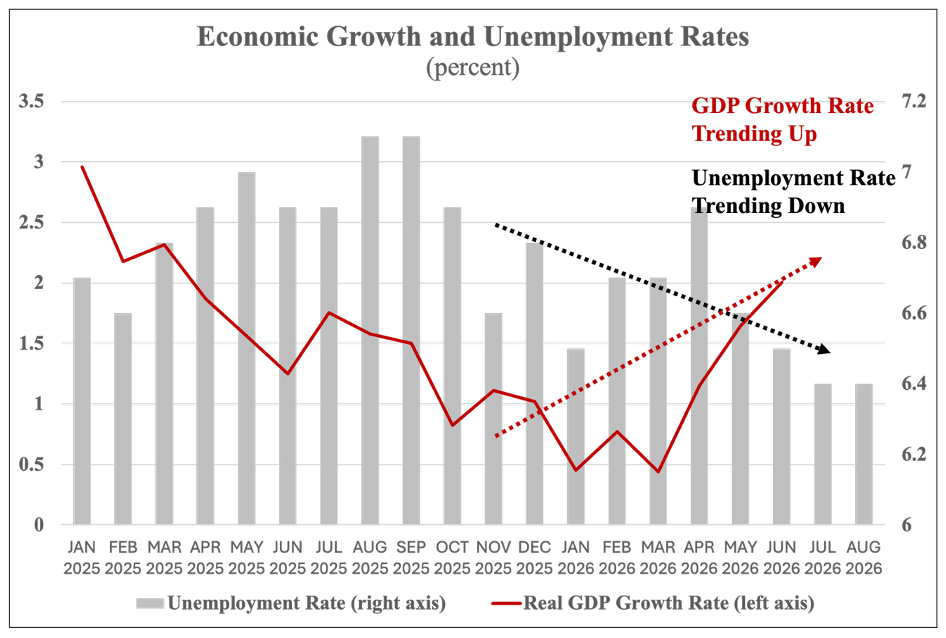
Chart 1: The Economy
Sources: Statistics Canada, Haver Analytics
Issues generating debate around the Build Canada Strong agenda (i.e., labour, environment) and the government’s definition of operating versus capital will fade to the background in the face of stronger economic growth. Labour needs growth to generate jobs and incomes. The environment needs investment dollars. Growth will boost tax revenues and lighten debt burdens.
The overarching theme of Budget 2026 will be one of moving from stabilization to economic growth and resilience.
A significant portion of the new deficit-financed money in the last two fiscal statements (about $60 billion of $130 billion over the next 5 years) is focused on stabilization, affordability and tariff adjustment. This includes the middle-class tax reduction (about $27 billion); the tariff related worker and industry support (about $12 billion); the groceries and essential benefit (about $12 billion) and the fuel charge and fuel excise tax relief (about $7 billion).
With modest economic multipliers attached to those various measures, Finance officials would expect a $20 to $25 billion bump in GDP over the next few years.
The economic argument for stabilization measures (type and magnitude) is based on the fact that the economy is operating well below potential (1.5 to 2.5 percentage points of GDP using Bank of Canada estimates). The policy argument is based on the perceived need to help households deal with affordability pressures and businesses with an unanticipated trade shock. The economic and policy strategy is to give Canada the best possible start position to launch a hinge-moment agenda focused on growth, resilience, and national security.
Chart 1 shows that economic growth has bounced upward since Budget 2025, largely on the strength of consumption and a rebound in exports (after an initial drop). The unemployment rate has drifted downward with the help of modest employment growth.
Would this growth have happened without stabilization support? Likely not. Is deficit-financed stabilization support cost free? No.
Growth is now stronger than expected in 2026. This is positive news for transitioning to a growth agenda and for holding the line on future budgetary deficits.
The picture on affordability is mixed.
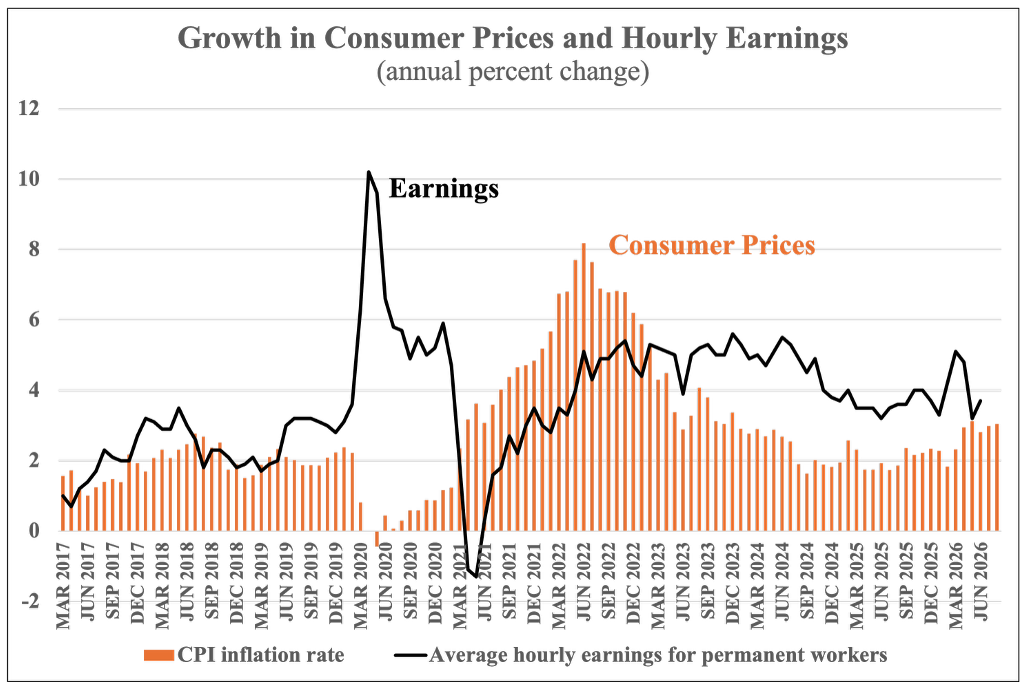
Chart 2: Affordability
Sources: Statistics Canada, Haver Analytics
Chart 2 indicates that average hourly earnings have more than kept pace with consumer price increases in recent years. This has bolstered disposable incomes and supported consumption. The increases in energy prices stemming from war in the Middle East are not good news for consumers. Rising industrial and commodity prices have central bankers worried again about higher inflation expectations.
Household debt-service and housing-affordability indicators have improved in recent years but remain elevated. Affordability pressures persist.
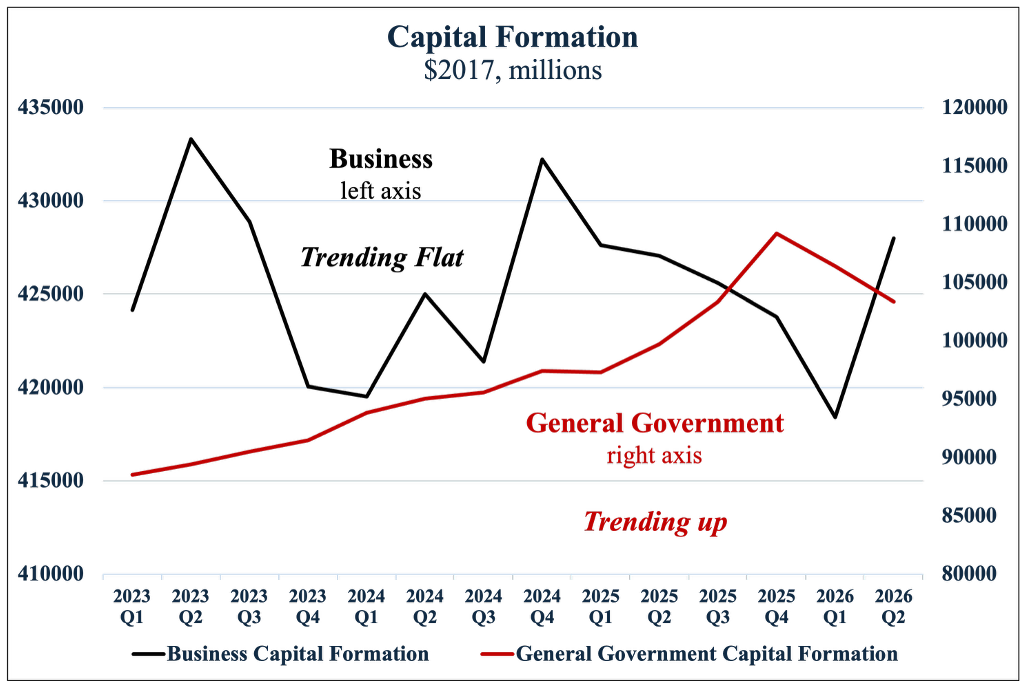
Chart 3: Investment
Sources: Statistics Canada, Haver Analytics
The Carney narrative begins with economic stabilization, but it succeeds or fails on whether that stabilization translates into measurable gains in productivity, investment, and living standards. Chart 3 illustrates that business capital formation has been flat for a number of years. It has held back productivity and living standards. Governments have boosted capital investment, but it is not big enough (by itself) to move top line-indicators in the face of rising debt-interest cost.
The central challenge for Budget 2026 is that the economy is no longer weak enough to justify broad stabilization measures, but not strong enough to make difficult fiscal and productivity choices unnecessary.
Whereas Budget 2025 and the Spring Economic Update 2026 were primarily about stabilization, Budget 2026 will need to be about transformation. And for that, Canada needs investment.
Carney is attempting to redefine Canada’s growth model around investment and productivity. The Liberal government has paired high-profile efforts to attract global capital through the Canada Investment Summit with one of the most generous capital write-off regimes in the G7, while also pursuing east-west trade and infrastructure reforms aimed at reducing Canada’s long-standing internal economic fragmentation.
The logic is that a larger, more connected domestic market, combined with a more competitive tax environment and a credible pipeline of major projects will encourage both domestic and foreign investors to deploy capital in Canada.
In this vision, stronger investment is not simply an economic objective; it is the primary mechanism for boosting productivity, expanding growth and strengthening Canada’s economic resilience in a more uncertain global economy.
Policy Contributing Writer Kevin Page is the President of the Institute of Fiscal Studies and Democracy at the University of Ottawa, former Parliamentary Budget Officer and a Contributing Writer for Policy Magazine.
Abigail Sampson is a fourth-year undergraduate economics and political science student at the University of Ottawa. She plans to attend graduate school next year.