
Budget 2026 Preview: Guardrails and Blind Spots
 Shutterstock
By Kevin Page and Abigail Sampson
October 21, 2026
Finance Minister François-Philippe Champagne will table the 2026 federal budget on November 5th.
Two issues that may not be highlighted in the budget speech are the carry cost of public debt — the interest and servicing expenses the government pays to hold and roll over its accumulated debt — and something called non-budgetary transactions, or government expenditures and receipts that do not require appropriations.
The first is a fiscal guardrail: an early warning system that could trigger a reassessment of fiscal policy. The second is a potential blind spot — an overlooked risk that, if insufficiently monitored, will undermine the fiscal plan.
In its biannual Economic and Fiscal Outlook released October 20th, the Parliamentary Budget Officer warned that Ottawa’s government borrowing is on track to grow faster than the federal deficit and that its accounting “obscures” the true scale of debt.
“Public debt charges are the fastest-growing expense,” per the PBO report. “Debt charges more than doubled from $24.5 billion in 2021‑22 to $59.3 billion in 2026‑27 and are projected to reach $83.0 billion by 2030-31.”
In a world of uncertainty, in which fiscal margin of maneuvre is diminishing, the PBO report puts further pressure on the Carney government’s budget preparations.
The financial requirements of the government are much larger than the budgetary deficit. The government is making greater use of its balance sheet (i.e., loans, investments, and advances) through non-budgetary transactions to spur investment. We must tax-spend-loan-borrow wisely.
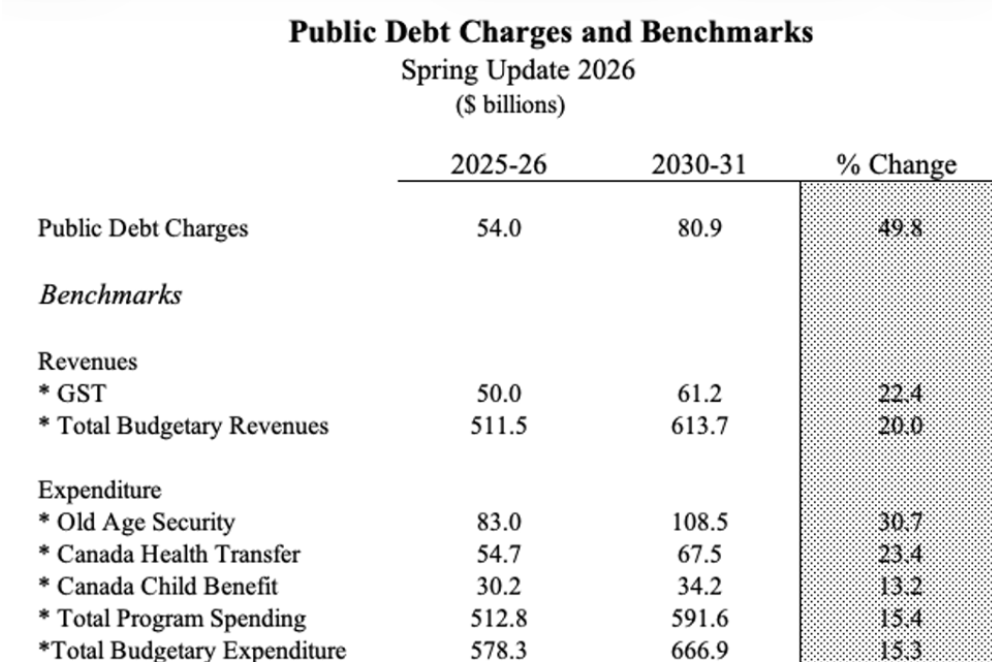
Table 1: Outlook
Source: Spring Economic Update 2026
A case can be made that Canada is not (yet) on the highway to the danger zone. Heading into Budget 2026, the government’s fiscal plan for the hinge moment is largely intact – an operating balance in 2028-29 and holding the line on deficits and debt relative to GDP over the medium term. Nevertheless, more transparency, understanding and debate on key fiscal indicators, like public debt charges and non-budgetary transactions, are needed to bolster credibility and trust.
Table 1 highlights that public debt charges are the fastest growing spending component. Between 2025-26 and 2030-31, the government’s credit card bill will grow by almost 50 percent – that is more than 3 times faster than total program spending; and more than twice the growth in the Canada Health Transfer. In 2025-26, all the revenues generated by the GST are needed to pay for public debt charges – the last time was in 2011-12; in 2030-31, GST revenues will cover only 75.
The growth of public debt charges is shocking but largely inevitable given the significant deficit-financed fiscal supports provided to Canadian households and business in the 2008 global financial crisis and 2020 COVID pandemic and the subsequent rise in inflation and interest rates.
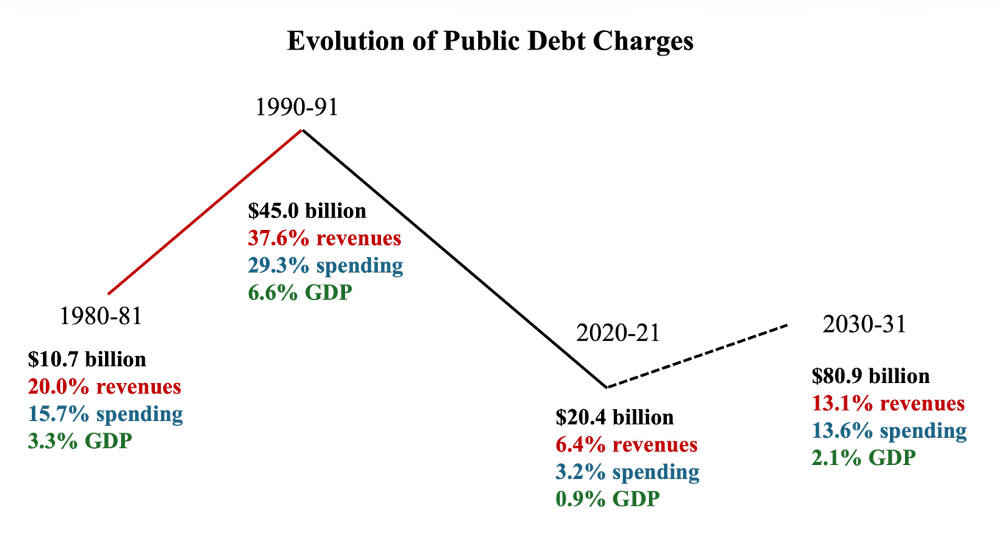
Chart 1: Evolution
Sources: Department of Finance Fiscal Reference Tables; Spring Economic Update 2026
Chart 1 illustrates that the carry cost of debt has been on a roller coaster over the past four decades.
Credit card bills bite hard. A finance minister in 2030-31 will calculate about 13 cents on every revenue dollar (under the current fiscal outlook and plan), compared to a little more than 6 cents per revenue dollar in 2020-21; the increase relative to program spending will more than triple; the share of GDP will more than double.
International comparisons by the IMF indicate that Canada (federal-provincial-municipal) pays relatively more interest expenditure relative to GDP than almost all European countries (Italy is the exception) although less than the US.
Still, the projected carry cost numbers in 2030-31 are only a fraction (about one third) of what they were when Canada ran into a fiscal wall with bond markets in the 1990s. Across the board, they are projected to be better than what Canada experienced in 1980-81when it entered a dangerous deficit-debt spiral.
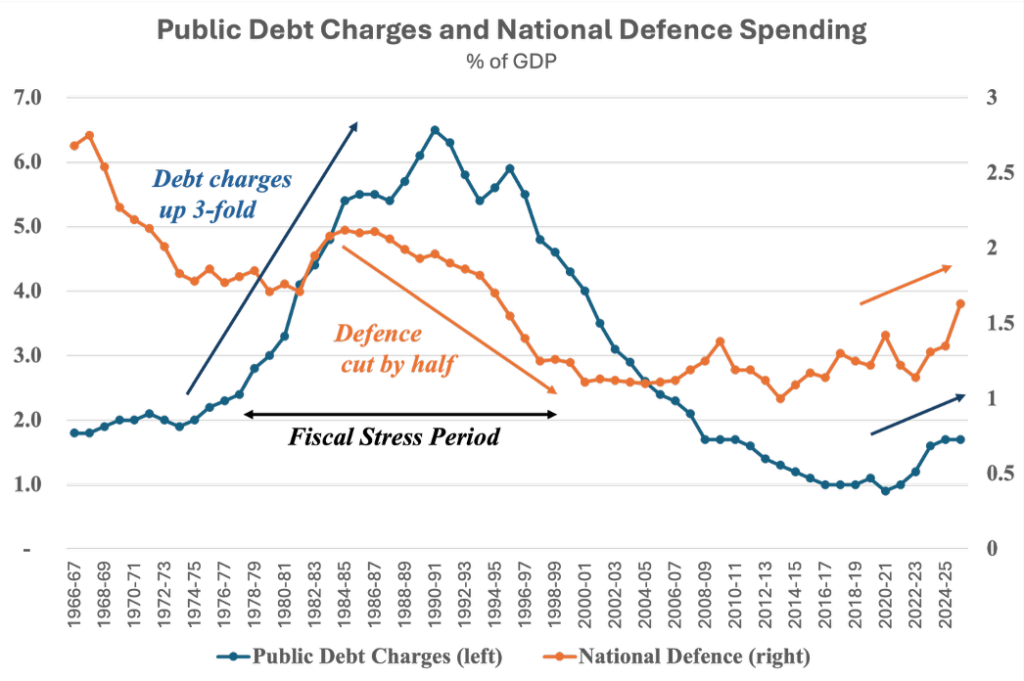
Chart 2: Crowding Out
Sources: Department of Finance Fiscal Reference Tables; Macrotrends
A fiscal guardrail is a measurable benchmark that policymakers monitor to determine whether changes in economic conditions have materially weakened the government’s fiscal outlook, thereby triggering a reassessment of fiscal policy. They are typically designed to reassure investors, rating agencies, legislatures, and the public that deficits and debt will remain sustainable. It is a generic term.
Fiscal guardrails include debt servicing costs, deficit targets like an operating balance; and a declining debt-to-GDP ratio, sometimes referred to as a fiscal anchor.
Prime Minister Carney has talked about the importance of forward guidance. Parliament, Canadians, and financial markets would benefit from a better understanding of how the government will respond to the rising carry cost of debt in the years ahead.
Is there a level of the carry cost of debt (relative to revenues, expenditures, or GDP) that will trigger reassessment of fiscal policy, including targets, spending reductions and tax increases?
Chart 2 illustrates that rising cost of debt can correlate with significant policy responses. In the 1980s, public debt charges relative to GDP increased threefold. With diminishing fiscal room, Canada saw national defence spending relative to GDP cut by half. Federal budgets in the 1980s and early 1990s included a separate planning line for defence spending. With the relative decline in national defence spending, the government stopped separate reporting on defence.
With Canada’s commitments to meet NATO defence spending targets, we now live in a time when national defence and public debt interest charges will both trend upwards relative to GDP.
What policy envelopes might bear the future burden of declining fiscal room? Will the government publish a separate planning line for national defence in Budget 2026? We need forward guidance.
In many respects, one of the biggest fiscal developments of the post-pandemic era has been the transformation of the federal government from primarily a grant-maker into a much larger balance-sheet investor and lender, which is exactly what the growth in non-budgetary transactions is signalling.
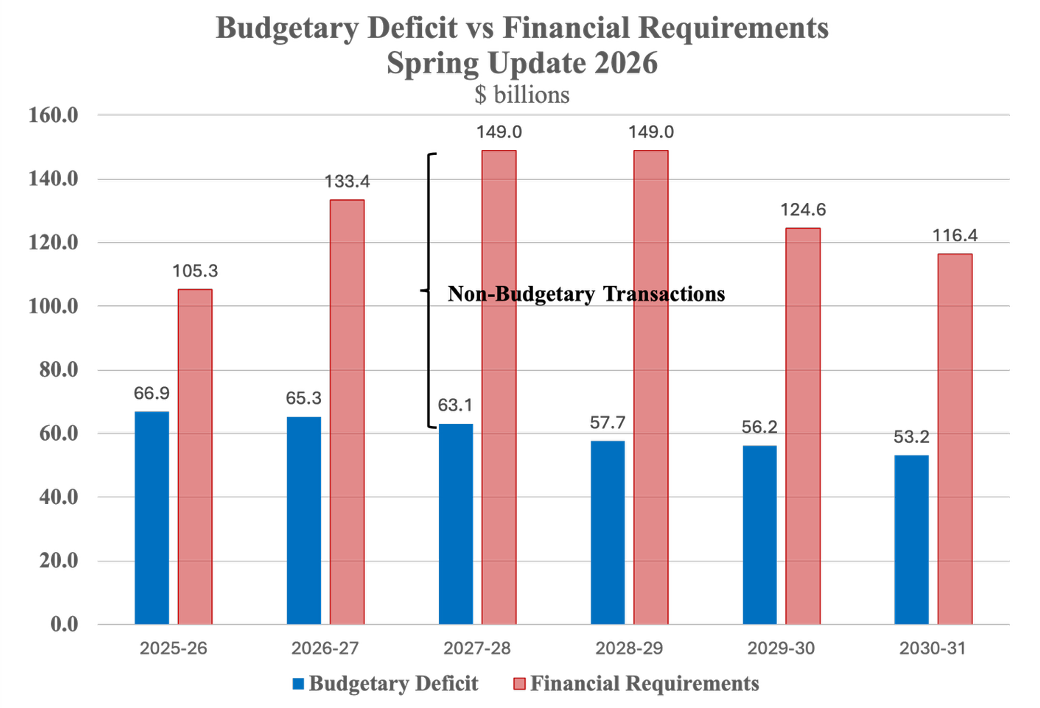
Chart 3 illustrates that the borrowing requirements from non-budgetary transactions over the medium-term are more than double those generated from budgetary deficits. Total financial requirements (the sum of the budgetary balance and non-budgetary transactions) average about 4 percent of GDP compared to about 2 percent of GDP for the budgetary deficit.
Chart 3: Financial Requirements
Source: Spring Economic Update 2026
Non-budgetary transactions are government financial transactions that do not affect the annual budgetary balance (surplus or deficit) because they involve an exchange of financial assets or liabilities rather than revenues or expenses.
For accountants, it means things like loan disbursements and repayments, pension account transactions, accounts receivable/payable changes.
For government policy makers, it means moving forward with the Infrastructure Bank; housing through CMHC activities; access to the Canada Growth Fund and Industrial Strategy; a more important role for business financing programs and Export Development Canada. It is a core lever for Building Canada Strong.
For analysts and financial markets, the significant growth in non-budgetary transactions signals a fundamental shift toward a more active federal balance sheet. While these transactions often create public assets rather than immediate expenses, they still require borrowing. Combined with higher interest rates, this has contributed to a rapid increase in public debt charges and has made the government’s total financing requirement an increasingly important measure of fiscal performance.
Future budget documents need to better reflect the role of non-budgetary transactions from a policy and fiscal perspective. Budget 2025 had one table and 2 pages of text (in a 400-page document). There was little breakdown. Little reporting on the returns on the investments that can flow to budgetary revenues. No analysis on the impacts of higher borrowing requirements from non-budgetary transactions on public debt charges.
There is a need and opportunity for Budget 2026 and future fiscal statements to address transparency gaps and strengthen the Building Canada Strong fiscal plan of 2025 with forward guidance around how the government will respond to rising public debt charges.
Kevin Page is the President of the Institute of Fiscal Studies and Democracy at the University of Ottawa, former Parliamentary Budget Officer and a Contributing Writer for Policy Magazine.
Abigail Sampson is a fourth-year undergraduate economics and political science student at the University of Ottawa. She plans to attend graduate school next year.