
Building Resilience: The Canada-Japan Rare Earths Supply Chain

By Anastasia Ufimtseva and Sun Ryung Park
August 24, 2026
Critical minerals constitute a policy-defined category rather than a geological one: governments designate minerals as critical based on their economic importance and supply risk. Canada’s list includes 34 minerals, ranging from copper and lithium to gallium and potash. Rare earth elements (REEs) are one category on this list, comprising 17 chemically similar elements essential to technologies such as electric motors, wind turbines, semiconductors, and precision-guided weapons.
This article focuses on REEs because their supply chains are particularly concentrated in China and because their separation and processing are technically complex, with commercial-scale capacity limited to relatively few countries. These characteristics make REEs a particularly acute example of the broader supply-chain vulnerabilities associated with critical minerals, and the one where Beijing has repeatedly chosen to apply pressure.
In 2010, after tensions flared between Japan and China over a territorial dispute in the Senkaku/Diaoyu Islands, China restricted its exports to Japan of rare earth elements (REEs). As a result, Japan diversified its suppliers, expanded its strategic stockpiles, and used public financing to develop non-Chinese REE mining and processing capacity. Yet diversification has remained incomplete, and 16 years later, China’s renewed export restrictions have demonstrated that the underlying vulnerability of Japanese dependence on China persists.
For example, Japan has partnered with Vietnam to improve REE extraction and processing, but Hanoi’s own separation technology covers only about 40 per cent of the value chain for producing high-purity oxides, leaving it reliant on Chinese know-how. And, as of 2025, China was still supplying 75 per cent of Japan’s REE imports.
The most recent set of restrictions imposed by Beijing has redoubled Japan’s efforts to secure overseas deposits and build resilient supply chains encompassing separation, refining, and metal production. This – along with the ongoing tensions between Japan and China – creates a strategic opening for Canada.
Canada possesses substantial REE resources and a growing portfolio of extraction and processing projects, but most have yet to reach commercial scale. Japan, meanwhile, can provide the patient capital, technical expertise, and long-term offtake commitments needed to advance these projects through lengthy development cycles. Bilateral cooperation has expanded accordingly, from working groups to broader bilateral initiatives.
Given Canada’s emerging capacity to meet Japanese demand and opportunities for further investment, Ottawa-Tokyo partnerships are likely to extend beyond resource extraction to establish non-Chinese processing capacity capable of delivering materials that meet manufacturers’ specifications, while addressing the financial, regulatory, environmental, and community-related barriers facing Canadian projects.
Trade and Supply Dependencies
As noted above, Japan’s efforts to reduce its dependence on Chinese REEs began in earnest in 2010, when a collision between a Chinese fishing vessel and Japanese Coast Guard ships near the Senkaku/Diaoyu Islands was followed by a reported suspension of Chinese REE shipments. Beijing denied imposing a formal embargo and the empirical evidence remains contested, but the disruption exposed the vulnerability of near-total reliance on a single supplier.
The conventional account holds that Japan has since cut its share of REE imports from China from 90 to 60 per cent. That figure rests on a single HS (Harmonized System) code, which categorizes goods for customs and trade purposes. Japan Organization for Metal and Energy Security (JOGMEC), which combines eight Japanese customs categories and converts them into contained REE content, puts China’s share at 75 per cent in 2025 — with Vietnam a distant second at 12.4 per cent. Comparing the first half of 2025 and the first half of 2026, that share slipped to 72.5 per cent, showing that China’s export volume to Japan grew slightly. The aggregate decline conceals continuing dependence on China’s heavy REEs.
Japan has spent a decade building REE supply chains outside China, expanding JOGMEC’s mandate to fund refining projects and designating critical minerals under its 2022 Economic Security Promotion Act. China’s 2026 restrictions on REE exposed the limitations of that effort. Formally aimed at military end-users, Beijing nonetheless halted the shipment of dysprosium, terbium, and yttrium from December 2025. Tokyo protested the restrictions, drew down its domestic stockpiles, and accelerated efforts to secure alternative supplies. These included a revised agreement reserving 75 per cent of Australia-based Lynas’ heavy rare earth output for Japanese industry, a ¥17.5 billion (C$ 155 million) subsidy for Shin-Etsu Chemical’s first domestic refinery since 2008, and a stake in France’s Caremag refinery securing half its planned output for Japan.
For Canada, the opportunity extends beyond supplying mineral deposits to Japan. Tokyo has strengthened its National Stockpiling System by introducing mineral-specific targets, extending the stockpiling horizon by as much as 180 days for high-risk critical minerals. To support overseas resource deployment, JOGMEC maintains offices in 15 countries with more than 30 projects.
Within this strategy, Canadian projects will be most attractive where Japanese financing and offtake agreements can establish dependable non-Chinese capacity in separation, refining and metal-making — and ultimately deliver materials that meet manufacturers’ specifications. REE concentrates that must still be processed in China offer considerably less supply-security value.
Can Canada Meet Japan’s REE Needs?
To meet Japan’s REE needs, Canada must convert its geological advantage into a commercial opportunity. Canada has one of the largest measured and indicated REE reserves and resources in the world, and ranks as the 10th-largest holder of commercially extractable REE reserves. Yet Canadian REE production remained at zero in 2024-2025, reflecting the country’s limited commercial-scale supply chain capacity.
Canada is now making progress in developing its REE supply chain capacity. Natural Resources Canada has identified 23 active REE projects in but only three have reached the processing stage: the Sorel-Tracy Scandium Demonstration Plant in Quebec (operational since 2022), the St. Hubert Rare Earth Recycling Demonstration Plant in Quebec, (scheduled for completion by mid-2026), and the Saskatchewan Research Council Rare Earth Processing Facility in Saskatchewan (scheduled for completion in September 2026).
The Saskatchewan REE facility is particularly significant. It will be the first commercial-scale facility of its kind in North America, integrating hydrometallurgy, solvent extraction, and metal smelting into a single processing operation that is crucial for REE refining and exports. By mid-2024, the facility positioned Canada as “the first jurisdiction outside of China” to produce REEs at commercial scale, demonstrating a potential pathway for future Canadian projects.
Advancing more projects from the exploration stage to commercial production, however, will require substantial financing and offtake agreements that reduce investment risks by providing greater certainty of demand. Japan could help provide these commitments, supporting the development of Canadian REE production while securing a new source of supply for its own market.
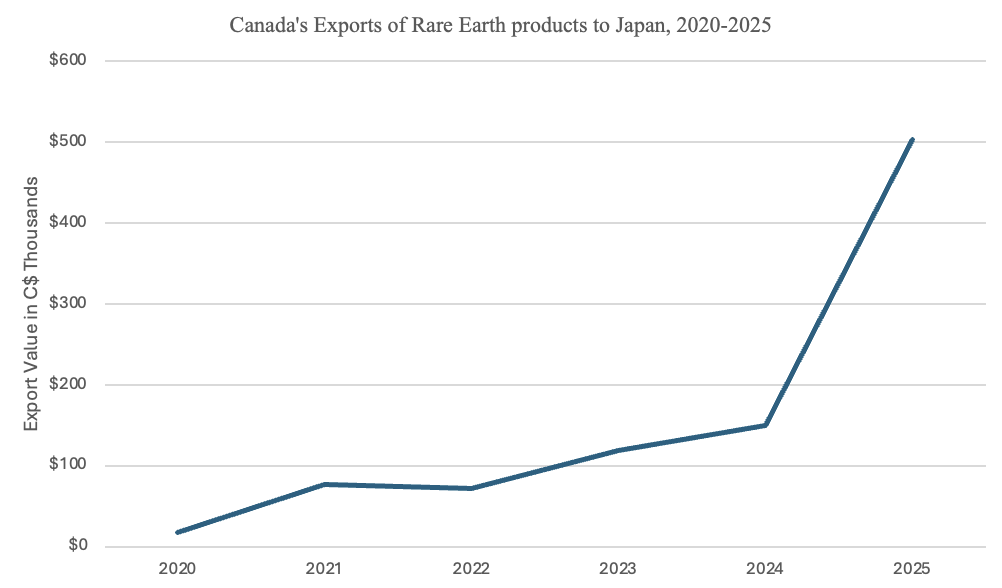
Despite not having reached substantial commercial-scale REE production, Canada already exports small quantities of REE products to Japan, with exports increasing significantly over the past three years. Statistics Canada data indicate that Canadian exports of REE products – specifically cerium compounds and compounds of REEs, yttrium, or scandium – have grown significantly from C$0.018 in 2020 to C$0.5M in 2025 (Figure 1). Japan accounted for 19 per cent of Canada’s total REE exports in 2025 (Figure 1). Quebec, British Columbia, and Ontario are major exporters of REE products to Japan. The observed growth in REE exports will likely increase as Canada ramps up production of REEs to meet growing demand from partner economies.
Partnering with Japan to Scale-Up Production
Japanese multinationals can provide the capital needed to help Canada scale up REE production and processing, as they have already done across Canada’s critical mineral supply chain. Recent prominent examples of Japanese investment in Canada’s critical mineral sector include Nippon Steel Corporation’s and Sojitz Group’s investments in the Kami Iron Ore project, Marubeni’s investment in Hudbay Minerals’ mining projects, and Panasonic Energy Corp.’s investment in Nouveau Monde Graphite. Panasonic’s investment, for example, not only provides capital for project development but also includes an offtake agreement to purchase the graphite produced. Combining patient capital to support mining projects with guaranteed demand through offtake agreements provides an ideal foundation for new REE projects to move from development to production.
While there is a significant potential for Canada-Japan partnerships in REE extraction, Japanese multinationals and government organizations have adopted a cautious approach, reflecting their mixed experience investing in critical minerals projects in Canada. One prominent example of an REE project that did not proceed as planned was the Ytterby project, developed by Midland Exploration Inc, in partnership with JOGMEC. JOGMEC entered into an agreement with Midland in 2010, under which JOGMEC committed to spend C$2.7M to earn a 50% interest in the project. However, the agreement was terminated in 2017 after the project failed to advance beyond the exploration stage. Despite this setback, Japanese companies continue to support Canada’s REE sector. For example, Sumitomo Corporation is collaborating with Ucore Rare Metals to advance REE processing capabilities. A recent example is Kap Minerals Inc.’s announcement in May 2026 of a long-term offtake agreement with Hanwa Co., a Japanese trading and industrial materials firm, for phosphate and REE concentrates from Kap Minerals’ Kapuskasing project.
Government’s Helping Hand
The combination of investment and offtake agreements is reinforced by a supportive government-to-government institutional framework. Canada-Japan collaboration on critical minerals dates back to the establishment of the Canada-Japan Sectoral Working Group on Critical Minerals in 2020 under the Canada-Japan Energy Policy Dialogue.
This cooperation has since been reinforced through both the federal government’s Indo-Pacific Strategy and Critical Minerals Strategy. Bilateral collaboration was further strengthened in 2023 with the signing of the Canada-Japan Battery Supply Chain Memorandum. At the subnational level, British Columbia also renewed its MOU with JOGMEC in 2023 to strengthen exports of natural resources, including critical minerals, to Japan.
In 2026, Prime Minister Mark Carney and Japanese Prime Minister Takaichi Sanae elevated the Canada-Japan critical minerals partnership through the newly signed Comprehensive Strategic Partnership, which seeks to attract Japanese capital to Canada and deepen bilateral cooperation on critical minerals, as well as collaboration through the G7 Critical Minerals Production Alliance. Critical minerals have featured significantly in the Canada-Japan Comprehensive Strategic Roadmap, with both sides committing to strengthen supply chain security by ensuring “reliable supplies, enable[ing] value-added processing, and support[ing] diversified manufacturing ecosystems” in the face of “market distortions” and “export restrictions”. The two countries are also exploring potential for joint critical minerals stockpiling.
From Roadblocks to Progress
Mining projects present a range of challenges that must be factored into Canada-Japan collaboration on REEs. . The main challenge is building an REE supply chain from scratch in an uncertain market dominated by a single producer – China. Canada’s newly proposed REE projects are capital-intensive and have long development timelines, with permitting, feasibility studies, and construction often taking a decade or more and requiring substantial upfront patient capital.
These projects can also have lasting impacts on local communities and the environment, potentially generating local opposition. Compounding these challenges is the risk that REE extraction projects may ultimately fail to achieve commercial viability.
China’s recent restrictions on REE exports to Japan may become a catalyst for Japan’s greater engagement in building Canada’s REE supply chain. In 2010, China’s REE restrictions encouraged JOGMEC to enter Canada’s Ytterby project. Today, Japan’s engagement ranges from offtake agreements to collaboration on feedstock sourcing with Ucore Rare Metals for the US-based Louisiana-located plant that will meet the qualifications of Japanese and South Korean buyers.
As Canada works to expand its REE supply chain, Japanese companies can support this process by providing patient capital and drawing on their extensive experience supporting REE projects globally, including the Lynas project in Australia. Japan’s resource acquisition strategy – combining patient financing, expertise in developing overseas mines, long-term offtake agreements, government support, and strong links to downstream manufacturers – provides an ideal mix for Canada’s mining companies.
Anastasia Ufimtseva is a Senior Program Manager of the International Trade and Investment research pillar at the Asia Pacific Foundation of Canada, an Adjunct Professor at the Beedie School of Business, and a faculty fellow at the Jack Austin Centre for Asia Pacific Business Studies.
Sun Park is a Senior Research Specialist at the Asia Pacific Foundation of Canada. Her research examines how states build and deploy strategic capacity across emerging sectors, including clean energy, advanced manufacturing, critical minerals, and green and digital transformation.