
Business Leadership in a Time of Crisis: The 2026 Ivey Thomas d’Aquino Lecture on Leadership
The following is the text of the 20th Anniversary Ivey-Thomas d’Aquino Lecture on Leadership, delivered by Thomas d’Aquino, Founding Chief Executive Officer, Business Council of Canada, at the National Gallery of Canada.
This speech marks the launch of our Policy-Business Council of Canada series Lessons in Leadership: A Canadian Perspective, celebrating the BCC’s 50th anniversary.
March 2, 2026
Good evening, dear friends, chers amis.
My lecture this evening is dedicated to my colleagues, the CEOs and entrepreneurs who make up the Council and to the business leaders across Canada who, despite extremely challenging circumstances, continue to power the small, medium and large enterprises that generate innovation, growth and jobs.
The title of my lecture is “Business Leadership in a Time of Crisis”. The crisis I speak of is worldwide in its sweep: geopolitical fracture in a world with hegemonic powers competing for dominance; bloody regional conflicts in Ukraine, the Middle East and elsewhere; division and paralysis at the United Nations; democratic government in retreat around the globe, with populism and protectionism surging; multilateral institutions falling into irrelevance; the rule of law being flouted; and trust in institutions in sharp decline.
The economic consequences of this crisis are deeply troubling. The global economy is endeavouring to adjust to shocks that are structural rather than cyclical. High and rising debt levels, slower growth, and persistent inflation are placing increasing pressure on public finances.
Globalization is being re-engineered around security rather than efficiency. Inequality within and between countries is undermining social cohesion. Add to this the shock of artificial intelligence with both its immense promise and its power to disrupt. As if this were not dismal enough, consider the continuing degradation of the global environment.
In his historic address to the World Economic Forum in Davos in January, Prime Minister Mark Carney bravely confronted the realities of the global crisis. He challenged the middle powers of the world to respond.
Now, let’s challenge business leaders throughout the democratic world to respond — to stand up and be counted.
How so, you might ask? By upholding the basic principles of democratic capitalism — first and foremost, by pursuing the core mission of business — to assemble capital, to hire the best talent, to invest wisely, to adapt and innovate, to generate growth, and to create jobs. And to do so ethically — by embracing the rule of law, mindful of the broader public good.
The idea of a corporate responsibility transcending the bottom line was a founding principle of the Business Council of Canada in its earliest days — a position that was unique among CEO-based business associations in the world at the time. Back then, I said the ultimate purpose of capital is to build a better society. My views have not changed.
If I had been at Davos this year, I would have looked to business leaders to stand up and condemn authoritarianism and autarky; to oppose beggar-thy-neighbour protectionism; to express zero tolerance of corruption; and to reject the siren song of crony capitalism. I would have wanted to hear them defend the territorial integrity of nations, the peaceful resolution of international disputes, and the importance of building multilateral institutions.
Is this asking too much of business leaders? Not if we are true believers in the symbiotic relationship between democratic capitalism and liberal democracy.
Canada cannot escape the tectonic effects of the geopolitical fracture I have outlined. And we have added our own homemade ingredients: lacklustre growth; anemic levels of investment; low levels of productivity; threats to national unity by secessionist movements; and seriously deficient defence capabilities.
The idea of a corporate responsibility transcending the bottom line was a founding principle of the Business Council of Canada in its earliest days. Back then, I said the ultimate purpose of capital is to build a better society. My views have not changed.
Add to this the stunning reality that for the first time in modern history, we have a wildly unpredictable president of the United States — one who brazenly threatens Canada’s very sovereignty through economic coercion and the oft-expressed desire to annex our territory.
Harkening back to Winston Churchill and the darkest days of World War II, Canada faces a “hinge moment” says Prime Minister Carney. He has been joined in this grave assessment by opposition party leaders, by former prime ministers, and by tens of millions of Canadians shaken by uncertainty.
To the men and women of corporate Canada, I say — this is our hinge moment, too. We have three duties to perform in order to successfully meet it.
At home, we must do all that we can to strengthen national unity and the integrity of the Canadian economic union.
Looking south, we must do all we can to re-establish long-term stability to the Canada-United States relationship.
And third, we must help to build economic and security resilience at home, and Canadian influence abroad.
I know these may sound like formidable tasks — some would say impossible tasks. But let me take them one by one.
From the moment of Confederation in 1867, Canadian business leaders have been inseparable from the project of nation-building. In a vast, sparsely populated country, with weak capital markets and daunting geography, private enterprise supplied the vision, the risk capital and the organizational capacity that transformed a political union into an economic reality.
The foundational example, of course, was the building of the Canadian Pacific Railway from Eastern Canada to Vancouver in just over four years — six years ahead of the original schedule — an achievement of staggering ambition that served to knit this country together.
I will cite one other inspiring example of nation-building in a time of crisis — Canada’s “dollar-a-year” men. Working closely with the government of Prime Minister Mackenzie King and Minister of Munitions and Supply C.D. Howe, business leaders from across Canada answered the country’s call in 1939. They left their boardrooms for Ottawa to join the war effort.
Along with hard-working men and women in manufacturing and resource industries across the land, they played the lead role in transforming Canada into a formidable arsenal of democracy. By 1945, Canada was the fourth largest producer of war material among the Allied powers. Given Canada’s small population, this was impressive beyond words.
At the same time, we can never forget the level of human sacrifice that saw over one million Canadians serve in uniform, 45,000 of whom never returned.
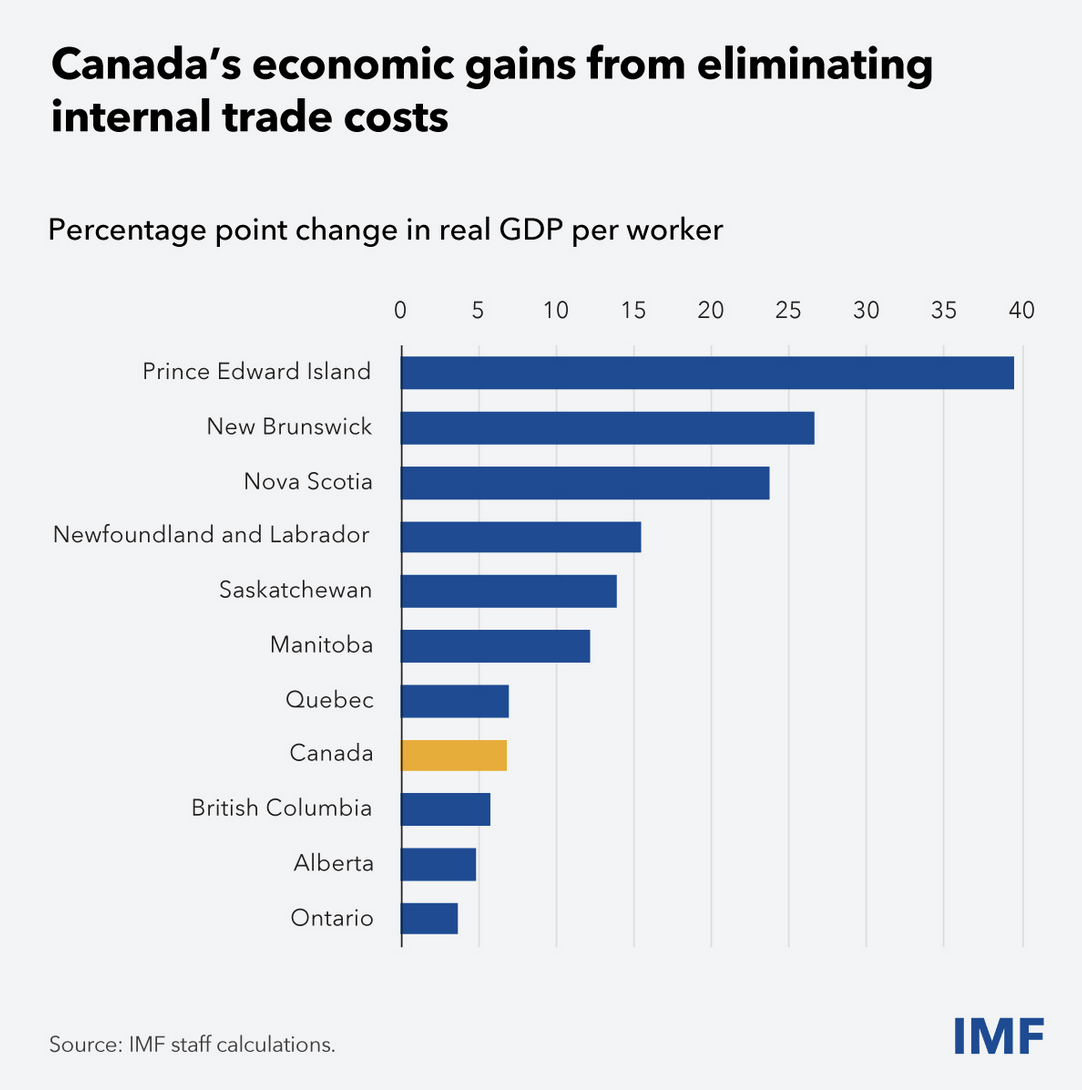
Let me now turn from stories of extraordinary success to one of abject failure — the persistence of internal barriers to trade in Canada that impede our economic well-being. It is ironic that at the same time as we build upon a vast array of trade agreements spanning the world, we continue to be plagued by internal barriers.
The International Monetary Fund assesses these as equal to a tariff of roughly 9% on goods and services traded between provinces, and a reduction in Canadian GDP of 7%. This translates into approximately C$210 billion of lost opportunity per year. What is wrong with us? While some progress has been made in tackling these barriers, they persist. A top priority of business should be to wage war against such barriers and convince provincial premiers to get the job done, once and for all.
And what about the renewed threat of Québec separatism and now a highly vocal separatist movement in Alberta? We certainly do not need these diversions at this time of crisis. Here, the role of business is seminal to winning support for the defence of Canada’s economic union. Such a role is not new to organized business in Canada.
At the Business Council of Canada, we were heavily engaged in the constitutional debates throughout the 1980s and 1990s. At the heart of our advocacy was the defence of our great country — we built the case for economic growth and jobs within a well-functioning federation.
Business leadership must again engage. Our message must include an appeal to our political leaders of the urgency of putting partisanship aside as we deal with crises in our country. And we must deliver a clear message that foreign interference in our internal economic and political affairs will not be tolerated.
Let me turn now to our thorny relations with the United States — a subject that has become an obsession among tens of millions of Canadians. And for good reason. For more than a century, Canadians looked to our southern neighbour in the warmest and friendliest terms as a steadfast partner and as a guarantor of our security.
We largely marched to the same drum in advancing the cause of democracy, in championing the rule of law, in building and supporting international institutions, in fighting dictators in foreign wars, in promoting development. We often said of ourselves that we were the best of friends and the closest of allies. So deep was our trust in one another and in our shared economic future, that in the 1980s we negotiated the Canada-United States Free Trade Agreement — at the time, the most ambitious bilateral agreement in modern history.
It did not come easily. As some of you will remember, the Business Council was the private sector leader in advancing the agreement. I had the privilege of seeing up-close the deep friendship of Prime Minister Brian Mulroney and President Ronald Reagan at work.
Cross-border trade thrived. Cross-border investment multiplied. The competitiveness of Canadian enterprises soared. Likewise, the co-operation between our respective business communities could not have been closer.
The success of the Free Trade Agreement shortly thereafter gave rise to the North American Free Trade Agreement, or NAFTA, encompassing Mexico — again a hugely ambitious undertaking that offered the promise of North American regional economic pre-eminence among the world’s leading economic blocs.
Again, I saw firsthand how the bond of friendship that united Prime Minister Mulroney and President George H.W. Bush delivered results. In the years that followed, even as the trilateral relationship was the focus of political and economic attention, cooperation between Canada and the United States continued to flourish under a series of prime ministers and presidents. Think of Chrétien, Martin and Harper. Think of Clinton, Bush, Obama and Biden.
We are seen by most Americans as a steadfast friend and ally. The vast majority of Americans have no interest in harming Canada. Moreover, we cannot change geography. We will always live side by side.
With the arrival of Donald Trump in his first term, and an America First policy rooted in nationalism and protectionism, trust in America began to diminish. In his second term, this transactional president has driven home his agenda, and we all know only too well the impact it has had on Canada. It has created uncertainty and fear. It has bred hostility and rancour.
Personally, this comes as a great shock. Much of my life has been devoted to working with Americans in the domains of trade, investment, financial services, energy, the environment and defence. My work has included engagement with business organizations, think tanks and arts and cultural organizations. Along the way, I have seen the best in leadership that America has to offer.
Whether fly-fishing with President Bush Senior in the rivers of northern Labrador, or travelling the hemisphere with David Rockefeller, or co-chairing the North American Forum with Secretary George Shultz, American ideals shone brightly in these individuals. It pains me to see how much has changed of late.
Does this mean that the relationship is broken beyond repair, that trust between Canada and the United States can never be found again? I do not share the thesis of permanent rupture.
Here is why. For one, it is critical that we distinguish between the Trump administration and his followers on the one hand, and the tens of millions of Americans who have refused to accept the America First doctrine. We must also appreciate that Canada’s brand in the United States remains impressively positive.
We are seen by most Americans as a steadfast friend and ally. The vast majority of Americans have no interest in harming Canada. Moreover, we cannot change geography. We will always live side by side. Our deep economic integration — and with it the network of family friendships, of business, educational and institutional relationships, and of defence collaboration — is a reality that cannot be reversed. Within Prime Minister Carney’s variable geometry, the United States will always occupy a place of prominence.
So, what do I believe this means for Canadian business leadership? Let me make three points.
First, we must leverage more vigorously than ever the deep and elaborate networks of business relationships that span our two nations. We must work with business and political allies in making the case that close co-operation between our two countries will continue to generate impressive levels of growth and jobs on both sides of the border. We must remind Americans that Canada is an indispensable partner in both commerce and in security. We must communicate to Americans in the clearest language that no country in the world can offer what Canada can.
At the same time, as we double efforts in Canada to build resilience, we must boldly assert our sovereign rights and leave no doubt that we are and will remain masters in our own house. With heads held high, we must demand respect from the Trump administration.
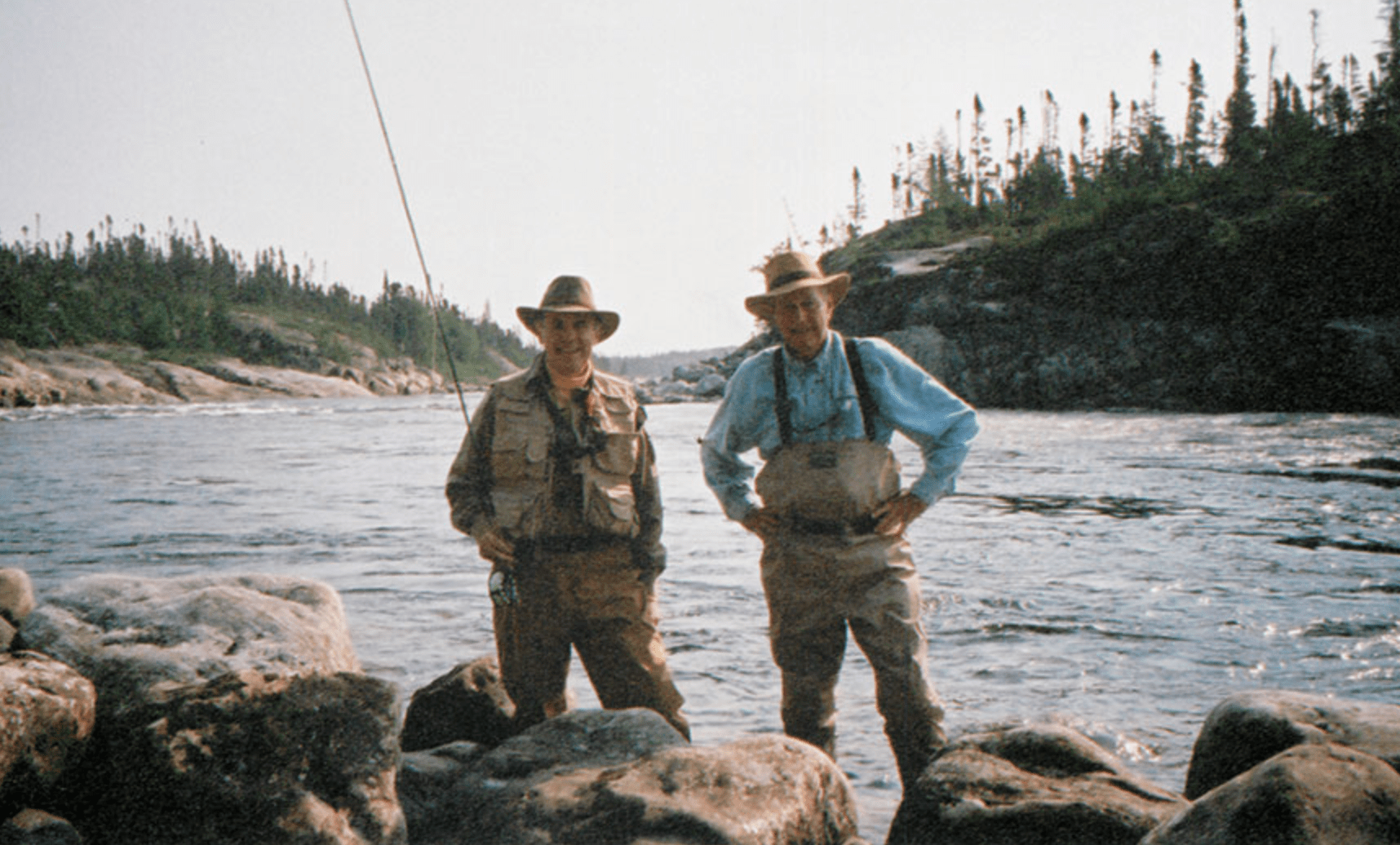 Fly fishing with George H. W. Bush in Labrador
What we must not do, I say, is turn away from America. Yes, we must pursue diversification and new trade and investment opportunities with other countries and regions. And this we must do at high speed and with unprecedented intensity.
But we also must do all that we can to protect our position in America, our massive investments, our market-share and wide-ranging relationships developed over more than a century — the results of hard work.
Above all, we must protect our preferred access to the American market. And here, it is important to stress a hard reality. The huge-scale investment that Prime Minister Carney is seeking to attract to Canada will in large part depend on that preferred access. That is what business leaders from across the world have been telling me. As we build a more resilient and independent Canada, we should be thinking with steely pragmatism of what we might call an “America Plus” strategy. That is playing to our strengths.
Second, we must spare no effort in the defence of the Canada- United States-Mexico Agreement, or CUSMA, in league with our like-minded American and Mexican allies. It is worth reminding ourselves that the CUSMA is the child of the NAFTA and that the ambitious idea at its beginnings was that our continent, bound together by free trade principles and a joint commitment to North American competitiveness, would make us the regional powerhouse of the world. Sadly, that ideal began to fade even before the advent of Trump. Ominously, Trump’s threats have raised further questions about the CUSMA’s future.
The CUSMA is worth fighting for. It means that 80 percent of our commerce with the United States and Mexico is exempt from tariffs. Unsurprisingly, hearings in Washington under the aegis of the United States Trade Representative earlier this year made it clear that North American business leaders overwhelmingly support the renewal of the Agreement.
Nevertheless, I expect the upcoming negotiations will be turbulent, with demands from President Trump and his proxies to re-shape the Agreement around “I win, you lose” America First principles.
To wreck the Agreement would be a catastrophic blunder. It would do irreparable damage to jobs and investment in all three countries. Here again, vigorous business advocacy by Americans, Canadians, and Mexicans could be a game-changer.
Thirdly, at the same time as we navigate the turbulent waters of the Trump world, it is vital in my view that both political and business leaders in Canada look well beyond the present and pursue what I call the holy grail in Canada-United States relations. In one word, the holy grail is stability — stability that would govern our relationship not for decades, but for a century or more. How to do such a thing?
For my efforts, I was burned in effigy in front of the Chateau Laurier and peppered with hate mail. Then came the Shamrock Summit in 1985 and the great free trade election of 1988 — the rest is history.
Earlier this year, I proposed that Canada and the United States explore the idea of a Canada-United States Economic and Defence Treaty. I emphasize, a constitutionally protected treaty under American law, and not a mere agreement that could be erased on a whim. Forged with the approval of Parliament and the American Senate, it would take form as a comprehensive treaty that would pledge mutual respect of sovereignty and the adoption of rules-based dispute-settlement.
Core to the treaty would be a mutual defence pact that would expand NORAD to include Canadian participation in continental anti-missile defence. Also core to the treaty would be mutual obligations in the domains of energy, agriculture, critical minerals, advanced manufacturing, technology development and artificial intelligence. Importantly, the treaty would recognize the right of each country to pursue its own international trade and foreign policies.
In return for this “grand bargain” — strongly supported, I would hope, by the business communities of both countries, would be a return to a largely tariff-free relationship.
Pie in the sky, some of you may think. Perhaps in the short term, especially while Trump is in office. But down the road, I believe it is an idea worth pursuing. To those of you who might say to me “no truck or trade with the U.S., ever”, I would ask you to reflect on the idea of free trade with the United States back in the early 1980s.
All federal parties in Canada were opposed. Major elements of the business community were skeptical. A majority of Canadians were opposed. Americans were largely uninterested. For my efforts, I was burned in effigy in front of the Chateau Laurier and peppered with hate mail. Then came the Shamrock Summit in 1985 and the great free trade election of 1988 — the rest is history.
Finally, let me now turn to the vital role of business in building economic and security resilience at home, and Canadian influence abroad. Prime Minister Carney has rallied Canadians to action with the words Building Canada Strong. He speaks of fast-tracking nationally significant projects and constructing a modern defence industrial base.
But as you know, the plan also embodies a larger vision: a more diversified Canadian economy and a renewed role for Canada as a leader among like-minded middle powers in an increasingly fractured world. These objectives are inseparable. Economic strength at home underpins credibility abroad.
Neither can be achieved through government action alone. They require a decisive response from Canadian business leaders — not as advocates at arm’s length, but as partners in the ambitious national project that is envisaged. The question before us is not whether business supports this agenda, but how business chooses to lead in this time of crisis.
As Canadian business prepares for this new role, it is important to recognize a hugely consequential shift that must take place in business thinking. In the case of the Business Council of Canada, for a half century we have argued that the road to economic success is rooted in open and competitive markets, limited government, balanced budgets, regulatory efficiency, and competitive taxation.
It depends on private enterprise and entrepreneurship as the primary engines of growth, tempered by public policies that safeguard competition, manage systemic risk, provide social mobility, and prevent the concentration of economic and political power.
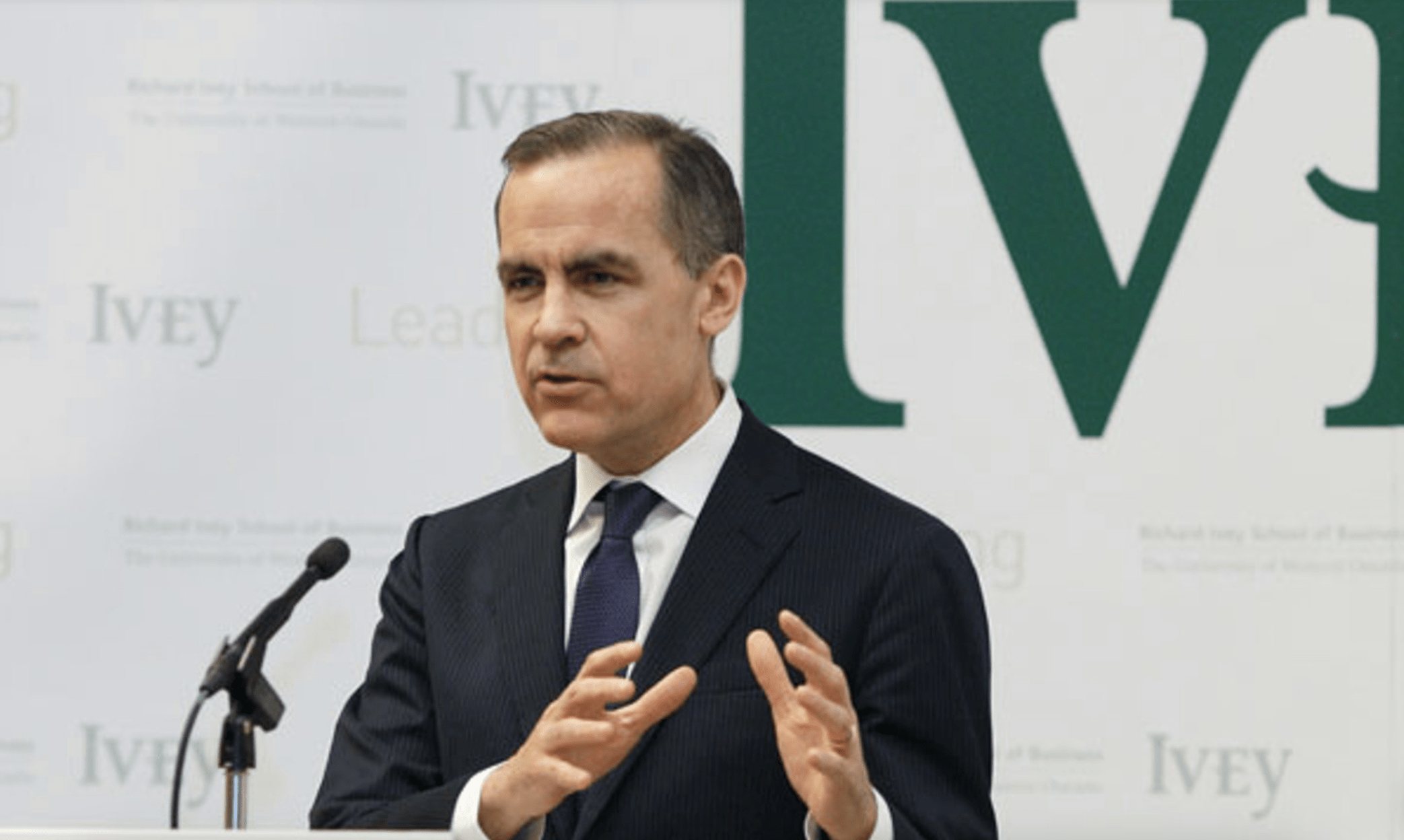 Bank of Canada Governor Mark Carney delivering the Ivey Thomas d’Aquino Lecture on Leadership in 2013
Building Canada Strong is ushering in a new paradigm — one that entails huge public expenditure and investment, and a major role on the part of the state. Prime Minister Carney is inviting Canadian business to be a leading partner in executing this agenda. Given the gravity of the challenges facing Canada, I believe corporate Canada should be “all in”.
I believe we can do this without abandoning our commitment to market principles and economic efficiency. On the contrary, I believe that business experience and know-how can help ensure the success of this nation-building exercise. As I pointed out earlier, Canadian business leadership played a decisive role in the 1939-1945 war effort. We did it then. We can do it again.
Fast-tracking national projects — whether in energy, critical minerals, transportation corridors, digital infrastructure, or defence manufacturing — requires business leaders to seize opportunity, to commit capital earlier and be prepared to take on more risk. One of the clearest signals from the Prime Minister, which we in the business community welcome with enthusiasm, is that speed now matters as much as scale.
I have argued for decades that complacency has been one of Canada’s major liabilities – a liability shared by both government and business. This is about to change. In a world of weaponized trade, fractured supply chains and intensifying strategic competition, delay is no longer neutral. It is dangerous.
Let me add that the Carney government’s new Defence Industrial Strategy marks an historic turning point. For much of the post – Cold War era, Canada treated defence production as peripheral to our economic story. That era is over. At the heart of the strategy is the deployment of massive financial resources to establish, and I quote: “a clear, long-term demand signal to Canadian industry for defence and dual-use goods so it can be better prepared to meet the requirements of the Canadian Armed Forces.”
This means working with private-sector defence industry firms to create an array of sovereign capabilities. It means picking national champions to turn into world-leading defence industrial firms. It also means securing the supply chains required to construct these capabilities. Industries targeted are aerospace, ammunition, digital systems, specialized manufacturing, personnel protection, space, sensors, training and simulation and uncrewed and autonomous systems.
Let’s pause here and be clear that both governments and industry have a poor track record when it comes to procurement. If the new strategy does not materially shorten procurement timelines, simplify authorities, and empower decision-makers to accept managed risk in pursuit of practical delivery, the defence manufacturing effort will be crippled.
Business leadership from these countries, acting as a resolute coalition of the willing, and in league with their governments, could change the world as we know it.
Building Canada Strong will also be crippled without the right people. Fast-tracked projects, defence manufacturing and global diversification will require skilled trades, engineers, technicians and digital specialists in unprecedented numbers. Here, the role of business will be crucial. We must work with governments, educational institutions, unions, and Indigenous partners to build a powerful talent pipeline — through apprenticeships, co-op programs, mid-career re-training and targeted immigration.
Let me turn now to another central theme of Building Canada Strong — greater diversification of trade, investment and partnerships. For half a century and more, arguments have been made that Canada should accelerate efforts to expand our commercial footprint to markets other than the United States. In pursuit of this goal, Canadian governments have secured an impressive network of free trade agreements around the globe, encompassing some of the fastest growing countries and regions.
Canadian business has by and large failed to respond to the opportunity. The main reason is all too well known — the allure and accessibility of the world’s biggest and most dynamic market — the United States. Prime Minister Carney has set a goal to double Canada’s exports to markets outside the United States, aiming to generate an extra $300 billion in trade by 2035.
If corporate Canada believes that over-reliance on the American market carries an increasingly burdensome risk, will our companies finally take serious steps to broaden their reach? Given the sheer size of the opportunities, it would be the smart thing to do. Only determined business leadership can make this happen. Will this hinge moment propel them? It remains to be seen.
Let me conclude with some thoughts about Prime Minister Carney’s bold invitation to democratic countries around the world to come together around an agenda that celebrates a rules-based international order and support for multilateral institutions. Despite skepticism in some quarters, I strongly support this idea.
Think about it. Apart from the United States, the democratic countries of the world represent a combined economic output considerably larger than that of the United States or China. Given Canada’s favoured geographical and geopolitical positioning, I believe we would be a logical convenor of such a coalition.
Now, here is the added value of the idea. The business communities of these countries largely share common values — a commitment to market economics and to democratic institutions — and are supportive of a rules-based international order where trade and commerce can once again flourish, where the threats and intimidation of the hegemons will matter less. Business leadership from these countries, acting as a resolute coalition of the willing, and in league with their governments, could change the world as we know it.
Friends, chers amis. The time for leadership at home in our Canada and on the world stage, is now. Today’s crisis offers us a rare opportunity — to shape the next chapter in our history.
Business leaders across Canada and the democratic world, step up, seize the moment, and deliver on the promise that lies before us.
Policy Contributing Writer Thomas d’Aquino is an entrepreneur, corporate director, author, philanthropist and a member of the Order of Canada. He is the Founding CEO of the Business Council of Canada, Chairman of Thomas d’Aquino Capital and author of the national best-selling Private Power Public Purpose: Adventures in Business, Politics and the Arts.