
Can Canada and the EU reconcile ‘Buy Canadian’ with ‘Made in Europe’?
By Brian Wu
September 21, 2026
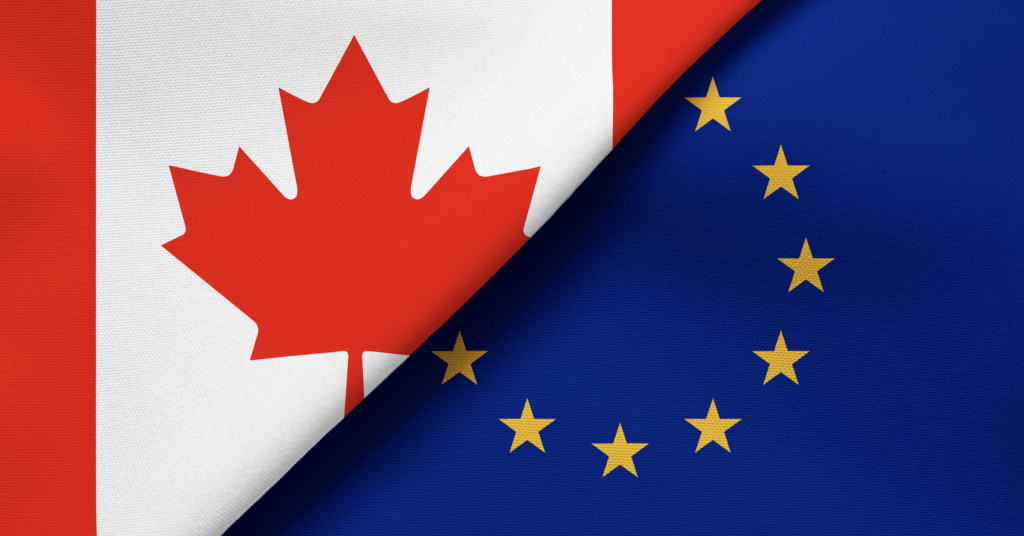
Canada is moving with urgency to upgrade its ties with the European Union (EU) in the pursuit of a goal that has been given an array of monikers, from “associate membership” by European Commission President Ursula von der Leyen to Prime Minister Mark Carney’s “alliance for the future.”
Nomenclature aside, the trajectory is clear: with Canada-US relations in freefall, Carney is making a bold pivot towards Europe.
Accelerating Canada’s trade diversification away from the US is top of mind. However, there are questions over the feasibility of increasing bilateral market access beyond the current Comprehensive Economic and Trade Agreement (CETA), which is still pending formal ratification by 10 EU member states.
Carney’s speech in Strasbourg on September 17th raised the prospect of a digital trade agreement and deepening energy and critical minerals supply chains. These will likely encounter fewer hurdles because bilateral interests are more closely aligned in these areas.
However, the broader Canada-EU economic relationship is unlikely to shift significantly. In particular, two areas will present major roadblocks: industrial policy and public procurement markets.
Canada is seeking a closer partnership at a time when the EU’s economic strategy is becoming more inward-looking and protectionist. For the past year, the EU has been reeling from what analysts are calling “China Shock 2.0”—the post-pandemic flood of low-cost, high-value-added goods from massively state-subsidized Chinese industries producing far beyond what domestic demand can absorb.
Since the pandemic, the EU’s bilateral trade deficit has surged to an average of €1 billion per day, which leaders including French President Emmanuel Macron and German Chancellor Friedrich Merz have characterized as “unsustainable” and rooted in “unfair trade practices.”
What sets the current crisis apart is that China’s export basket increasingly resembles those of major European economies like Germany and Italy. Its industries have moved up the value chain in automobiles, advanced machinery, chemicals, and clean technologies. In many subsectors, Chinese products are cheaper than European equivalents while offering comparable quality and performance.
For example, Chinese electric vehicles (EVs) are outcompeting German automakers both in Europe and around the world, leading to job cuts at car manufacturing plants in Germany and wider fears of creeping deindustrialization.
Brussels has recognized that an overhaul of trade defence and industrial policy tools is needed. Previous efforts have fallen short: in October 2024, the EU imposed tariffs of 8-35% on Chinese EVs, which briefly slowed the rate of imports. Chinese companies responded by pivoting towards hybrid vehicles and quickly regained their footing. By December 2025, the share of new car sales in the EU that were Chinese made had surged to a record 9.3%.
The Carney government has to decide whether it is willing to soften its Buy Canadian policy after resisting similar US demands. To achieve an ‘alliance for the future,’ the two sides must find a way to meet in the middle.
In March 2026, the European Commission proposed the “Made in Europe” Industrial Accelerator Act (IAA), which is currently under negotiation by the European Parliament and the Council of the European Union. It aims to protect the European manufacturing base by imposing “Union-origin” content rules for firms that receive public procurement contracts, subsidies, and other public financial support in a range of sectors including net-zero technologies, automobiles, and construction materials.
To comply with World Trade Organization (WTO) rules and avoid provoking retaliation, the IAA does not explicitly target China. Instead, it would apply universally, with potential carve-outs for “content equivalent to Union origin” covering key trade partners, but the European Commission retains discretion over which countries qualify for that status.
This has prompted lobbying from the UK, Japan, and Canada, which were alarmed that their companies could be excluded from public funds in the single market. They had reason to worry, given reports that the commission was divided over whether to include preferential exemptions for third countries, which some feared would dilute the overarching “Made in Europe” objective.
The final bill is expected to create a pool of non-EU “trusted partners” based on a case-by-case assessment of the level of reciprocal access granted to European companies.
This gets back to Canada’s hopes to upgrade its relations with the EU. If enacted, the IAA would clash with Canada’s similar Buy Canadian policy, which favours local suppliers for federal procurement contracts worth more than C$5 million in sectors such as defence, health and pharmaceuticals, infrastructure, and transportation.
EU officials in Canada have already flagged the Buy Canadian policy, along with Canadian tariffs on European steel and aluminum, as major trade irritants that would need to be resolved in any broader deal.
Despite the warm rhetoric on both sides of the Atlantic, the path ahead is far from smooth. Canadian officials have to contend with an asymmetrical economic relationship: the EU is Canada’s second largest trading partner, but Canada is only the EU’s 12th-largest.
Leaders in Europe are scrambling to grapple with a second China shock that poses a potential existential threat to their industrial base. Now more than ever, Brussels will not shy away from driving a hard bargain to protect the interests of European companies.
The Carney government has to decide whether it is willing to soften its Buy Canadian policy after resisting similar US demands. To achieve an “alliance for the future,” the two sides must find a way to meet in the middle.
Brian Wu is an MA candidate in international affairs at the Norman Paterson School of International Affairs, Carleton University. His work has been published by the Strategic Analysis Network, the Yale Review of International Studies, and The China Project. His policy proposal, Stronger Middle Powers: Opportunities in Canada-Japan relations, has been selected as one of the winners of Global Affairs Canada’s 2026 International Policy Ideas Challenge.