
Canada and South Korea Need a Critical Minerals Partnership that Delivers

August 11, 2026
Critical minerals have become pressure points in the global economy. A disruption in graphite or rare-earth elements supply can slow battery production, constrain advanced manufacturing and expose the limits of national industrial strategies well before replacement capacity becomes available.
Canada’s resource potential and South Korea’s industrial scale give the two countries a compelling basis for cooperation at precisely this point of vulnerability.
Canada brings deep resource potential and low-carbon power, reinforced by its strategic position within North American manufacturing networks. South Korea brings the industrial demand and processing expertise needed to turn those advantages into supply. Canadian projects need buyers willing to commit early and patient capital; Korean manufacturers need dependable access to materials that meet technical specifications at scale.
The policy architecture is already in place, and Korean companies have established a meaningful industrial foothold in Canada. The harder test is commercial execution: financing mines, building processing capacity and securing contracts that can withstand volatile prices and geopolitical shocks. The partnership will be judged by whether Ottawa and Seoul can convert strategic alignment into dependable supply.
A Partnership with Real Economic Weight
Canada–South Korea critical-minerals cooperation rests on an established commercial relationship. In 2025, energy products were Canada’s largest export to South Korea, valued at C$2.2 billion, followed by metal ores and non-metallic minerals, valued at C$1.5 billion. The relationship also extends beyond trade. Korean manufacturers have become major investors in Canada’s emerging battery industry.
A flagship example is Volta Energy Solutions, a subsidiary of South Korea’s Solus Advanced Materials, which invested C$750 million in a Quebec copper foil factory supplying a key component for lithium-ion battery cells.
Bilateral cooperation has deepened as both countries have recast critical minerals as instruments of industrial and economic security. Canada released its Critical Minerals Strategy in 2022, supported by nearly C$4 billion in federal funding. The strategy treats mineral security as an industrial-development project encompassing extraction, processing, manufacturing and recycling. It also places Indigenous partnership and environmental performance at the centre of project development.
But as we’ve argued in this series, the 2022 Critical Minerals Strategy requires an update to reflect the transformative geopolitical and global supply-chain disruptions that have unfolded since then.
South Korea adopted its Critical Minerals Securing Strategy in 2023. It identified 33 minerals requiring economic-security management, with particular attention to inputs used in batteries, semiconductors and clean-energy technologies. Subsequent legislation broadened this into a wider supply-chain stabilization framework. Public funding now supports overseas investment, import diversification and strategic reserves.
South Korea has also expanded early-warning systems that flag emerging supply chain risks in advance across all 33 critical minerals and set a target of recovering 20 per cent of its 10 strategic minerals through recycling by 2030.
The two national strategies address different points of vulnerability. Canada’s framework concentrates on expanding domestic extraction and processing capacity, while South Korea’s focuses on securing industrial inputs through overseas investment, diversification and stockpiling. Bilateral cooperation is therefore most relevant where Canadian project-development support can be matched with Korean capital, technical expertise and long-term demand, particularly in upstream and midstream segments that remain underdeveloped.
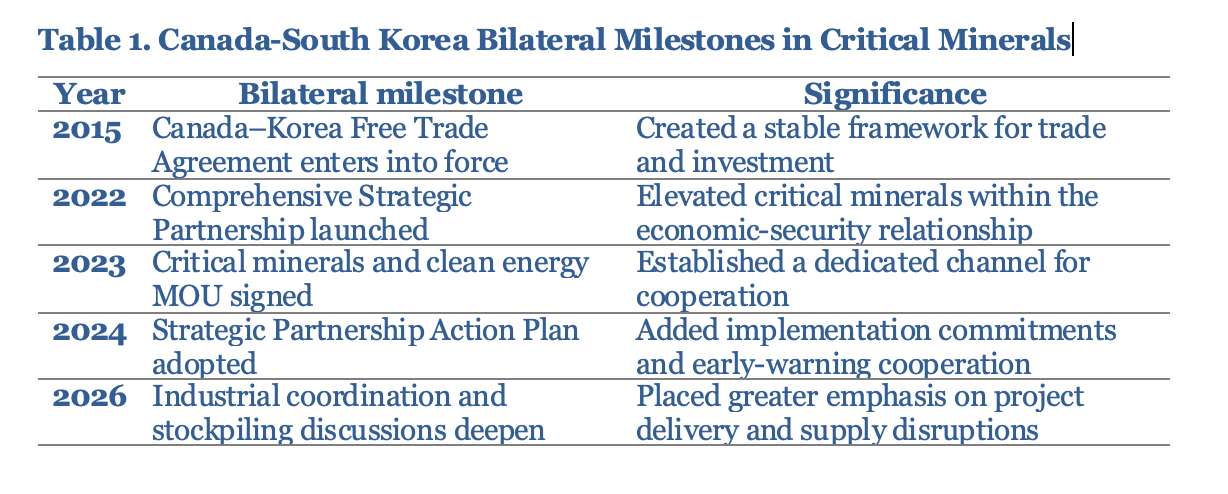
Ottawa has tightened scrutiny of foreign control over strategic assets, especially where state-owned enterprises are involved. Korean private firms benefit from operating within an allied relationship that aligns with Canada’s broader economic-security objectives. The 2023 bilateral MOU reflects this selective openness through its emphasis on investment cooperation and screening.
At the same time, the institutional framework has steadily deepened. The 2015 Canada–Korea Free Trade Agreement established a stronger commercial base, the 2022 Comprehensive Strategic Partnership elevated critical minerals within the bilateral economic-security agenda, and the 2023 Critical Minerals and Clean Energy MOU created a dedicated channel for cooperation on supply chains, clean energy and investment.
The 2024 Action Plan added implementation and risk-monitoring commitments, while developments in 2026 introduced a more operational focus through an industrial cooperation mechanism covering future mobility and battery materials, work on a joint stockpiling plan, and prospective Korean purchases of Canadian lithium, nickel, rare earths and copper concentrate.
Korean interest in a Canadian graphite investment further suggests that bilateral cooperation is beginning to move toward more concrete supply arrangements, although commercial execution remains the decisive test.
Corporate investment has already given the relationship material substance. POSCO Future M, working with General Motors, selected Bécancour, Quebec, for a cathode-active-material facility. SK On joined EcoPro BM and Ford in another major cathode project in the same region. LG Energy Solution entered supply arrangements with three Canadian developers, including Electra Battery Materials. Korean investment has helped anchor battery clusters in Quebec and Ontario while connecting Canadian production to North American vehicle manufacturing.
This pattern also exposes the limits of the current model. Cooperation has advanced most rapidly where Korean manufacturers can use Canadian public incentives to serve the North American market, while progress has been slower around mine development and mineral processing.
The EcoPro BM project encountered delays. Electra’s cobalt refinery also required a revised timetable. Earlier memoranda involving upstream developers have produced limited public evidence of binding purchase commitments. These cases show that strategic interest does not automatically provide the revenue certainty required for project finance.
The Missing Middle
Canada–South Korea cooperation is most developed in downstream battery manufacturing. Korean firms have invested in cathode materials and related production where Canadian incentives strengthen the commercial case. Upstream equity participation remains limited, and several supply arrangements have yet to become fully financed projects or binding purchase contracts.
This pattern leaves an important gap in processing. Canadian mineral deposits offer limited supply security when their output still depends on concentrated refining networks abroad—mostly in China. Korean manufacturers require battery-grade chemicals, purified graphite, and separated rare-earth products that meet precise industrial specifications.
The current portfolio includes cobalt sulfate and cathode materials, while visible progress in graphite purification, rare-earth separation, nickel sulfate, and commercial recycling remains limited.
The underlying policy problem is weak coordination among project selection, public finance, and industrial demand. Canada offers project finance, tax incentives and infrastructure support. South Korea provides overseas-resource financing and supply-chain funds. These instruments have supported individual transactions, yet they are rarely assembled around the same project with a committed buyer and a credible delivery plan.
As a result, Canadian developers may receive public support without securing long-term Korean demand, while Korean manufacturers may seek diversified supply without identifying Canadian projects that meet their technical specifications, cost requirements and production timelines.
U.S. policy uncertainty compounds this coordination problem. Quebec’s battery strategy gained momentum under the U.S. Inflation Reduction Act signed in August 2022, whose sourcing and production incentives strengthened the economics of an integrated North American supply chain.
Trade barriers continuously raised by Washington since then could reduce Quebec’s attractiveness as a production base serving the American market. The specific U.S. measures have continued to evolve, yet the underlying exposure remains: in April 2026, the Bank of Canada still identified the future of North American trade as a major source of uncertainty.
This uncertainty has reshaped Korean firms’ North American strategies. LG Energy Solution warned in July 2025 that U.S. tariffs and the early termination of federal EV purchase subsidies could slow North American EV growth, prompting delayed investment and greater emphasis on energy-storage batteries (ESS).
Subsequent developments at its NextStar Energy plant in Windsor illustrate adjustment rather than withdrawal. In February 2026, LG Energy Solution moved to acquire Stellantis’s 49% stake and assume full ownership of the facility, while Stellantis remained a customer. The company subsequently added an ESS battery-pack production line, broadening the plant beyond its original automotive focus. This case shows how policy uncertainty can alter ownership structure and capital allocation without eliminating installed capacity.
So, contract design matters alongside public incentives. Longer-term offtake agreements and limited risk-sharing mechanisms could improve financing certainty where demand and production costs remain commercially credible. A bilateral stockpiling arrangement could provide short-term protection against disruption and support selected projects during early production.
Future cooperation should be selective. Projects with identified buyers, viable processing routes, and realistic exposure to North American policy changes are more likely to deliver durable supply-chain benefits. This places particular value on midstream projects whose commercial case can draw on Korean demand without relying entirely on continued growth in the U.S. electric-vehicle market.
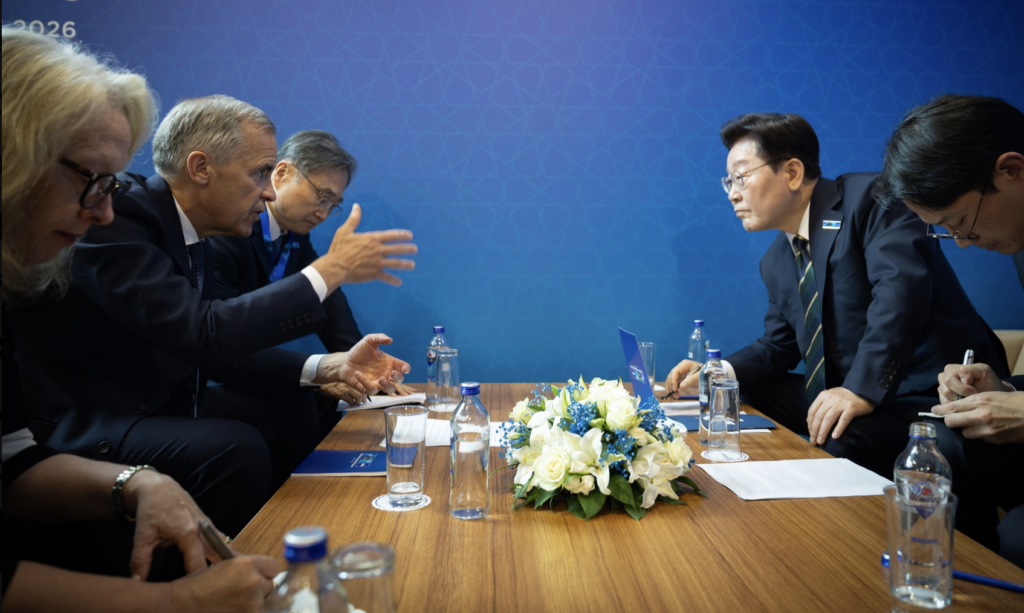
Prime Minister Mark Carney and President Lee Jae Myung at the NATO Summit in Ankara on July 7, 2026/PMO
The Next Phase: Selective Implementation
The institutional foundation for closer implementation is already in place. The 2023 critical-minerals MOU, the 2024 Action Plan, and the 2026 Industrial Cooperation Committee already provide the necessary mandates. A small secretariat could maintain a shared project pipeline, identify regulatory or financing bottlenecks, and publish an annual record of progress.
Natural Resources Canada and Innovation, Science and Economic Development Canada would lead on the Canadian side, while South Korea’s Ministry of Trade, Industry and Energy would coordinate with the finance and foreign ministries. Provincial governments and public lenders would participate when individual projects require their involvement.
The mechanism should concentrate on a small number of projects where the Canadian resource, required processing capacity and a Korean buyer are already identifiable. Graphite is a plausible priority because Canadian production and purification could support Korean anode-material manufacturing. Cobalt cooperation could build on Canadian refining capacity and Korean cathode production.
Rare-earth separation could widen the partnership beyond batteries by establishing non-Chinese processing capacity, and thus reducing Korean manufacturers’ exposure to supply disruptions and Chinese export restrictions.
Public finance should be coordinated with industrial demand. Canadian tax incentives, infrastructure funding and project-finance programs could be paired with Korean policy-bank lending, export insurance and the Korea Eximbank-administered Supply Chain Stabilization Fund. Their impact would be greater once a Korean industrial user also provides a long-term purchase commitment. Public support should remain conditional on private investment, credible costs, and measurable delivery milestones.
Long-term offtake agreements would provide the commercial anchor. Canadian developers need sufficient demand certainty to raise capital, while Korean manufacturers need confidence that projects can deliver the required volume and product quality.
Minimum purchase commitments or limited price-support provisions may improve project viability where market fundamentals remain credible. The proposed bilateral stockpiling plan could provide additional support, particularly for materials exposed to short-term disruption, but it would require clear rules on ownership, release and replenishment.
Risk monitoring should form part of the same framework. Canada and Korea already track trade restrictions, project delays and market conditions. A limited bilateral early-warning system could focus initially on minerals tied to active projects. Shared analysis would help identify emerging processing bottlenecks and allow governments to test responses to export controls or interruptions at major facilities.
An annual project report should distinguish exploratory agreements from binding contracts and track financing, construction, production and secured supply. These measures would allow both governments to assess whether bilateral cooperation is producing commercially viable processing capacity and reducing exposure to concentrated supply networks.
Building on the institutional momentum behind deeper critical-minerals cooperation, Ottawa and Seoul should move from broad strategic commitments to a small number of commercially viable projects.
Geopolitical shocks and market uncertainty will persist, but coordinated support combining patient capital, processing investment and credible long-term demand can translate bilateral alignment into resilient supply chains.
Sun Park is a Senior Research Specialist at the Asia Pacific Foundation of Canada. She holds PhD in Political Science at the University of British Columbia. Her research examines how states build and deploy strategic capacity across emerging sectors, including clean energy, advanced manufacturing, and critical minerals. Focusing on Korea, Japan, and Taiwan, she studies green and digital transformation within the broader context of great power strategic rivalry.