
Canada and Ukraine: The Asymmetrical Impact of the Kerch Bridge Attack
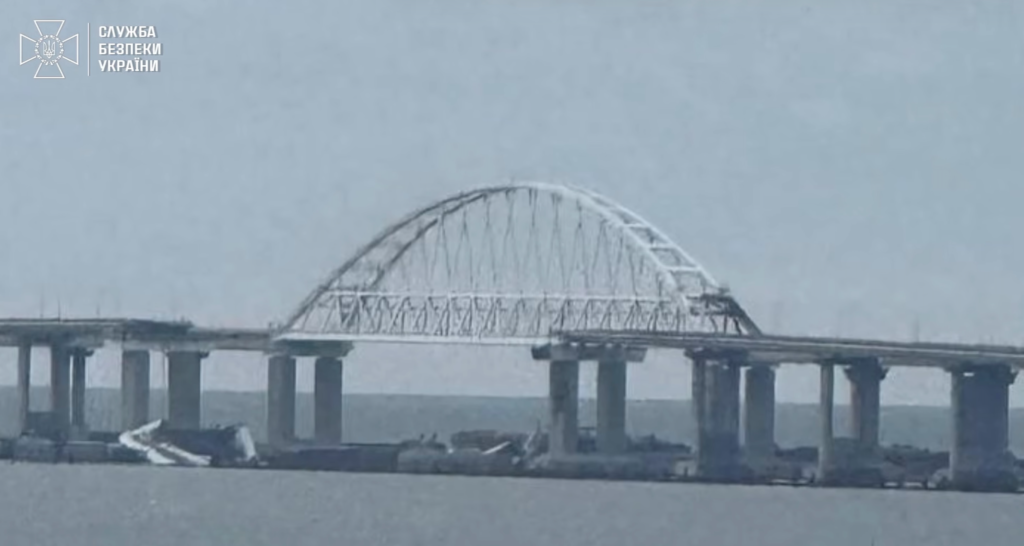 The Kerch Bridge following the Ukraine attack, November 17, 2026/Ukraine Security Service
By Natalka Cmoc
November 24, 2026
Amid the fog of Russia’s propaganda war obscuring the failure of its illegal invasion of Ukraine, the fallen arches of the Kerch Strait Bridge have become Ukraine’s concrete rebuke.
Ukraine struck the bridge — repaired after smaller strikes in 2022 and 2023 — a key supply route from Russia through occupied southern Ukraine to occupied Crimea, multiple times last week, beginning days before the Shenzhen APEC Summit, where presidents Xi Jinping, Donald Trump, and Vladimir Putin held a trilateral meeting on 19 November, and ending the same day.
Images, drone footage, and memes of the broken central span of the 19-km bridge — Europe’s longest — have been circulating widely ever since.
While one hugely symbolic bridge has fallen in Crimea, other bridges are being strengthened among Canada, Ukraine and Europe, acting as a counterweight to the nuclear triad sabre-rattling meeting in Shenzhen.
The loss of the Kerch Strait Bridge’s road crossing is a logistics challenge for Moscow. It puts more pressure on routes through Russian-occupied southern Ukraine and makes it harder for Russia to deliver civilian goods and military supplies to Crimea.
However, it would be too strong to say that all supplies must now travel overland: the railway’s changing operational status and the availability of other transport options remain relevant. Still, disrupting Russian logistics was not the only outcome Ukraine desired.
The value of disrupting the bridge had as much to do with psychological impact as with logistics. After all, the parallel railway remained standing, allowing the most urgent needs to still be met.
The bridge was a source of pride for Putin himself, who had been there to cut the ribbon at its opening. The timing – while Putin was trying to present Russia as a “superpower” in Shenzhen – must have been a little embarrassing.
The meme with the LEGO kit was particularly popular.
It was also significant for President Volodymyr Zelensky to deliver this strike at that precise moment. It kept Ukraine in the news as a country not only with agency but with technological capabilities that have prevented Putin from declaring victory in an act of reckless expansionism that was supposed to be settled after four days.
While one hugely symbolic bridge has fallen in Crimea, other bridges are being strengthened among Canada, Ukraine and Europe, acting as a counterweight to the nuclear triad sabre-rattling meeting in Shenzhen.
While the three autocratic leaders were playing at a self-serving “Declaration Toward Peace” to suit global and personal ambitions and consolidate their power at the expense of smaller nations, the Berlin meeting of the Coalition of the Willing – showing solidarity with President Zelensky – could not have been more meaningful.
Canadian Defence Minister David McGuinty’s presence there signalled solidarity with Ukraine, and with multilateral cooperation and principles, including the United Nations and the International Criminal Court. It also showed that Ukraine’s partners beyond Europe will help decide its future.
For President Zelensky, it was important to emphasize that the Kerch Bridge attack was not carried out using donated or purchased foreign weaponry, but with weaponry made in Ukraine. Over the last year, Ukraine has carried out major strikes against Russia using its own arsenal.
One of the three main topics at the Shenzhen meeting was petroleum supply. The war in Iran is a major factor, of course, but disruptions are also caused by Ukraine’s strikes on oil refineries inside Russia. Ukraine is motivated to disrupt Russia’s main resource, which is fueling the war both literally and economically. For Canada and other countries, it is important that Russian petroleum remain sanctioned while Russia is the aggressor.
The parallel Coalition of the Willing meeting was therefore more than a show of solidarity with Ukraine alongside the Shenzhen meeting. It was also a statement about Europe defending its sovereignty and exerting its geopolitical importance. Times have changed: middle powers and Europe itself are setting up their own security, including energy security, to ensure that they are not dependent on autocratic hegemons.
The leaders’ statement was important: Europe will decide its own security, and Europe will decide how it cooperates with Ukraine. These matters will not be determined by Russia. Russia cannot have a say in who belongs in NATO.
The episode also shows why Ukraine is a valuable partner and not only a recipient of assistance. Ukraine has direct, hard-won experience of Russian aggression, and it has become adept at asymmetric warfare: producing its own weapons, preparing missions, and striking strategic targets with much less expensive hardware. Canada, like Europe, has good reason to keep learning from Ukraine.
The broken Kerch Strait Bridge is more than a logistics problem for Russia. It is a symbol. Canada has chosen its side. It will help build the bridges that include Ukraine, respect the sovereignty of nations, and uphold the principles of multilateral institutions and global economic partnerships, so that power is not concentrated in the hands of a few.
Natalka Cmoc is the former Canadian Ambassador to Ukraine and a Senior Fellow at the Conference of Defence Associations Institute.