
Canada’s Approach to UN Politics: Hothouse Flower No More?
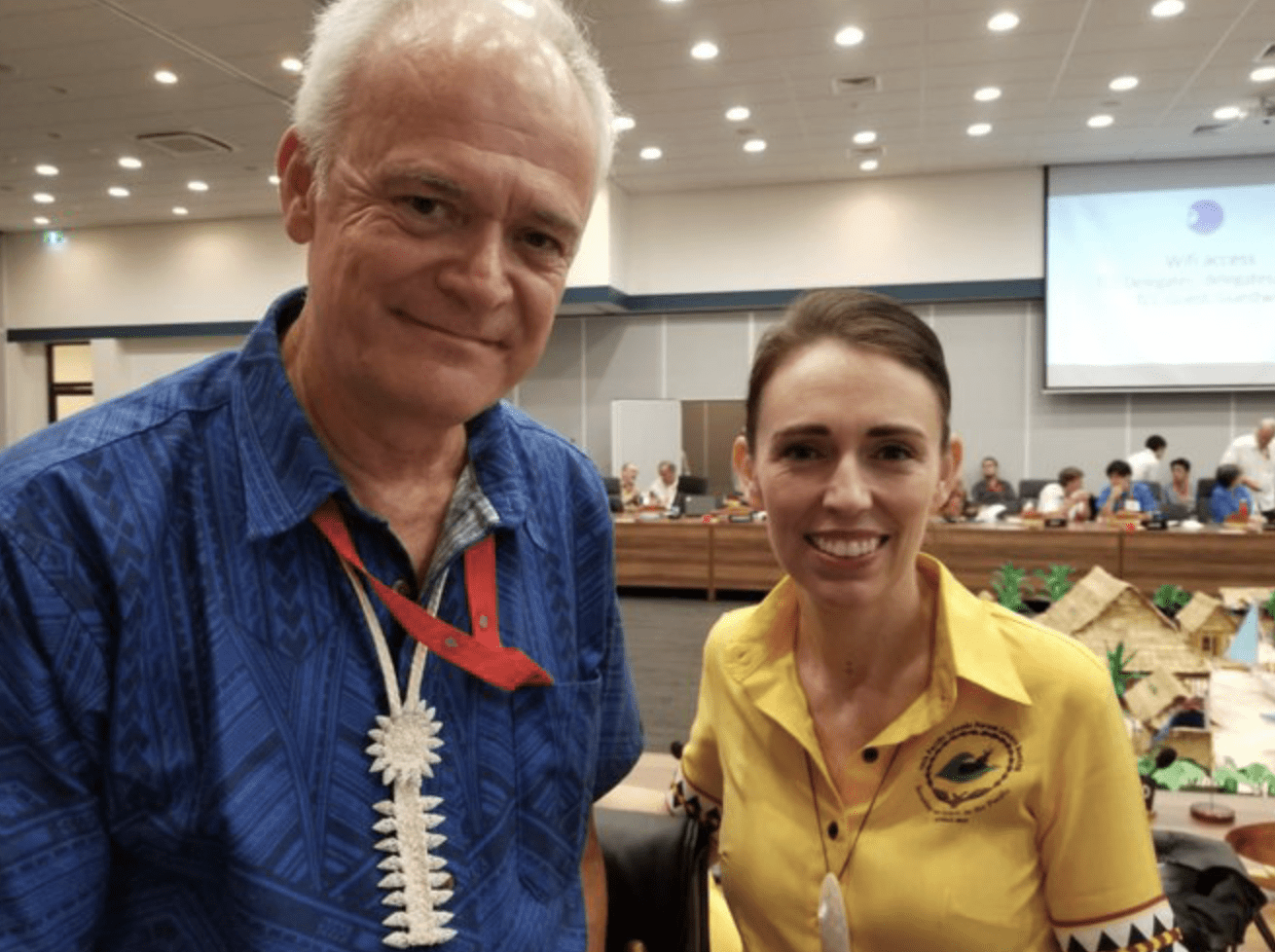
Sen. Peter Boehm with New Zealand Prime Minister Jacinda Ardern while campaigning for UNSC non-permanent member votes at the Pacific Islands Forum in Tuvalu, Aug. 2019/Courtesy
September 24, 2025
The late US Secretary of State Dean Acheson, in channeling his inner William Wordsworth, once referred to Canada and our perceived moralizing as “the stern daughter of the voice of God.”
Nevertheless, Canada persisted, its negotiating hand clear in the creation of the UN specialized agencies: the Food and Agriculture Organization (FAO), the World Health Organization (WHO), the International Civil Aviation Organization (ICAO) (located in Montreal), the World Food Programme (WFP), and others.
Canada brought its functional principle and negotiating ability to the Bretton Woods institutions and by extension the regional development banks, but especially to the General Agreement on Tariffs and Trade (GATT) which led to the formation of the World Trade Organization (WTO) that has been in an existential crisis for some time but now faces — in keeping with Donald Trump’s status as a new world order accelerator — annihilation through the Trump administration’s weaponization of tariffs.
What’s the story behind Canada’s focus on multilateralism as a foreign policy vocation? It made sense as the democracy-led global order was taking shape after World War II to be prepared and active at these tables. As time went on, our more discretionary emphasis on multilateralism and its rules-based order served as an effective counterweight to our geographically circumscribed, increasingly integrated bilateral relationship with the United States.
We can count our many UN laurels: among them UN peacekeeping, defeating apartheid, setting up election observation, the Ottawa Treaty for the elimination of anti-personnel landmines, the Responsibility to Protect (R2P), the establishment of the International Criminal Court (ICC), and feminist international aid policy. All Canadian initiatives that moved the multilateral needle forward, not always without friction.
The ground we staked out as the darling of multilateralism — everyone’s party, interlocutor and candidate of least resistance — was not without hubris. Our competitions for elected international office have often been framed — including by our policy leaders during “the golden age” of Canadian diplomacy — by the assumption that we should simply stand on a combination of our good intentions and our proudly inoffensive reputation, like a hothouse flower at a cotillion.
There were disappointments from the beginning. Multilateral politics can be just as rough as regular politics. It is difficult and can get bare-knuckled. I was involved in our election campaigns for a non-permanent seat on the UN Security Council in both 2010 and 2020.
On both occasions, we came close but did not prevail. It should be noted, however, that Canada has served as a non-permanent member of the Council eight times, most recently 25 years ago, placing us in the top 10 non-permanent members in terms of frequency.
Whether candidacies and campaigns will become more strategic amid the ongoing Trump-fronted turbulence in the UN and its specialized agencies is anyone’s guess.
There are several reasons why securing a non-permanent Security Council seat is not as straightforward as it may seem, or as it once was. First, we belong to the “Western European and Others Group” or WEOG in acronym parlance. Decades of thinking about Security Council reform aside, getting on the Council is a prize and attracts much attention, regardless of any given country’s activities in the General Assembly or specialized agencies. WEOG is allocated two seats, and the Europeans always want them, making contested elections with third candidates the norm.
In 2010, Portugal and Canada were the designated two until Germany, in its wish to be on the Council more frequently, entered the campaign. The odds were against us, given European solidarity, Portugal’s campaign in the global south (using Brazil’s influence) and Germany approaching this contest like this was the World Cup: strong offence in all international bodies and solid defence. I was ambassador to Germany at the time and was often on the secure telephone with our UN ambassador John McNee, comparing notes and discussing strategy.
Second, our 2010 UNSC campaign was a relay — launched by the government of Jean Chrétien, pursued by the short-lived government of Paul Martin and then continued with some ambivalence by the government of Stephen Harper. In contrast, Norway declared its intentions for a 2019 seat back in 2005 with a full consensus of all its political parties. We entered the fray in 2016, well after both Norway and Ireland.
Third, the spirit of Mackenzie King still animates our understated approach at the UN, including and especially in campaigning for NPM seats: we can’t be too ostentatious wouldn’t be proper, wouldn’t be prudent (with all the piousness of Dana Carvey’s SNL church lady). Our prime ministers tend to find better things to do than to make trade-offs or campaign phone calls with other leaders.
For our 2020 UNSC campaign and during my first year in the Senate, I headed the Canadian delegation to the Pacific Island Forum (PIF) in far-away Tuvalu. There were many potential votes from PIF-member, small-island states facing the existential challenge of climate change. As a late entry into the race, our delegation did our best in the face of competitor Norway, which had a dedicated roving ambassador for the South Pacific, and our other competitor, Ireland.
Moreover, Ireland was playing the “Wee island nation that’s never been on the UNSC” card, infused with the patently unfair advantage of Irish charm. When we all met for UN high-level week in New York a month after the South Pacific campaigning, Ireland hosted a reception where a group of Celtic dancers was accompanied by a South Pacific Island orchestra — like a Polynesian Riverdance. I turned to our then-ambassador, Marc-André Blanchard (now Prime Minister Mark Carney’s chief of staff), and said, “We’re finished” (a diplomatic euphemism). Ireland and Norway won the two contested seats.
During my time as ambassador to the Organization of American States (OAS) 25 years ago, I suggested that we join the Latin American and Caribbean group (GRULAC) at the UN. My idea elicited much mirth in Ottawa. Yet GRULAC agrees on its candidates and rarely has contested elections for UNSC seats. The Europeans smile at us and then shun us, tending to support themselves, swinging deals with blocs of other countries who look to advantage in their own election campaigns to various councils and multilateral bodies.
Whether candidacies and campaigns will become more strategic amid the ongoing Trump-fronted turbulence in the UN and its specialized agencies is anyone’s guess. If we are indeed to expect a comprehensive foreign policy review on the part of the Carney government, then our approach to candidacies in multilateral bodies, whether as a country or in the promotion of qualified Canadians to international posts, should form part of the consideration.
As the Irish will tell you, luck goes a long way, but not without strategy.
Senator Peter M Boehm is a former ambassador, deputy minister and sometime UN election envoy.